
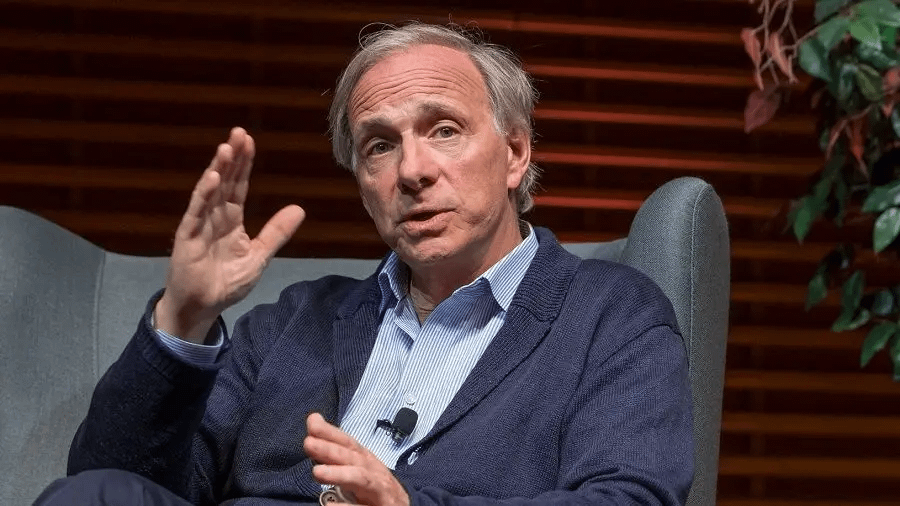
Most people are mistaken about the war in Iran, focusing too much on short-term issues — for example, the fate of the Strait of Hormuz or the price of gasoline, wrote Bridgewater Associates founder Ray Dalio in his blog on April 7. He urges looking at things more broadly — according to the investor's hypothesis, the world is already in the early stages of a world war that will not end anytime soon.
It may seem like an exaggeration, Dalio admits, but here are his arguments. First, several full-scale conflicts are already taking place simultaneously in which major nuclear powers are involved. Plus, the metaphorical 'wars' have not gone anywhere: trade, economic, technological wars, wars for capital, and geopolitical influence. All of this, according to Dalio, forms a 'classic world war'—a global conflict consisting of interconnected conflicts into which the world enters gradually, without a clear beginning or official declaration of war.
What does history teach?
For Dalio, historical analogies are a way to understand what point in the Big Cycle the world is in. This historical theory, which the investor has long promoted, describes how world orders change—through repeating phases of debt crises, internal conflicts, and external geopolitical confrontations. According to this theory, the world moves from prosperity to depression and war, and then to a new order.
Dalio writes that we are currently in the ninth phase of the Big Cycle, where conflicts are occurring simultaneously across several theaters of war. In his opinion, the situation increasingly resembles the transition from a pre-war stage to open confrontation—as in 1913–1914 and 1938–1939.
One of the main signs of this phase, according to Dalio, is the overstretch of the leading power. This is how he suggests looking at the USA: the country maintains 750–800 military bases in 70–80 countries. Such a network provides influence but simultaneously creates vulnerabilities. History, Dalio writes, shows that powers that take on too much struggle worse with multiple conflicts at once. Therefore, the war with Iran is important as a test of how far the US can still fulfill its commitments to allies.
According to Dalio's theory, after the ninth phase of the Big Cycle, authorities begin to demand unconditional loyalty from the population, and dissent regarding the war and state policy is increasingly suppressed. Then direct military confrontations between major powers begin. To finance the war, states raise taxes, increase debt issuance and money supply, impose currency controls, tighten financial restrictions, and in extreme cases, even close markets. The cycle ends with one side winning and establishing a new world order according to its own rules.
Who can win?
Dalio writes that in major wars, the decisive factor is not so much the military power of a country, but its ability to endure hardships longer than others. The US, Dalio believes, is not prepared for prolonged deprivation.
China entered the Korean War against the USA at a time when China's power was negligible, and the USA was a nuclear power. At that time, Mao supposedly said: "They will not be able to kill us all," meaning that the enemy cannot win as long as there are those who continue to fight. The lessons of Vietnam, Iraq, and Afghanistan are evident.
Another important guarantee of victory, Dalio mentions, is internal stability—the support ratings in democracies or the ability of authorities to maintain control in autocracies.
"This is undoubtedly a key factor in the war between the US and Iran, in which the president assures the American public that the war will end in a couple of weeks, gas prices will drop, and we will return to the familiar times of prosperity," Ray Dalio.
What to do next?
Dalio is confident that the next five years will not be peaceful: with a probability of more than 50%, new wars will start or ongoing ones will intensify. Here is what he sees as a potential map of conflicts:
1. War between Iran, the US, and Israel
Dalio believes that this conflict continues to escalate, exhausting the resources of all parties. He names key issues such as control over the Strait of Hormuz, the Iranian nuclear program and missile arsenal, the willingness of participants to incur new losses for victory, the resilience of their alliances, and the risk of conflict escalation—if Iran's allies intervene directly or indirectly or if a new crisis erupts in Asia simultaneously. A separate question, according to Dalio, is whether it will be possible to restore security in the Persian Gulf at all.
2. Russia's war against Ukraine
Dalio calls it an extremely dangerous conflict, already involving almost all major military powers except China. Combat actions have not gone beyond Ukraine for three years, and this, in his assessment, has so far kept the situation from escalating further. At the same time, NATO is supplying Kyiv with weapons and bearing significant financial costs, while Europe is increasing military spending and preparing for a possible confrontation with Moscow. The main risks, according to Dalio, are a Russian strike on NATO territory, an attack on supply lines, direct intervention of the alliance in the war, or an accidental collision of Russia with one of the bloc's countries. He estimates the probability of such a scenario in the next five years at 30–40%.
3. Taiwan: risk of war between the US and China
Dalio writes that the US and China are already in a state of ideological, technological, trade, and geopolitical confrontation, although direct war has not yet occurred. He identifies Taiwan as the main risk point: for Beijing, it is a question of sovereignty that is non-negotiable. He assesses that both sides are openly preparing for a possible confrontation, increasing military spending and armaments, while American infrastructure in the 'First Island Chain' (stretching from Japan through Taiwan to the northern Philippines and Borneo) is very vulnerable.
Among the possible signals of escalation, Dalio highlights the change in the US position on Taiwan's independence, a possible blockade by China, a direct confrontation between American and Chinese forces, as well as Beijing's attempt to increase control if they decide that the US is too weakened to respond. He estimates the probability of military conflict between the US and China over Taiwan in the next five years at 30–40%, considering 2028 to be the most dangerous period.
4. War involving North Korea
Dalio calls North Korea a provocative nuclear power that is ready to fight. In his assessment, Pyongyang has missiles capable of carrying nuclear warheads and reaching US territory, and these capabilities may strengthen in the next five years. He also emphasizes the close ties of North Korea with China and Russia and allows for the possibility that the DPRK could act on their behalf as a proxy player. Dalio estimates the probability of military conflict involving North Korea at 40–50%.
5. Confrontation in the South China Sea (Philippines — China — USA)
Another dangerous point, according to Dalio, is the South China Sea. He states that even a relatively minor incident—a collision of ships, an attack on a Philippine vessel, a blockade, or a missile episode—would put the US in a position where intervention would be necessary due to allied obligations to the Philippines. At the same time, he notes that the American electorate is unlikely to support such a decision. He estimates the probability of such a conflict in the next five years at about 30%.
#MarketTurbulence , #GlobalEconomicNews , #AreWeFree ?
A group for those who like to stay updated on changes in the news agenda of the world of finance, cryptocurrencies, commodities, and technological changes in the markets.
🤫
And besides everything else, sometimes in this group we will publish quite interesting stories...
🙄
Welcome to the club! Our doors are open to subscribers!
😉