
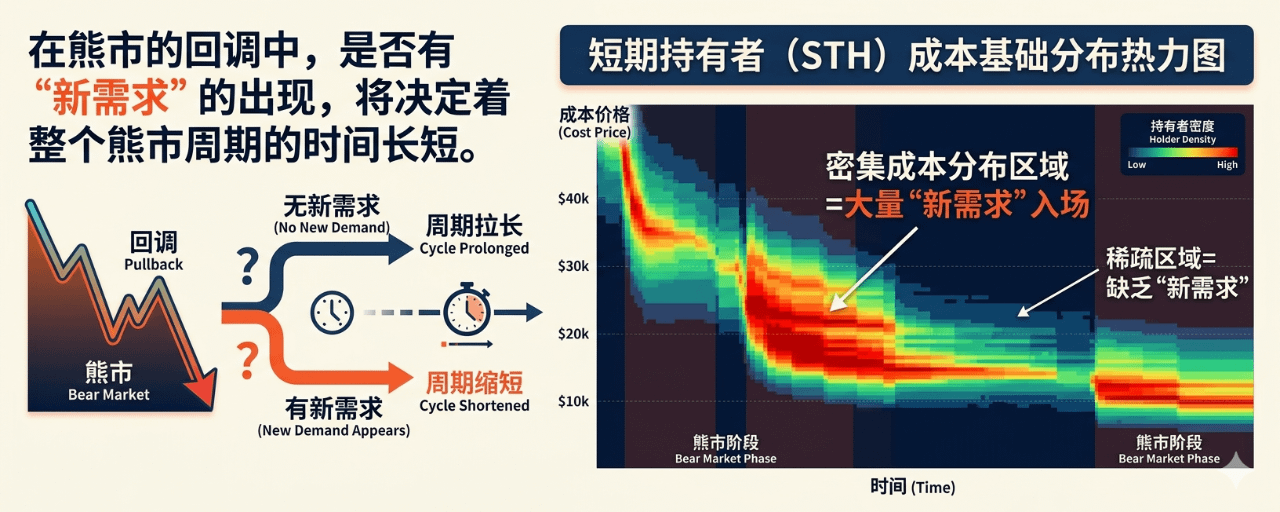

In the pullback of the bear market, the emergence of 'new demand' will determine the duration of the entire bear market cycle.
The cost basis distribution heatmap of short-term holders (STH) gives us a very clear perspective. When there is a dense cost distribution in a certain range, it indicates that a large amount of new demand has entered the market.
From Figure 1, when BTC pulled back from the historical high of 120000 to around 105000, the first wave of bottom-fishing demand appeared (during 10/17-11/2).
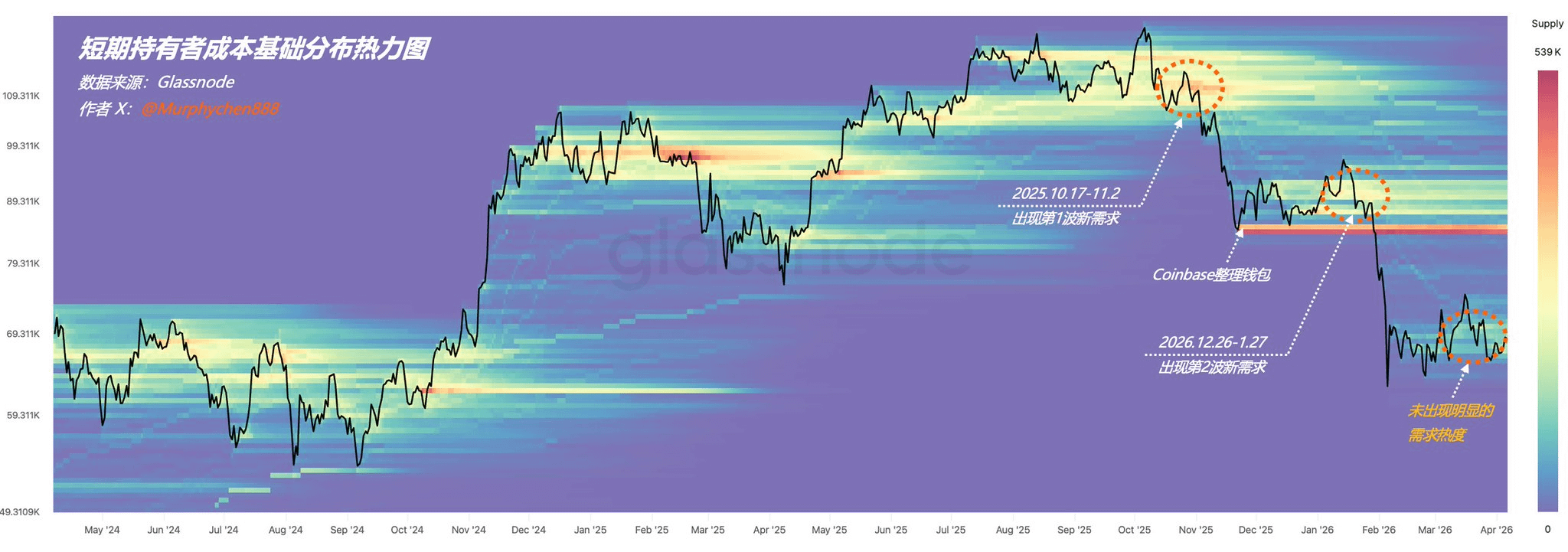
I speculate that at that time, quite a few investors thought this was just a phase pullback, so they started building positions in batches from this point.
On November 2, it fell to 82,000 without any demand heat appearing; this indicates that everyone is somewhat bewildered and starting to doubt whether the bull market cycle has ended?
Until the price stabilized and began to gradually rebound, the 2nd wave of demand appeared (during the period from 12/26 to 1/27), and they also became the liquidity for the trapped chips at high positions.
Until today, most of these chips are still firmly held, without cutting losses to sell.
However, when BTC fell to 60,000 again, the market really got scared......
From February to April, a full 2 months of consolidation did not attract enough bottom-fishing troops. From the data, the demand heat compared to the previous two times was obviously insufficient.
This indicates that everyone is very cautious now, waiting to see the direction, or waiting for the last drop.
If we compare with the previous cycle (Figure 2), we can find a rather interesting point:
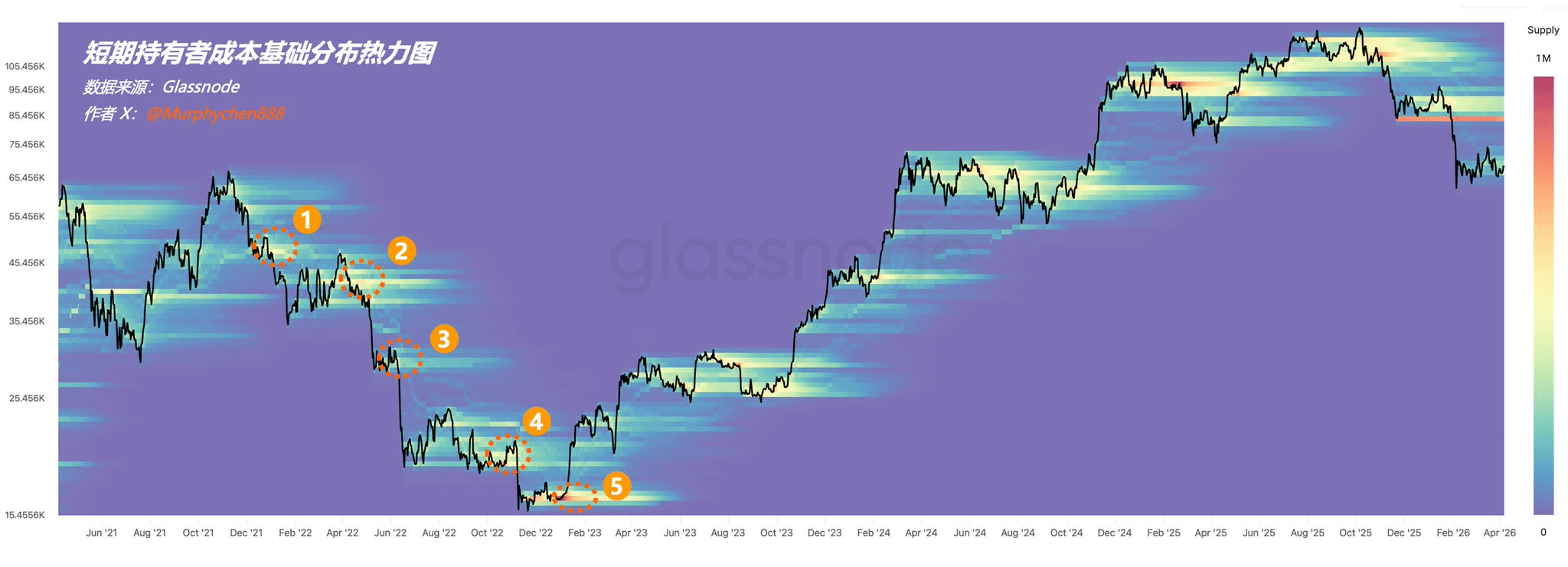
That is, during the last bear market correction, there was also strong demand in the 1st and 2nd waves, but it failed to stop the continued decline.
Similarly, in the 3rd wave, the market began to get scared, and the demand heat noticeably weakened.
By the 4th and 5th waves, demand began to recover, especially in the 5th wave where the red demand value peaked. As the saying goes, things should not happen in threes; continuous declines, yet buying increases, indicating that the bear market is about to end.
To avoid being countered by the cynical, I want to emphasize one point: I do not mean to imply that this bear market will also experience similar 5 waves, or that there will be a deep correction next!
This is just to illustrate that whether it is a decline or a consolidation, as long as we see demand becoming stronger, there is nothing to fear.
So what if we don't see the demand heat now?
Just relax!
Besides dollar-cost averaging, do not operate casually. Patiently wait for its appearance; trust me, it will definitely appear!