
The geopolitical landscape has changed dramatically this April. With the Strait of Hormuz under maximum tension and Urals crude prices reaching 13-year highs (hitting $100 - $116 in destinations like India), Russia has stopped using cryptocurrencies only out of necessity and has turned them into a financial weapon.
Here I explain how this "new digital order" is functioning:
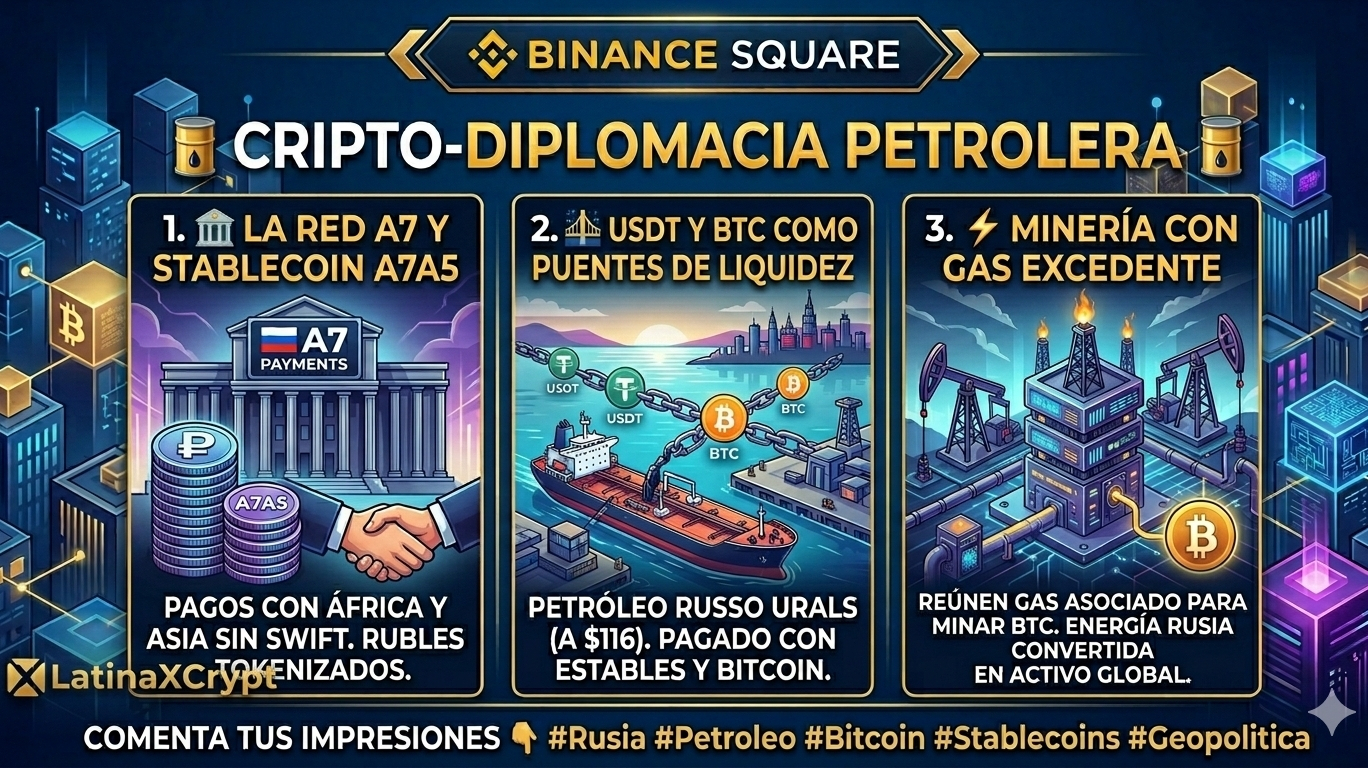
1. The "A7" Network and the A7A5 Stablecoin 🇷🇺
Moscow no longer relies solely on external networks. The A7 network, backed by state banks like Promsvyazbank, is expanding its own stablecoin: the A7A5.
What is it? A stablecoin linked to the ruble that has already moved over $68 billion in trade transactions.
The goal: To settle oil and gas exports with allies in Africa (Nigeria, Zimbabwe) and Asia, completely bypassing the SWIFT system.
2. USDT and Bitcoin as "bridges" of liquidity 🌉
Despite having its own currency, the Russian private sector continues to massively use Tether (USDT) and Bitcoin.
Oil companies are closing deals where crude is paid in local currency (like yuan or rupees), quickly converted to USDT to move capital agilely, and finally settled in rubles within Russia.
3. Mining with Surplus Energy ⚡
Russia has legalized massive mining farms that operate on associated gas from oil wells. Instead of burning that gas, they convert it into energy to mine BTC.
Result: The oil that cannot be physically exported due to sanctions is "exported" digitally in the form of Bitcoin.
💡 Market Analysis:
What we are seeing is the creation of a parallel financial rail. The global dependence on Russian oil (especially now with the energy crisis in the Middle East) is giving Russia the power to impose its own digital payment rules.
The question for the community: 👇
Do you think that the use of cryptocurrencies for trading commodities like oil will accelerate mass adoption or provoke stricter regulations from the West?
#Rusia #Petroleo #bitcoin #Stablecoins #GeopoliticalUncertainty
