
Morgan Stanley just ignited a new phase of the bitcoin ETF fee war. What happened - Morgan Stanley’s MSBT began trading on NYSE Arca with an annual fee of 0.14% — the lowest fee for a U.S. spot bitcoin ETF to date. - That undercuts every major competitor: BlackRock’s IBIT and Fidelity’s FBTC at 0.25%, Grayscale’s Bitcoin Mini Trust at 0.15%, Bitwise BITB at 0.20% and ARK 21Shares ARKB at 0.21%. Unchained Crypto compiled the current fee ranking. Why it matters - MSBT establishes a new fee floor in the market. Morgan Stanley’s combination of the cheapest fee and its advisor distribution prompted Phong Le, CEO of Strategy, to nickname the fund “Monster Bitcoin.” - The fee gap versus BlackRock’s IBIT is 11 basis points. That equals: - $11/year on each $10,000 invested, - $11,000/year on a $10 million allocation, - $110,000/year on $100 million — or $550,000 over five years (before accounting for tracking or liquidity differences). Who benefits - Long-term, low-turnover investors stand to gain most from MSBT’s lower fee, where savings compound over years. - Active institutional traders may prefer IBIT despite its higher fee. IBIT’s roughly $70.6 billion in assets and dominant options-trading activity provide liquidity and tighter execution—advantages that can offset management-fee differences for high-volume or frequent traders. Why a bank-issued ETF is a big deal - Every prior fee reduction in the spot bitcoin ETF race came from asset managers competing against one another. MSBT is the first meaningful fee cut led by a major bank issuing under its own brand. - Since 2024, Morgan Stanley has allowed its 16,000 advisors to recommend third-party ETFs (with fees sent to managers like BlackRock or Fidelity). MSBT brings that revenue stream in-house, potentially shifting how flows are sourced and retained. - Together, IBIT and FBTC have drawn over $74.3 billion in net inflows to date. A lower-cost, bank-branded alternative backed by a captive advisor network creates a new competitive dynamic. Bigger-picture signal - Bitwise advisor Jeff Park noted during MSBT’s S-1 filing that Morgan Stanley wouldn’t build proprietary ETF infrastructure unless it believed the addressable market was larger than many expected — the bank has about $9.3 trillion in client assets. - The real test will be early flows. If MSBT attracts significant allocations quickly, fee leadership could reshape market shares. But BlackRock’s first-mover liquidity advantage has proven resilient for more than two years, so fee cuts alone may not be decisive. What to watch next - Short-term: MSBT’s initial inflows and how Morgan Stanley deploys its advisor network. - Medium-term: whether other issuers cut fees in response, and whether liquidity/option-market advantages keep IBIT and FBTC dominant for institutional trading. Bottom line: MSBT’s 0.14% launch resets the cost benchmark and introduces a bank-led distribution dynamic that could matter for long-term allocators — but liquidity and execution considerations mean the fee war is only one part of the adoption equation. Read more AI-generated news on: undefined/news

Article
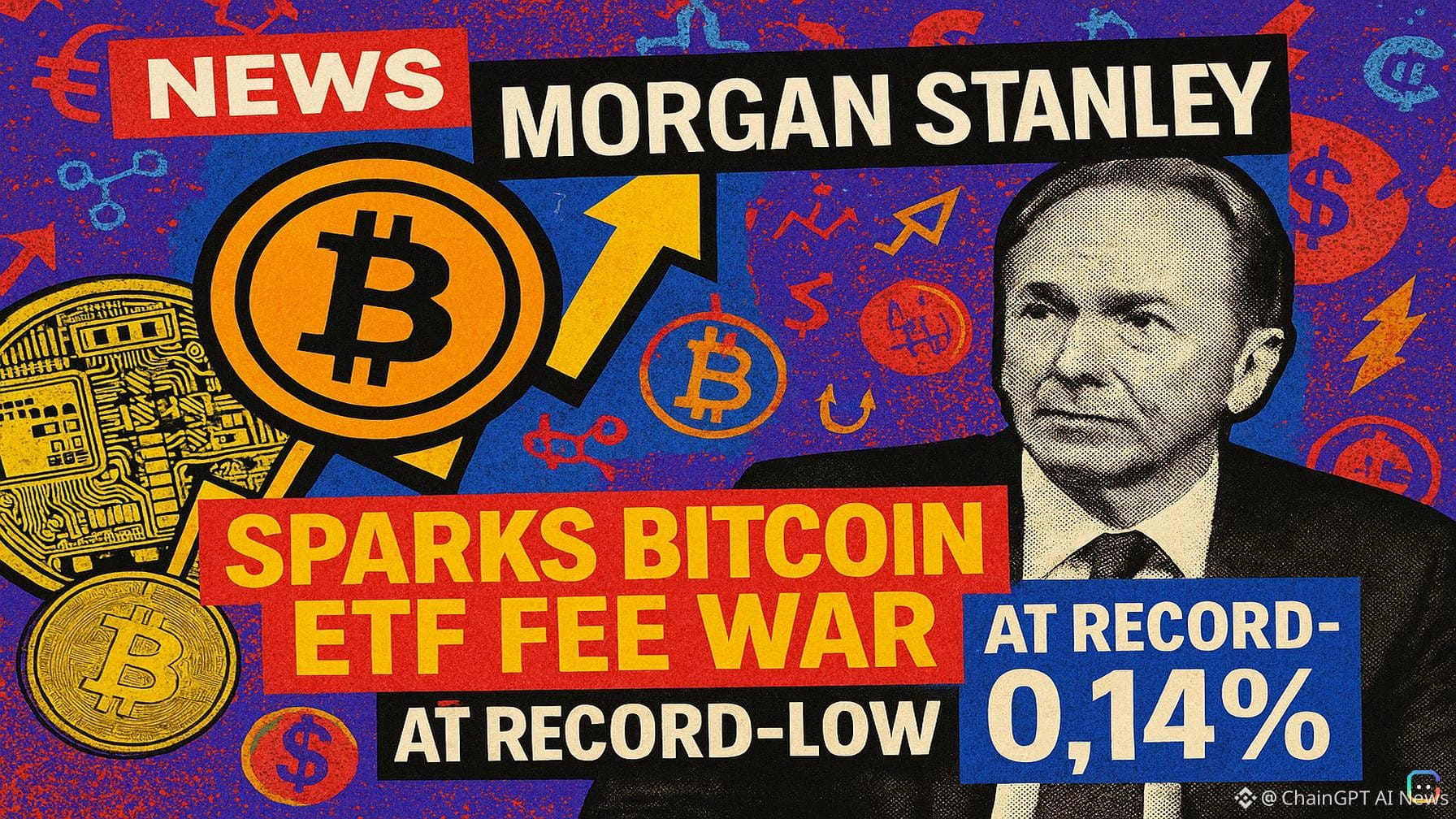
Morgan Stanley Sparks Bitcoin ETF Fee War With MSBT At Record-Low 0.14%