OpenLedger positions itself as an AI-native blockchain a system where data, models, and agents are first-class on-chain assets. The promise is bold: build a transparent, decentralized AI economy in which contributions (data, compute, modeling) are auditable, governable, and monetized.
At the heart of this architecture lie Datanets and ModelFactory two modules whose seamless integration shapes how users participate, build, and derive value in OpenLedger’s ecosystem.
Datanets: The Ground Layer of Community Datasets
What are Datanets?
Datanets (or “DataNets”) are purpose-built, domain-specific data networks. They aggregate, validate, and curate datasets tailored to particular verticals e.g. legal documents, medical imaging, climate sensors, Web3 trading, IoT data, etc.
Each contribution to a Datanet is accompanied by metadata recorded on-chain: who submitted it, when, under what license or condition. That forms an immutable provenance trail.
Because the chain holds the attribution information permanently, no one can silently reuse or repurpose data without trace. The system can always “go back to see who contributed each piece.”
Datanets also incorporate validation or curation layers to ensure data quality ensuring that contributions are not merely noise.
Why Datanets Matter
They act as the substrate of trust: model builders don’t just get raw datasets they get verifiably attributed datasets, which means the lineage and integrity of data is known and auditable.
They align incentives: data contributors are not passive donors but potential beneficiaries. As their data is used downstream, they can receive attribution-based rewards (via OpenLedger’s Proof of Attribution scheme).
They allow domain specialization: models fine-tuned on well-curated, domain-specific corpora tend to outperform general models in their niche. OpenLedger’s vision leans heavily into Specialized Language Models (SLMs) rather than one-size-fits-all LLMs.
Thus, Datanets form the bedrock a living, evolving, contributor-managed knowledge base.
ModelFactory: From Data to Models On-Chain and Transparent
Once Datanets provide structured, traceable datasets, ModelFactory is the bridge that turns that data into AI models all within the blockchain paradigm.
What is ModelFactory?
ModelFactory is a (largely no-code) interface built into OpenLedger, designed to allow model creators both experts and non-experts to fine-tune, adapt, or build models using Datanet data.
It maintains tight linkage between each model version (or adapter, or fine-tune) and its data lineage. That means each model version knows which datasets (and which specific contributions) influenced it, and via what transformations (e.g. training parameters, adapter architecture).
Model metadata such as training parameters, adapter choices, version history is also recorded in the chain. Thus, the model’s “identity” is not black-box but part of the on-chain ledger.
When a model is queried (inference time), the system can trace backwards: which datasets were used, which adapter logic was active, and who should be credited. The inference is thus auditable.
In practice, ModelFactory often works alongside OpenLoRA, which handles deployment/inference with high efficiency (adapter loading, dynamic merging, memory optimization) so that many versions/models can run simultaneously with low overhead.
Why ModelFactory Matters
It removes silos: users don’t have to build offline scripts, maintain custom pipelines, or wrestle with linking models to data provenance retroactively. Everything is unified.
It ensures traceability: a model is never “just a black box” every output can be traced back to contributions, giving contributors visibility and potential reward.
It supports versioning & modular evolution: you can take a base model, add adapters or fine-tunes (e.g. specialized for medical domain), and the new variant inherits lineage and attribution infrastructure. Contributors to base and variant both get their share.
It enables community-driven model governance: models (or proposals) can often be staked, voted, curated, or validated by community participants before deployment.
The Synergy: A Self-Reinforcing Feedback Loop
What makes Datanets + ModelFactory more than a sum of parts is how they mutually reinforce each other in a loop of participation and value.
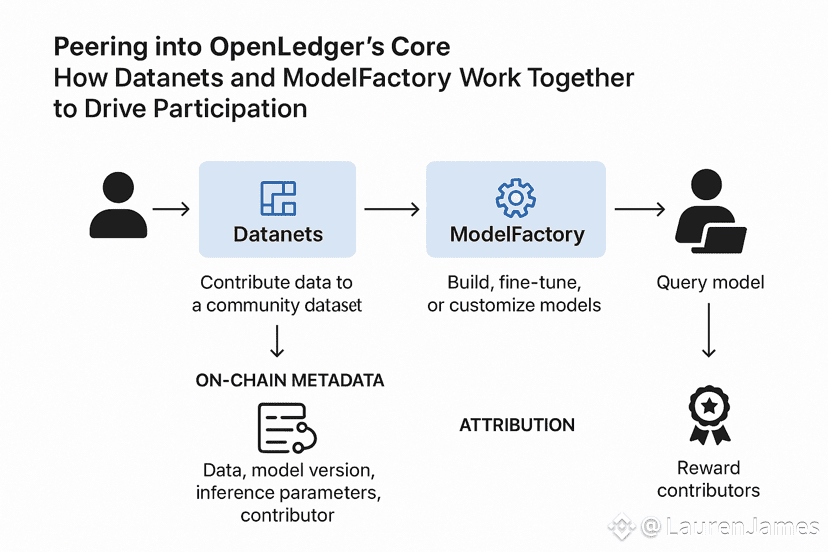
If you like, I can also produce a diagram or step-by-step walkthrough of how a user (data contributor → model builder → user querying a model) moves through Datanets → ModelFactory → inference, with attribution and rewards. Do you want me to add that?
Data growth fuels modeling
As Datanets accumulate more, diverse, high-quality data contributions, they become richer sources for model training. ModelFactory has more raw material to build smarter, domain-aware models.Model usage rewards data contributors
When models are deployed and used (inference), the system uses attribution to allocate rewards (in tokens, reputation, or other incentives) to original data contributors. This encourages more contributions to Datanets.Better models attract more usage and new contributors
Models built via ModelFactory, backed by strong data provenance, are more trustworthy and performant thus attracting more users, applications, and demand. That in turn increases incentives for further data contributions and model improvement.Lineage continuity across model evolution
As models are fine-tuned, branched, adapterized, or merged, the attribution framework continues to trace contributions across model versions. No matter how the model evolves, credit flows through the lineage.
Over time, this loop strengthens the ecosystem: contributors see fairness and transparency; model builders see leverage and trust; users benefit from stronger, auditable AI capabilities all within one cohesive architecture.
Under the Hood: How It’s Built & Some Technical Nuance
OpenLedger runs as an EVM-compatible Layer-2 chain (built on OP stack + EigenDA for data availability), which enables low-fee, high-throughput operations while settling on Ethereum.
All actions data uploads, model training, inference events, adapter merges trigger on-chain events / proof artifacts that serve as cryptographic evidence of what happened, when, and by whom.
OpenLoRA, integrated with ModelFactory, addresses the expensive challenge of model serving. It can dynamically load adapters and merge them at runtime, drastically reducing memory and compute overhead so many models can co-exist on a single GPU.
Because of the provenance and attribution, at inference time the model doesn’t just deliver output it can disclose its “ancestry”: which dataset fragments, adapter paths, contributor identities, and descriptive weights contributed to the inference.
Governance is also woven in: token holders can vote on protocol rules, model quality standards, and system upgrades.
Revised Narrative (Combined, Enhanced)
OpenLedger is not merely a blockchain with AI tacked on it is architected from the ground up to enable community-owned AI economies. Datanets serve as the collaborative ground where contributors upload domain-structured data, each piece tagged with on-chain metadata (contributor identity, timestamp, license). This substrate ensures that as datasets grow, their lineage remains transparent and immutable.
ModelFactory is the natural continuation: rather than exporting data to external pipelines, you build and fine-tune models within the OpenLedger environment, with each model version explicitly linked to its data lineage. Training hyperparameters, adapter logic, version forks all are part of the on-chain record. When an inference is made, the system can answer not just “what is the result?” but “which datasets, which contributors, which adapter paths produced this result?”
Because attribution is baked in, data contributors aren’t passive they can earn reward whenever their data is used, even years later. Model creators can build on collective datasets with confidence, while users benefit from explainable, auditable AI.
This symbiosis Datanets feeding ModelFactory, which in turn incentivizes better Datanets is the engine behind OpenLedger’s vision of turning AI into a participatory, traceable, and fair economy. The architecture ensures that AI development is not locked behind black boxes or centralized platforms, but unfolded transparently on-chain.