
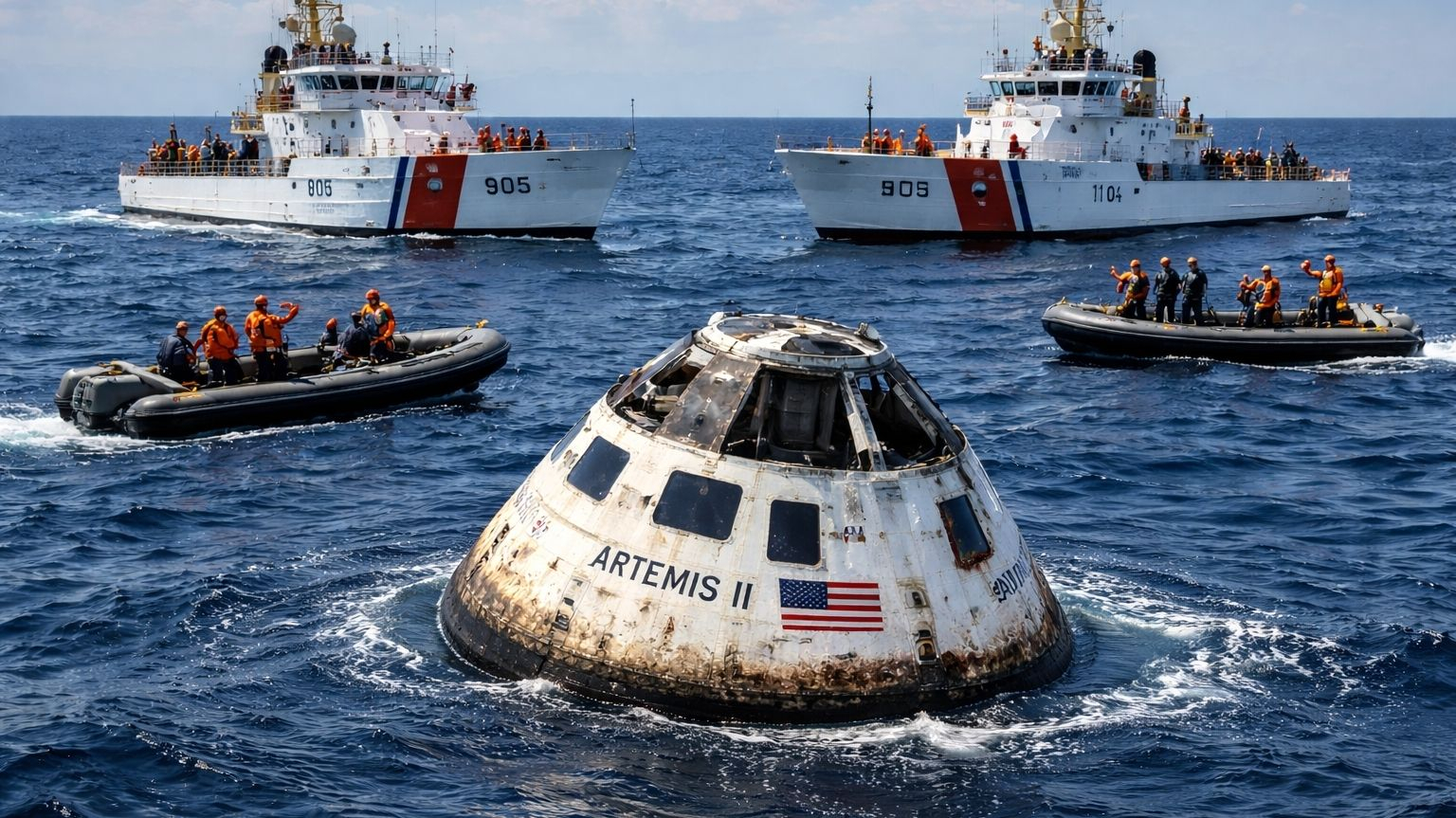
AT THIS MOMENT AT 21:15 THE CAPSULE WITH THE 4 ASTRONAUTS LANDS IN THE PACIFIC OCEAN, RESCUE OPERATION TAKES PLACE
🌎 1) Reentry into the atmosphere
After returning from lunar orbit, the Orion spacecraft separates from the service module.
It re-enters the Earth's atmosphere at about 40,000 km/h (approximately 25,000 mph).
At this moment:
the outer part of the capsule faces extreme temperatures
the thermal shield protects the crew
there is a communication blackout of about 6 minutes due to the plasma around the spacecraft.
This is one of the most critical parts of the mission.
🪂 2) Opening of the parachutes
When the capsule slows down significantly, the parachutes engage in sequence.
The Orion uses 11 parachutes in total:
First the small stabilization ones
then the intermediates
finally the 3 giant main parachutes
They slow down to about 30 km/h to 35 km/h, allowing for a safe descent into the ocean.
🌊 3) Landing in the sea (splashdown)
The capsule touches the water in the Pacific Ocean, near the coast of California, in a pre-defined area.
The impact is strong but controlled.
The astronauts feel as if it were a 'dry hit', similar to a rough landing.
Soon after, rescue teams are already approaching.
🚁 4) Rescue of the astronauts
This part is very interesting.
First to arrive:
• helicopters
• fast boats
• Navy / Coast Guard divers
• main recovery ship
The divers check:
• if there is a fuel leak
• if the capsule is stable
• if there is no chemical risk
Then they install an inflatable platform called 'front porch', like a floating porch next to the capsule.
The hatch is opened and the astronauts exit one by one.
Then, they are hoisted by helicopter or taken by boat to the rescue ship.
🩺 5) What happens to astronauts afterwards
As soon as they exit, they undergo immediate medical evaluation.
This is essential because, after days in microgravity, the body feels the return to Earth significantly.
The most common symptoms are:
• dizziness
• nausea
• difficulty standing
• muscle weakness
• imbalance
Then they proceed to:
• cardiac exams
• neurological tests
• hydration
• light food
• rest
🏥 6) Following Days
After returning to NASA's center, physical recovery begins.
They go through:
• physical therapy
• muscle strengthening
• bone tests
• medical follow-up for weeks
Full readjustment can take days or even months, depending on the time in space.