Overview:
Role of the project:
Hemi.xyz makes Bitcoin programmable, yield-generating, and composable—without bridges or centralized packaging. It is the fastest-growing programmable layer on Bitcoin, combining Bitcoin's security with the flexibility of EVM. Since March 2025, with over $1.2 billion in TVL and more than 70 protocol partners, Hemi is unlocking the next frontier of Bitcoin.
Hemi is a modular protocol with excellent scalability, security, and programmability, supported by Bitcoin and Ethereum. The dawn of the super network is before us, and Hemi begins its journey by integrating kings and queens. Hemi launched its testnet in July 2024 and its mainnet in March 2025. Hemi aims at one of the largest blank spaces in today's crypto sphere, representing a capital base of over $2.5 trillion. Hemi's mission is to advance the social, technological, and economic conditions between the two major protocols in the world.
Token Use Cases:
Network Transaction Fees
Incentivizing Bitcoin security inheritance through PoP
Chain payments denominated in $HEMI for PoP security aggregation
Stake $HEMI in the veHEMI system to participate:
Governance and Ecosystem Decision-Making
Decentralized Sorting
Decentralized ETH Publication (DA + State)
Bitcoin Tunnel hBitVM Contract Simulation
Liquidity of the Tunnel
Economic Security of dApps
Product, Technical Details, Consensus Mechanism, etc.
Proof of Proof (PoP) consensus—brings Bitcoin security to Hemi in a completely decentralized and permissionless manner.
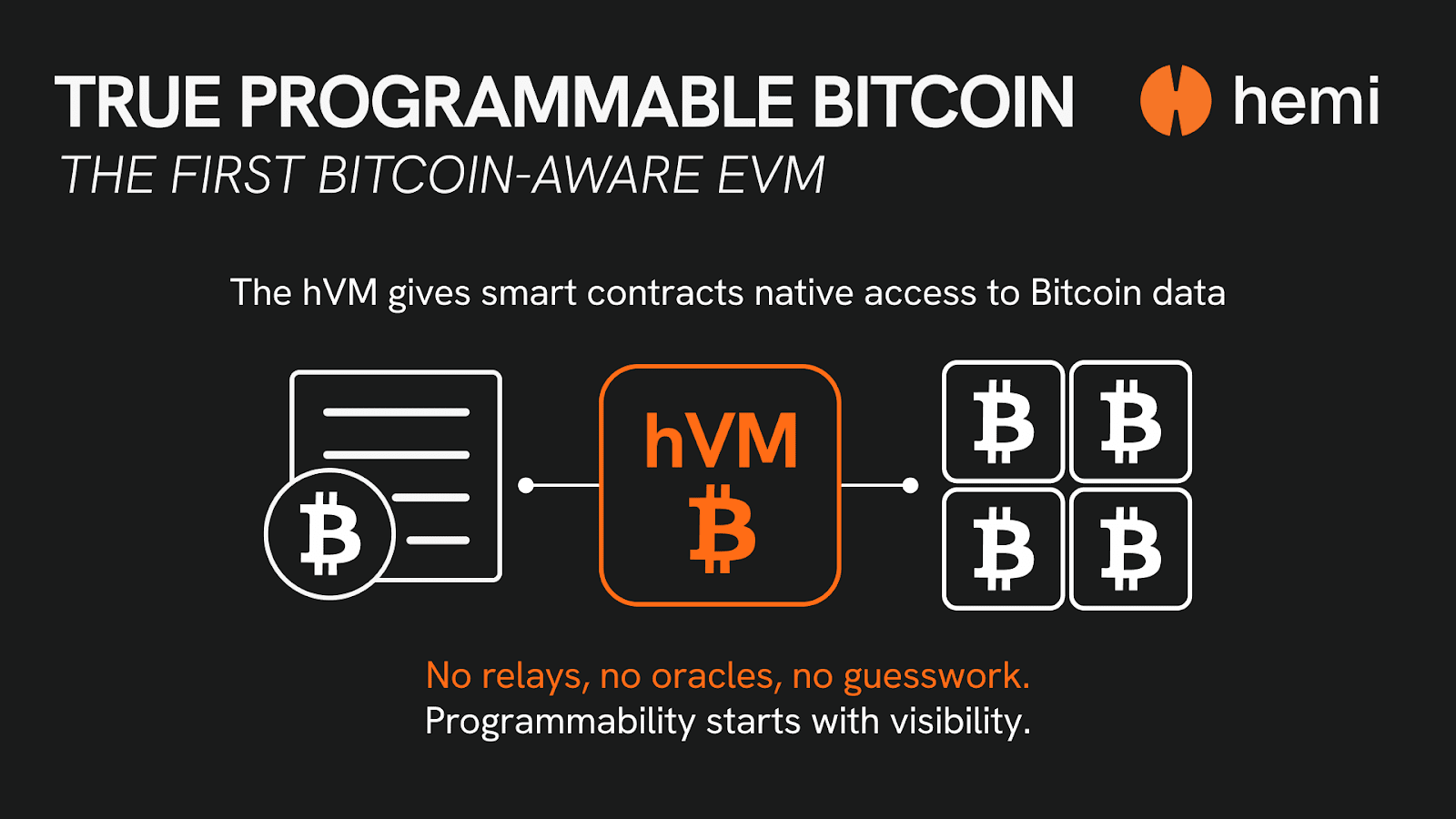
Half Virtual Machine (hVM) – wraps a Bitcoin node in the EVM to create a new robust, efficient Bitcoin smart contract. It enables non-custodial Bitcoin exchange and lending protocols, Bitcoin-secured AI, cross-chain Bitcoin interoperability infrastructure, multi-chain DAOs, and Bitcoin-backed finance.
Hemi Bitcoin Kit (hBK) – enables the development of Bitcoin-supporting smart contracts in a familiar programming environment.
Tunnel – securely transfer assets directly from crypto's most important networks (Ethereum and Bitcoin) to Hemi.
Fundraising:
The project has raised over $30 million, including $15 million in a growth round (investors include YZi Labs (formerly Binance Labs), Republic Digital, and HyperChain Capital) and $15 million in a seed round (including Breyer Capital, Big Brain Holdings, Crypto.com, DNA Fund, Selini Capital, Quantstamp, Web3.com). 28% of Hemi's initial supply has been allocated to investors and strategic partners.
Circulating and Total Supply Data:
As of September 23, 2025, the total supply of HEMI is 10,000,000,000, while the circulating supply at listing is 977,500,000 (approximately 9.78% of the initial token supply).
Key Metrics (as of September 23, 2025):
Label Name
Hemi
Token Type
ERC-20
Initial Circulation. Supply at Binance Listing
977,500,000
Maximum Token Supply
Unlimited (3-7% annual emission)
Total Token Supply
10,000,000,000 (as of September 23, 2025)
Current Circulating Supply
977,500,000 (9.78%)
Binance Holder Distribution
£100,000,000 (with an additional £150,000,000 to be allocated in future activities)
Binance Holder Start Date
9/23/2025
What is Hemi?
Project Overview:
Hemi is a programmable Bitcoin chain that extends Bitcoin beyond currency. It is a modular second layer powered by Bitcoin and Ethereum, combining the security of Bitcoin with the programmability of Ethereum. By embedding a full Bitcoin node in the EVM (hVM), Hemi allows smart contracts to access Bitcoin data natively. Since the mainnet launch in March 2025, Hemi has achieved $1.2 billion in TVL, 100,000 verified users, and over 70 ecosystem protocols, making it one of the fastest-growing networks in BTCFi.
Project Mission:
Hemi's mission is to make Bitcoin an active capital—unlocking loans, liquidity, staking, and DAO participation without wrappers or custodians. The project aims to bridge the historical gap between Bitcoin and Ethereum, seeing them as components of a single financial supernetwork. In doing so, Hemi provides a pathway for the next era defined by Bitcoin, where BTC is not just currency but also programmable, composable infrastructure. Ultimately, Hemi aims to make Bitcoin the trust-minimized foundation for Web3 and beyond.
Project Value Proposition
Hemi's tunnel provides secure, evidence-based asset movement between Bitcoin, Hemi, and Ethereum, with hVM's native Bitcoin programmability supporting fully non-custodial Bitcoin DeFi applications and infrastructure. Institutions gain treasury-grade yields, liquidity, and access to interest rate markets, while developers can build BTC-native DeFi using familiar EVM tools. In short, Hemi transforms Bitcoin into a high-yield, programmable asset class, secured by the finality of Bitcoin and powered by Ethereum's flexibility and robust DeFi ecosystem.
Key Highlights of the Project:
Achieved $1.2 billion in TVL in less than 40 days → the fastest-growing BTCFi network after the mainnet
100,000 verified users → Demonstration-driven human verification ensures fair participation
Over 90 ecosystem protocols → including Sushi, LayerZero, Python, Redstone, Swell, etc.
Co-founded by Jeff Garzik → Early Bitcoin core dev next to Maxwell Sanchez, the inventor of Proof of Proof.
With support from leading investors → raised $15 million in the recent growth round ahead of the TGE, bringing the total funding for projects by YZiLabs (formerly Binance Labs), Breyer Capital, Big Brain Holdings, and others to $30 million.
Existing Products:
Statistics
Hemi (Website + Portal) User Statistics Source: Cookie3 (Past 90 days)
DAU: 8,369 / WAU: 41,658 / MAU: 207,439
Views: 710,930 / Visits: 387,650 / Unique Visitors: 238,450 / Wallet Connections: 118,320
New EOAs from the 1st to the 23rd of the month: 2577 (+3%) Source: Blockscout
Half Virtual Machine
An Ethereum-compatible virtual machine wraps a full Bitcoin node.
Enable smart contracts to access granular Bitcoin data, including UTXO tables, balances, and transactions, without relayers or oracles.
Use Cases: Non-custodial BTC exchange and lending protocols, BTC-aware DAOs, programmable BTC custody and escrow systems, BTC-native staking/economic security.
Tunnel
Trust-minimized asset movement between Bitcoin, Hemi, and Ethereum.
Tethered to Bitcoin, eliminating relay, multi-signature, and custody risks.
Use Case: Securely bring native BTC and Ethereum assets to Hemi for use in DeFi, settling back to Bitcoin and Ethereum.
BTC Staking and Yield Layer
Treasury-grade yield markets, where BTC can be staked, borrowed, or used as collateral.
Unlock loans, liquidity, and interest rate markets while maintaining the finality of Bitcoin.
Use Case: Institutions earning verifiable BTC yields on treasury-grade securities.
Ecosystem Protocols
Deployed or integrated over 90 protocols at launch (Sushi, Redstone, Swell, LayerZero, Python, etc.).
TVL Early Milestones: $50 million on Day 1 → $250 million in 72 hours → $1B in 38 days.
The active DAUs of staking and ecosystem dApps reach six figures.

Technical Infrastructure:
Proof of Proof

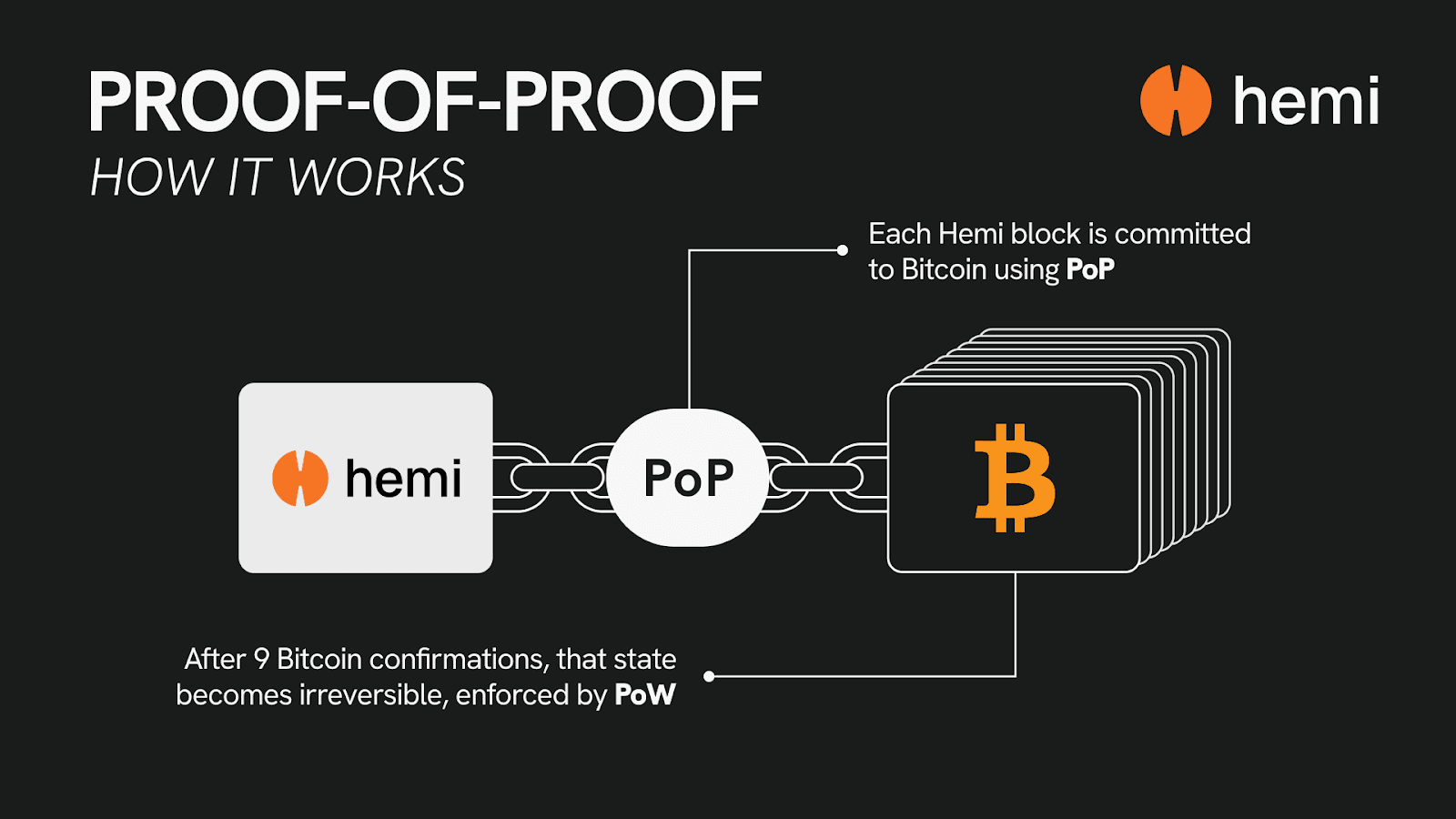
Proof of Proof (PoP) is a consensus mechanism invented by Hemi co-founder Maxwell Sanchez. It allows the blockchain to inherit Bitcoin's security without relying on merged mining or trusted intermediaries.
PoP does not replace Bitcoin's consensus but leverages it to publish the 'fingerprints' of another blockchain nation into the Bitcoin block, making Bitcoin's proof of work an external immutability system.
How it Works (Step by Step)
Mining PoP transactions
Participants (PoP miners) embed the most recent 'keystone' block header into Bitcoin transactions.
This transaction is confirmed on Bitcoin, becoming part of Bitcoin's immutable ledger.
Popular miners received rewards from the blockchain.
Create Anchors
Each PoP transaction acts as an anchor, proving that a specific block existed at a specific moment on the Bitcoin timeline.
Super Finality
Once the PoP release for a specific block reaches 9 confirmations, the chain preceding that block achieves finality.
This provides these blocks with Bitcoin-level immutability anchored in the chain—executing a reorganization would require a 51% attack on Bitcoin itself.
Bridges and Tunnels
Bridges vs. Tunnels: What are the actual differences?
Most crypto users are familiar with bridges—mechanisms that transfer assets from one chain to another. However, many bridges are notoriously fragile, with billions of dollars lost to hacks and exploits. Hemi's tunnel is designed as a more secure alternative, aimed at achieving secure definitions and interoperability between Bitcoin and Ethereum.
Here are their differences:
Custodial/Trust Model
Bridge: Assets are typically held by trusted off-chain custodians or external entities, creating single points of failure.
Tunnel: protects user assets by combining on-chain protocol-level custody with economically consistent decentralized custody. Future upgrades of hBitVM will offer more secure Bitcoin custody services in a permissionless manner with incentivized challengers available.
Verifiability
Bridging: limited and typically reliant on trusted relay sources, leading to delays or vulnerabilities.
Tunnel: a security protocol-level view based on Bitcoin and Ethereum, achieving fully evidence-based verification, meaning every asset movement can be credibly verified on-chain.
Why This Matters:
Bridges introduce risks by inserting intermediaries and unnecessary trust assumptions between users and their assets. Tunnels minimize or eliminate these trust assumptions, providing secure and verifiable asset transfers. For Bitcoin holders, this means their BTC can be safely transferred to DeFi and directly settled back to Bitcoin at any time.
Bridges are promises. Tunnels are evidence.
BTC on Hemi—what can you do

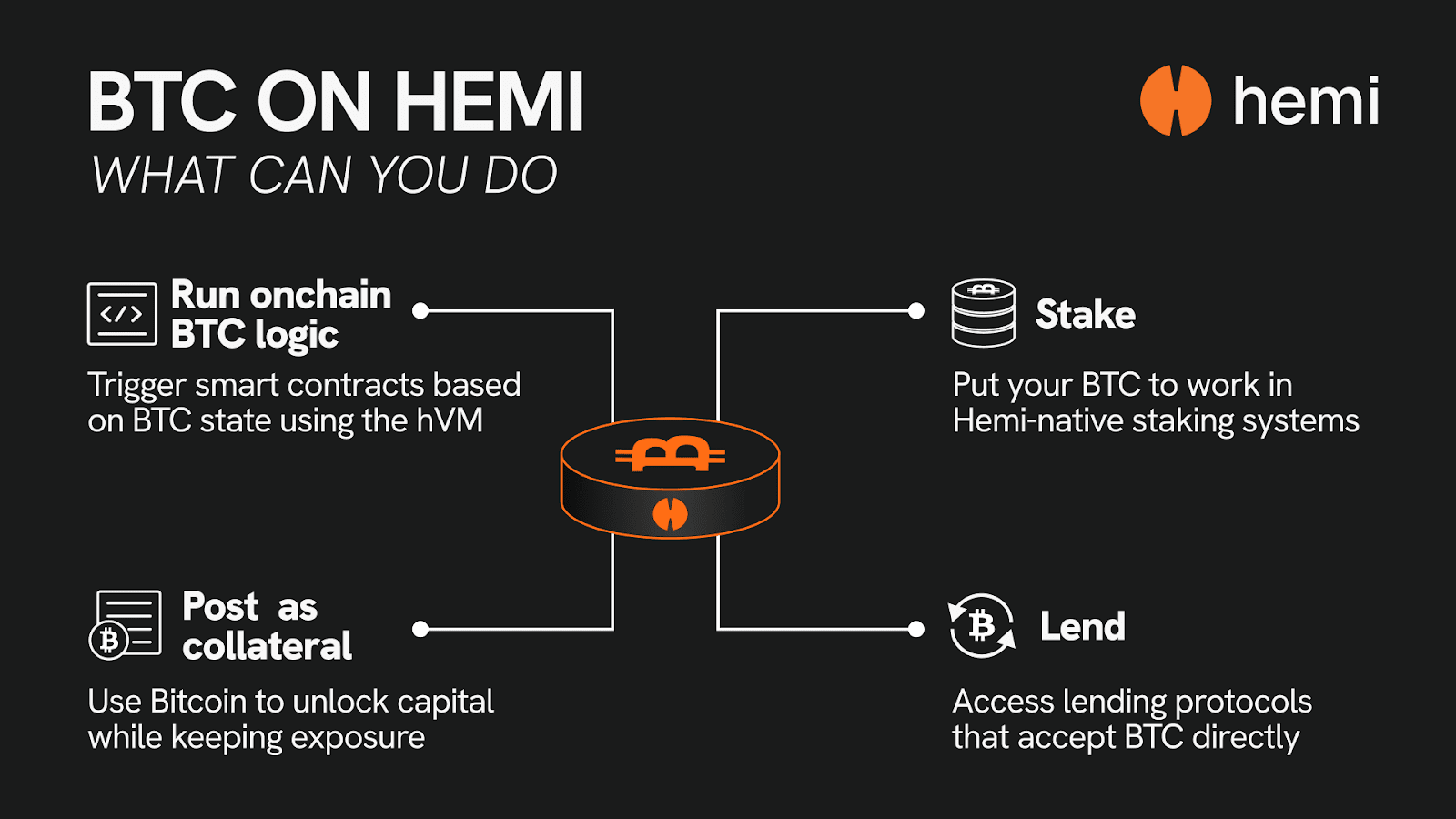
Hemi transforms Bitcoin from passive value storage into active programmable capital. By embedding a full Bitcoin node in the EVM (via hVM), Hemi unlocks use cases that were previously impossible or limited to wrapped tokens.
Running on the BTC Logic Chain
With hVM, smart contracts can now directly read the state of Bitcoin.
Developers can trigger dApps, DeFi protocols, or DAOs based on the actual state of Bitcoin.
For example: non-custodial BTC index and lending protocols that settle directly in Bitcoin, BTC-certified DAOs and AI models, flexible Bitcoin custody systems and smart wallets, Bitcoin MEV markets.
Use BTC as collateral
Use your Bitcoin to obtain loans or unlock capital while maintaining upside risk exposure.
This allows BTC to function as productive collateral—much like ETH supports most of DeFi.
Institutions can leverage BTC's over $20 trillion capital base without wrappers or custodians.
Stake BTC (Staking and Yield)
One of Hemi's main focuses is to earn opportunities for BTC.
Bitcoin holders can participate in a semi-native staking system to earn sustainable yields.
This introduces treasury-level yields for BTC—safely converting idle Bitcoin into yield-generating Bitcoin.
For example: leveraging BTC to protect lending markets, stablecoin protocols, or verification markets.
Lend BTC
Direct access to lending protocols that accept native or tunnel BTC.
Achieve a transparent lending market similar to Ethereum DeFi, but powered by real Bitcoin.
This opens up a sustainable online BTC yield market accessible to both institutions and retail.
Big Picture: From Idle to Active
On Hemi, Bitcoin evolves from 'digital gold' into a programmable, yield-generating asset.
BTC won't sit idle but can participate, earn yields, protect protocols, and act as programmable collateral.
For institutions, this means obtaining treasury-level loans, liquidity, and interest rate markets in a way that finalizes in Bitcoin.
For builders, it opens up new tracks for native Bitcoin DeFi (BTCFi).
In short: Hemi allows Bitcoin to do more than just store value—it enables Bitcoin to take action.
Inside the Hemi Virtual Machine (hVM): a fully EVM-compatible environment
hVM is Hemi's most significant innovation. It is an Ethereum Virtual Machine (EVM) that fully supports Bitcoin. Unlike traditional EVMs that only understand Ethereum state, hVM integrates a fully indexed Bitcoin node into its execution environment, allowing smart contracts to access it directly.
This means developers can build smart contracts that view and respond to Bitcoin in real-time, without third-party bridges, wrapped assets, relayers, or trusted Bitcoin data oracles.
What does hVM handle
hVM uses multi-layered Bitcoin data to make it programmable:
Block Headers and Consensus - normative Bitcoin block information. This gives Hemi contracts the opportunity to understand Bitcoin's current consensus state.
For example: establish dApps triggered after a specific number of Bitcoin confirmations for BTC transfers.
Using Bitcoin block hashes as secure, unaffected randomness.
\u003cm-141/\u003e
\u003ct-557/\u003e
\u003cc-320/\u003e