
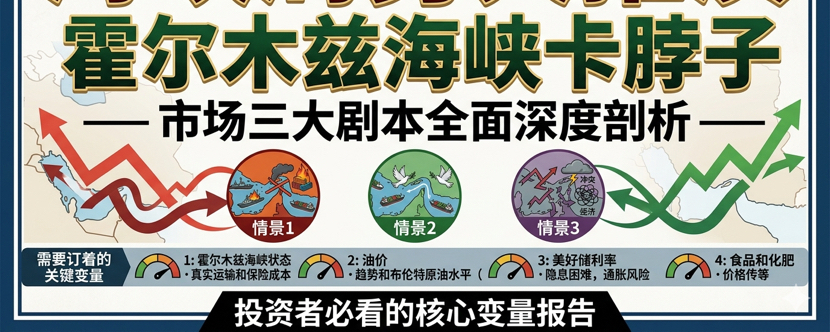
The biggest concern in the current market is not the short-term ceasefire news, but rather the ongoing restrictions in the Strait of Hormuz that have caused energy, insurance, and freight costs to be 'stuck' at high levels. Long-term high oil prices will translate into inflation, forcing the Federal Reserve and global central banks to maintain tight policies (making it difficult to cut interest rates and even possibly raising them), thereby suppressing overvalued sectors.
The future market trend depends on the evolution of geopolitics, focusing on four core variables:
The actual passage situation in the Strait of Hormuz,
The substantive decline in oil prices,
Changes in the Federal Reserve's interest rate cut expectations,
The transmission of price increases in the agricultural industry chain.
Three major scenarios and investment strategies
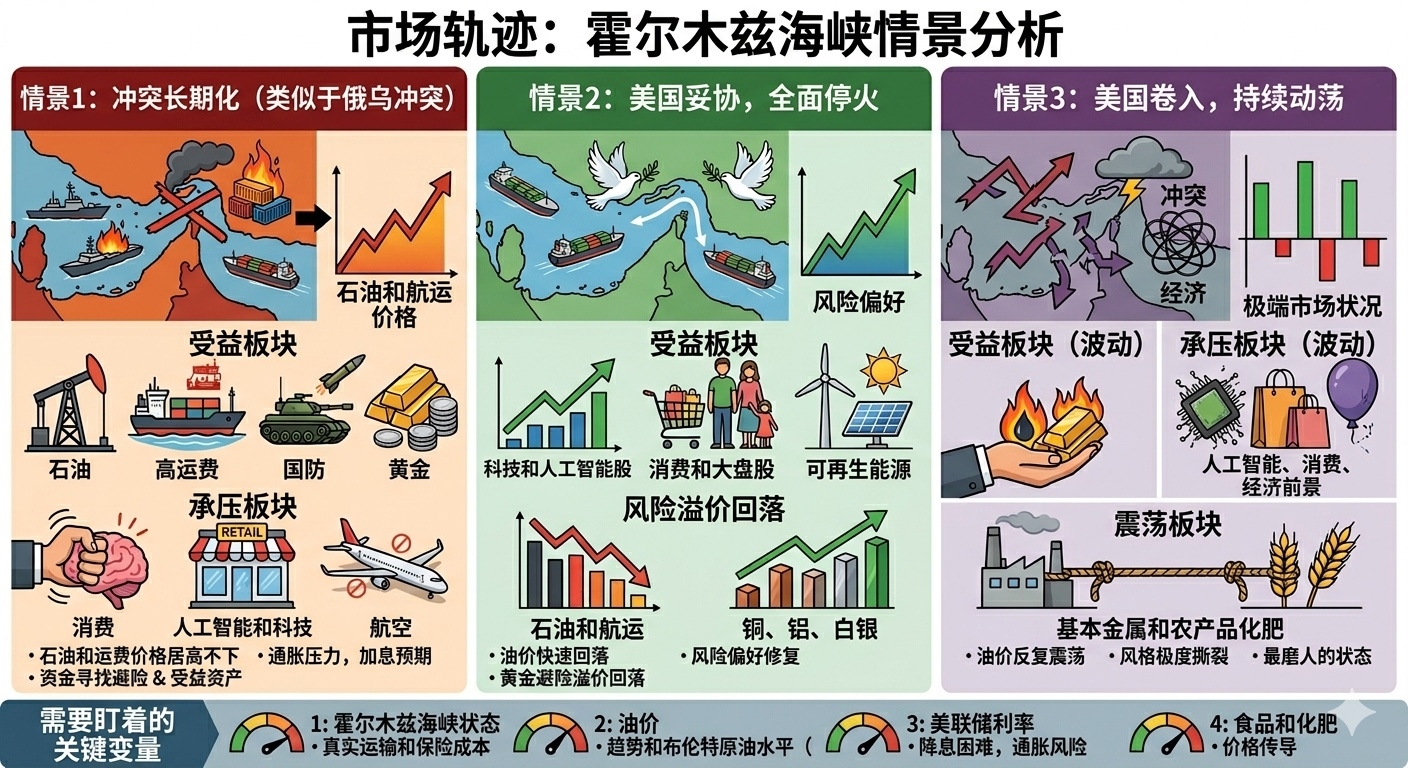
Scenario One: Prolonged Conflict (similar to the Russia-Ukraine stalemate)
Logic: Prolonged conflict, high energy prices, high freight rates, and high geopolitical risks become the norm, inflationary pressures continue, and interest rates remain high.
【Relatively Beneficial/Supportive】Sectors:
1. Energy, Shipping, Defense: The most direct beneficiaries of price increases and heightened risks.
2. Gold and Precious Metals: Fluctuating process, but long-term potential for new highs.
3. Agriculture and Fertilizers: Cost-push opportunities (oil and gas, transportation costs driving up food prices).
Pressured/Risks】Sectors:
1. AI and Highly Valued Tech Stocks: Most sensitive to rising interest rates, high capital expenditures and power consumption characteristics make them the first to be pressured.
2. Air Logistics, Consumption, and Manufacturing: Struggling with high oil prices, high freight rates, and raw material costs, and difficult to quickly pass through to the end consumer.
US stock performance: After valuation compression, differentiation emerges. Energy defense is resilient; major tech leaders with performance outperform second and third-tier AI concept stocks; Nasdaq is suppressed by interest rates; high oil prices drag down the US economy.
Scenario Two: Strong Peace Hypothesis (the US fully accepts Iran's conditions and completely ceases fire)
Logic: Hormuz returns to normal, oil prices fall rapidly, market risk appetite significantly recovers, liquidity expectations improve.
Market response:
1. Technology/AI/Consumption/Large Cap Stocks: The first to benefit, welcoming a recovery.
2. Energy/Shipping/Defense: Risk premiums retract.
Commodity differentiation:
1. Precious Metals: Gold's safe-haven premium falls; **Silver** has industrial properties and benefits from liquidity improvement, making its rebound potentially larger.
2. Base Metals: Copper and aluminum benefit from peace and economic recovery expectations, but copper is constrained by China's inventory, aluminum looks at supply chain recovery, not explosive increases.
3. Steel/Rare Earths: More constrained by their own fundamentals (real estate, infrastructure, policy, military industry, etc.), not dominated by Hormuz.
A-shares AI sector: leaning towards a rebound driven by sentiment and valuation, fundamentals are difficult to realize immediately.
Scenario Three: The most troublesome scenario (disagreement between the US and Israel, the US being dragged in, the situation is volatile)
Logic: Ceasefire is not complete, oil prices remain high, risky assets lack upward momentum.
Market style is extremely torn (grinding state):
Energy, Gold: Repeatedly bought by funds.
AI, Technology, Consumption: Repeatedly pressured and hammered.
Copper and aluminum metals: pulled back and forth with economic expectations and oil prices.
Agricultural Fertilizers: Due to fluctuating expectations of food inflation.
Key monitoring indicators
1. Strait of Hormuz: Whether passage surcharges and insurance risks return to normal levels.
2. Oil Prices: Whether Brent oil prices can truly fall back to pre-conflict levels.
3. Federal Reserve: Whether the interest rate cut path will be reassessed, leaning towards tighter policy.
4. Inflation Transmission: Whether the price pressures of food and fertilizers continue to be transmitted upward.

