
In the cryptocurrency circle, the relationship between contracts and multiples is not significant; it depends on your capital (the margin for each trade)!
Cryptocurrency Rolling Position Profiteering Technique: A personally tested method, the dark rule from 5000U to 1000000U
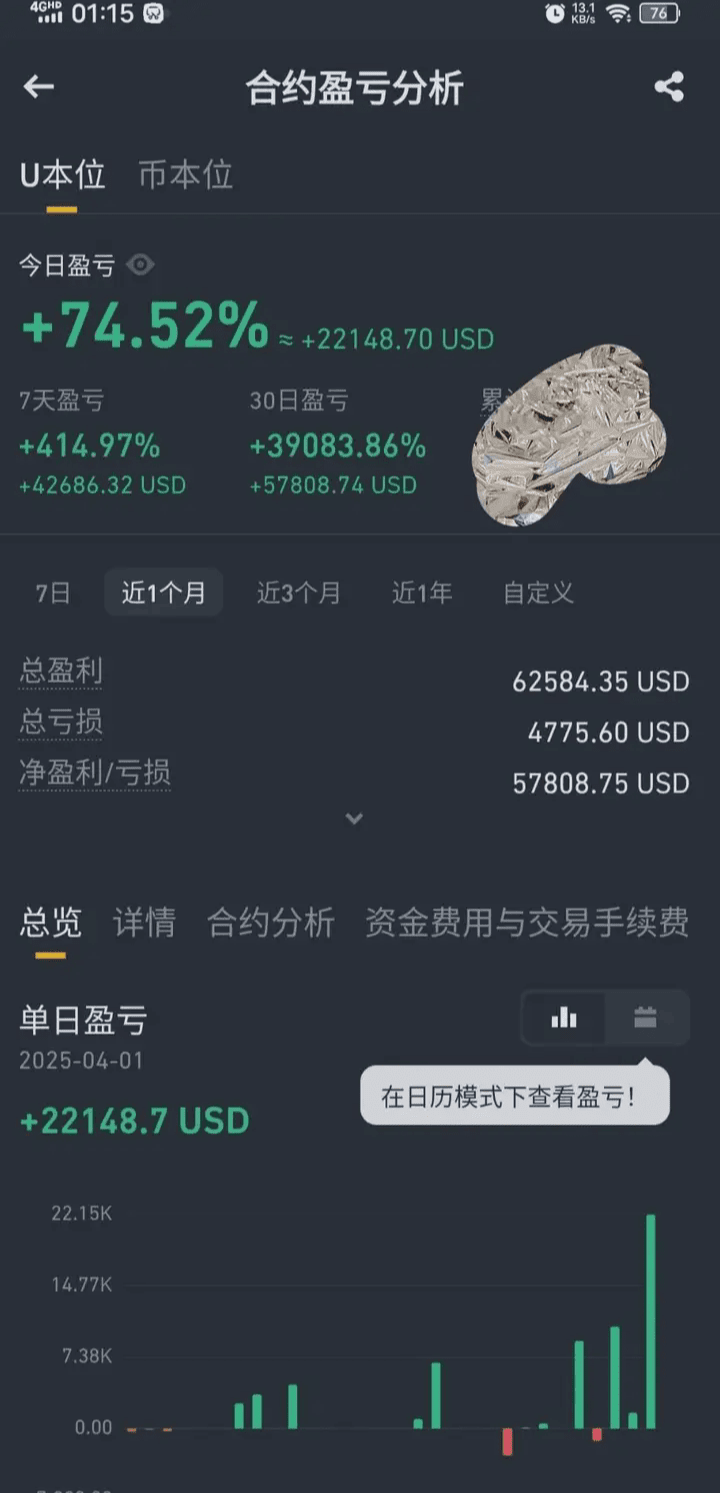
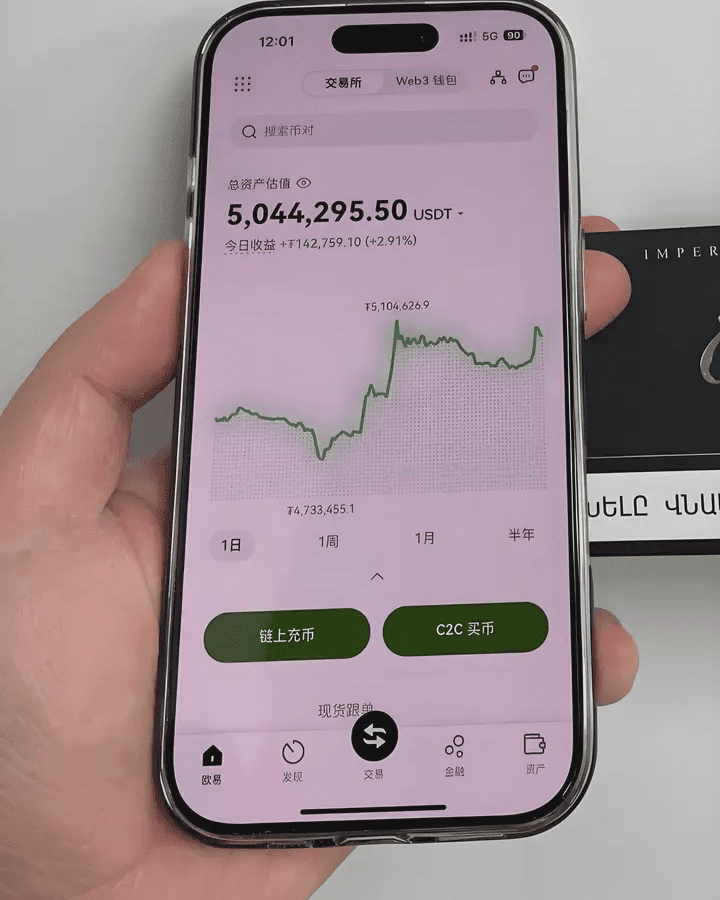
If you are still using a 'conservative strategy' to slowly struggle, you will never turn your life around.
The people who really make big money are all using a nuclear strategy called the 'Bloody Rolling Position Method' by professional traders. Today, I will reveal the secret that has made a few people rich.
Step 1: Understand the essence of rolling positions
Rolling positions is not gambling, but using mathematical advantages to crush the market.
You need to understand:
90% of the time, waiting in cash.
9% of the time is spent on trial observation.
Go all in during 1% of the time
Step Two: Only take action in these three situations
1. During exchange liquidation (within 30 minutes after a large long/short position is forcibly closed)
2. Five minutes before a new coin is listed (monitor listing announcements on major exchanges and use specific tools to target it).
3. When on-chain whales make unusual moves (track sudden transfers from the top 50 holding addresses)
Step 3: Devilish Position Management
My "3331" rolling position rule:
Initial position: 30% as a trial
Add 30% after making a profit
An additional 30% will be added to the second profit.
The last 10% is used for extreme market conditions.
The most deadly secret weapon
I developed a "fear index trigger system" (with hidden core parameters) that can automatically adjust positions when the market is at its most frenzied. Last month, I used this to achieve a 500% return on ORDI in a single week.
Are you brave enough to accept these three challenges?
1. Is it possible to remain out of the market for 7 consecutive days?
2. Is it possible to take profits immediately after a 200% gain?
3. Can you remain calm after three consecutive stop-loss orders?
This strategy will overturn your understanding.

To reduce the risk of margin calls and liquidation, the following strategies can be adopted.
1. Reasonably control the leverage ratio.
All leveraged traders should remember: the higher the leverage, the greater the risk of liquidation. For novice traders, it is strongly recommended to use leverage no more than 3x to avoid excessively amplifying risk.
For example, if your account has 1,000 USDT, using 3x leverage allows you to control a position of 3,000 USDT. Compared to 10x leverage with 10,000 USDT, the risk is lower, and you can earn less as long as you preserve your principal.
2. Set stop-loss levels in advance.
Stop-loss orders are an important risk control tool to avoid account liquidation. Traders can set a stop-loss price when opening a position.
For example, if you go long on BTC at 100,000 USDT, you can set a stop-loss at 98,000 USDT (2% loss). If the market price falls to this level, the system will automatically close the position to limit losses.
3. Maintain adequate margin.
Maintaining a high margin ratio can effectively reduce the risk of liquidation when market volatility intensifies.
For example, if the exchange's maintenance margin rate is 0.5%, it is recommended to prepare at least 3 to 5 times the amount of additional funds as a buffer. When the price approaches the liquidation point (when you receive a liquidation notice), add margin as needed to ensure sufficient account funds and reduce the risk of liquidation.
4. Observe the market's liquidation heatmap.
By using liquidation heatmaps, one can observe which price ranges in the market have a large number of liquidated positions and predict potential areas of sharp price fluctuations. Investors can adjust their entry and exit plans based on this data to avoid entering high-risk areas.
For example, if a heatmap shows a large number of liquidation orders between 100,000 and 98,000 USDT, it indicates that this range may become market support or resistance.
5. Diversify investments to reduce the risk of a single position.
Do not put all your funds into a single position. Instead, diversify across different trading pairs or reduce the leverage of a single trade. This way, even if one trade is liquidated, some of your funds will remain unaffected.
For example, if you have 5,000 USDT, you can allocate 2,500 USDT to BTC and 2,500 USDT to ETH to reduce the impact of fluctuations in a single market. It's important to note that the entire cryptocurrency market often declines simultaneously, so this strategy may not always be effective. However, a reasonable allocation between altcoins and mainstream coins can help reduce risk.
It can be observed that even the top five mainstream cryptocurrencies, such as ETH and SOL, have fallen by more than 30% from their highs during this major drop. This means that leverage of more than 3 times could potentially lead to liquidation, which is why we mentioned "more liquidations in bull markets" in our previous article on bull market prices.
6. Pay attention to market trends and major events.
Market news, macroeconomic data, and policy changes all affect Bitcoin prices. For example, significant market fluctuations often occur around FOMC meetings or the release of CPI data. Similarly, the approval or rejection of ETFs and changes in regulatory policies can also impact market confidence.
Investors should closely monitor these key events and adjust their positions accordingly to mitigate the risk of liquidation caused by drastic market fluctuations!
While leveraged trading can amplify returns, it also amplifies risks. Although we encourage everyone to avoid a gambling mentality and focus on researching projects and holding physical assets, if you still want to trade with leverage, understanding the mechanisms of margin calls and liquidation is crucial.
By employing strategies such as reasonable leverage control, stop-loss setting, sufficient margin preparation, observation of market heat maps, and diversification of investment targets, the possibility of being liquidated and forced to liquidate can be effectively reduced.
If you are a novice cryptocurrency trader or are new to contracts, although the leverage limit offered by exchanges may seem tempting, it is still recommended to start with low leverage trading and learn how to observe market trends and manage risk. This will help you avoid huge losses due to excessive leverage and graduate from the market in one trade!
Today we'll talk about a topic that everyone is interested in: in the cryptocurrency world, there's a derivative product with magical power—it can make someone rich overnight, or wipe them out in three seconds. Used correctly, it can accelerate your life, allowing you to achieve upward social mobility and financial freedom sooner; used incorrectly, it can also accelerate your life, causing you to restart your life and be reborn sooner. This is a futures contract.
We know that 80% of people lose money in the financial markets. There's really no way around it; everything follows the Pareto principle (80/20 rule). Only a small percentage of people are destined to reach the top, but everyone who enters this field aspires to be among that small group and acquire their own wealth.
So why do the vast majority of people lose money trading futures in the cryptocurrency market? For example, they lack technical experience and don't even know what the coins they're trading are for, essentially gambling on luck. Or they don't set stop-loss or take-profit orders, holding onto losing positions against the trend. Even if they do set them, they often cancel them at the last minute, unwilling to cut their losses. When big market moves come, they can't hold on, running away with small profits due to a lack of confidence; when a crash occurs, they try to buy the dip only to find themselves buying at the halfway point; when a surge occurs and they try to short at the top, they get wiped out in one fell swoop.
They make profits but don't withdraw them, sending them all back. They're prone to daydreaming, FOMO (fantasy), and impulsive decisions, resulting in going all-in, losing more and more money, always trying to recoup their losses in one go, frequently opening trades, repeatedly failing, and even resorting to the "five-minute candlestick chart firecracker strategy"—you can search for that online.
So why does this happen? Because most people misunderstand one thing, and it was only after experiencing the above situation countless times and losing a large sum of money that I gradually figured it out. That is:
The cryptocurrency world is a place where you can make a lot of money, but it's not a place to make quick money.
You only see others making a fortune, assuming it's all overnight success or a windfall, but you don't see the lessons learned, the determination and perseverance they accumulated before their success. To put it bluntly, you only see the thief eating meat, not the thief getting beaten, which makes most people very impatient. This impatience also leads to a general lack of the following three abilities.
First, there's a lack of ability to select suitable cryptocurrencies. Ideally, the chosen cryptocurrencies should be those that can generate profits on a yearly basis in the spot market.
Secondly, there is a lack of basic candlestick chart skills. I believe it takes at least two years to learn candlestick chart techniques before one can be considered to have entered the beginner stage.
Third, they lack time and space management skills, are unable to strictly execute trading plans, and therefore cannot maintain a good trading mindset, lacking willpower and execution ability.
So I want to talk about how to cultivate these three abilities, or trading plans. This isn't some kind of magic formula to make you money; such a formula doesn't exist, so I suggest you abandon any illusions. What I want to talk about is a method that can help you get infinitely closer to becoming one of that small group of people, because philosophically speaking, success itself is about infinitely approaching success, not achieving 100% perfect success.
First, what is the ability to select currencies?
As the name suggests, you need to find currently popular sectors or popular cryptocurrency projects. Why? Because popularity means liquidity, which leads to volatility, and you have the opportunity to profit from that volatility.
Trading should be as flexible as water, following the trend and the flow of funds to snowball and grow stronger. Choosing a stagnant coin is far more dangerous than investing in trending sectors. I highly recommend relatively stable and popular coins like BTC and ETH. Of course, when choosing popular coins, you should consider several factors comprehensively, not just one.
First, it's best to choose cryptocurrencies ranked within the top 100 by market capitalization. These coins typically attract larger inflows of funds, offer relatively higher security, and have growth potential. For real-time rankings, it's recommended to use CoinMarketCap.
Secondly, new cryptocurrency projects. After all, it's better to speculate on new things than old ones. New projects launched this year have generated buzz, have established capital bases, and face less selling pressure. If you find a good entry point, you can often reap a decent return.
Third, project background. Choose projects with a good background, strong team, and strong investors. You can assess the project's potential by checking its official website, white paper, technical team background, social media buzz, and capital support. You can also check coinmarket.
Fourth, technology and application. Choose cryptocurrencies with underlying technology and practical application value. The value of a blockchain project largely depends on its underlying technology's ability to develop applications with real-world significance. In other words, cryptocurrencies with proven practical applications are better.
Fifth, choose cryptocurrencies with good liquidity. Cryptocurrencies with good liquidity are easier to buy and sell, and their prices are generally more stable. You can check the daily trading volume of the cryptocurrency; trading volume is linked to liquidity, so the higher the volume, the better the liquidity. You can also check the order book on the exchange. More and more evenly distributed orders indicate better liquidity, while a lower volume indicates poor liquidity.
Finally, choose cryptocurrencies with relatively low unit prices. These are more likely to attract newcomers. For example, this year's popular cryptocurrencies like Pepe, Turbo, and NEIRO all share a common characteristic: low prices. They have all seen significant price increases this year.
Let me use this year as a starting point to illustrate some of the hottest sectors and cryptocurrencies. First, there's the Ton ecosystem. These were extremely popular, with soaring market capitalizations, meeting the requirements of new projects and strong backgrounds. Next, there's the Meme sector, with projects like Pepe, Bonk, Turbo, Bome, and Mew having very low prices, mostly below 0.001, making them suitable for newcomers to the crypto world. However, their volatility is relatively high, so be aware of market risks. Then there's the AI sector, with projects like WLD, Arkm, and FET, all closely related to the development of artificial intelligence. This year, the AI sector has been incredibly hot in both the US stock market and the crypto world, experiencing significant gains. Finally, there's the Sol ecosystem, with active projects like Sol, JUP, and Ray also performing exceptionally well this year.
That concludes our discussion of this screening ability, which is the first skill most people lack. The second skill is having a certain level of technical expertise in candlestick charts. Why is this skill listed after cryptocurrency screening?
Because only the candlestick charts of cryptocurrencies with high overall ratings are truly accurate, and only then can the candlestick chart techniques you've learned be truly useful, allowing you to make judgments based on them.
Imagine a coin without funds, traffic, hype, or liquidity. Even the best-performing candlestick charts are meaningless; they're fragile and easily broken, no different from a low-quality project in the primary market. This is why many people get trapped as soon as they open a contract, until they're liquidated, and they're completely baffled. Now that I've explained it, everyone should understand. Candlestick chart analysis requires personal learning; I can't explain it all in one article. My advice is to watch professional academic videos or read books. I can recommend a reading list—books I've read over the years that basically cover all technical analysis theory.
No matter what you do, patience in learning and investing time in learning and practicing step by step is of paramount importance. You can't be lazy about this; the knowledge you gain is entirely yours, and you reap what you sow.
The third and most crucial skill, one I learned through countless painful experiences of account blowouts over the years, is time and space management. This essentially refers to managing your trading time and operational space. If you can't do this well, no matter how well you do the first two points, you'll still suffer long-term losses, and huge losses at that. How exactly do you manage this? First, you need a scientific and objective trading system, or trading plan. It absolutely, positively, absolutely must be scientific and objective to be reasonable. We often see things like "10 USDT challenge 1 million USDT," "Multiple times your investment in a week," or "I made hundreds of times my initial investment by trading this way" on YouTube, Bilibili, and TikTok. Avoid having these kinds of thoughts, and watch or listen to as few related videos as possible.
This kind of anxiety-mongering, fantasy-spreading stuff—if you believe it, you're just being exploited. My assessment is that you'd be better off believing I was Qin Shi Huang. Of course, I'm not saying it doesn't exist; anything is possible in the crypto world. But we're all ordinary people, and the probability of this happening to us is extremely slim. It's a matter of fate. You're in this circle to make money, not to gamble.
Based on this sound trading plan, strict adherence to it, along with maintaining a good mindset, are mutually reinforcing. Only by strictly adhering to the plan can you maintain a good mindset, and only by maintaining a good mindset can you better adhere to it. If you can consistently maintain both, you can essentially achieve a leap in wealth accumulation. The test lies in your ability to formulate and execute strategies based on current market conditions. While it's impossible to follow a plan 100% perfectly, as plans can never keep up with changes, in the cryptocurrency market, the degree to which you execute your plan is directly related to your returns. The more distorted your execution, the closer you are to bankruptcy; conversely, the higher the degree of execution, the closer you are to success.
Of course, I know that some of you may understand these principles, but you just don't know how to formulate a reasonable plan. So I'll share one part of my own trading plan, which I use regularly. A plan includes both time and operational space. Let's talk about operational space first; we'll discuss the fixed-position method.
In other words, how do you set your position before placing a contract? How do I determine my position?
Let's say you have 30,000 yuan to invest in cryptocurrency futures trading. 20,000 yuan will be reserved as off-exchange funds and left untouched. The remaining 10,000 yuan will be used directly for trading, meaning your total futures capital is currently 10,000 yuan, which translates to approximately 1428 USDT at the current exchange rate. Here, we'll use the Kelly Criterion.
According to the Kelly Criterion, we can draw two conclusions.
First, the maximum position size cannot exceed the total funds.
Second, the amount used in a single transaction should not exceed 1/10 of the total funds. In the contract, this means using 1/10 of the account funds for a single contract transaction, and the maximum leverage should not exceed ten times. We open contracts in roughly two ways.
One option is to invest in mainstream cryptocurrencies, such as Bitcoin and Ethereum.
Mainstream cryptocurrencies are generally more stable with smaller fluctuations, making them relatively easier to predict. However, the probability of making big profits from small investments in the short term is relatively low. Altcoins, on the other hand, experience wild price swings, are highly volatile and difficult to predict. They can easily rise two or three times in a day, or fall two or three times in a day, or even be delisted. But it is precisely because of this volatility that altcoins are popular, as they can lead to quick riches.
Let's take altcoins as an example. If you open a single order with 1/10 of your position, then the maximum leverage should not exceed 10X.
We'll calculate based on the maximum multiplier. The position after opening the contract will be 1428u ÷ 10 × 10 = 1428u. Your actual contract position will be 1428u. The stop-loss is usually set at 5% of your entry price. For example, if I choose to go long on a coin at 1u, my stop-loss should be set at 0.95u. When trading contracts, we have a risk-reward ratio. We only open an order if the risk-reward ratio is at least 1. This means you need at least a 5% stop-loss to match a 5% profit (in this case, 1.05u) for it to be considered a worthwhile trade.
Because the essence of contracts is to manage risk-reward ratios, using leverage to generate substantial profits with minimal investment. For example, if I believe this is a very good relative bottom with the potential for the expected price increase, I might open a position directly. However, if the stop-loss order causes a 5% loss, and two consecutive losing trades result in a 10% loss, then we need to adjust our strategy.
We need to reduce our position size. Why?
Please remember this formula for price increases and decreases.
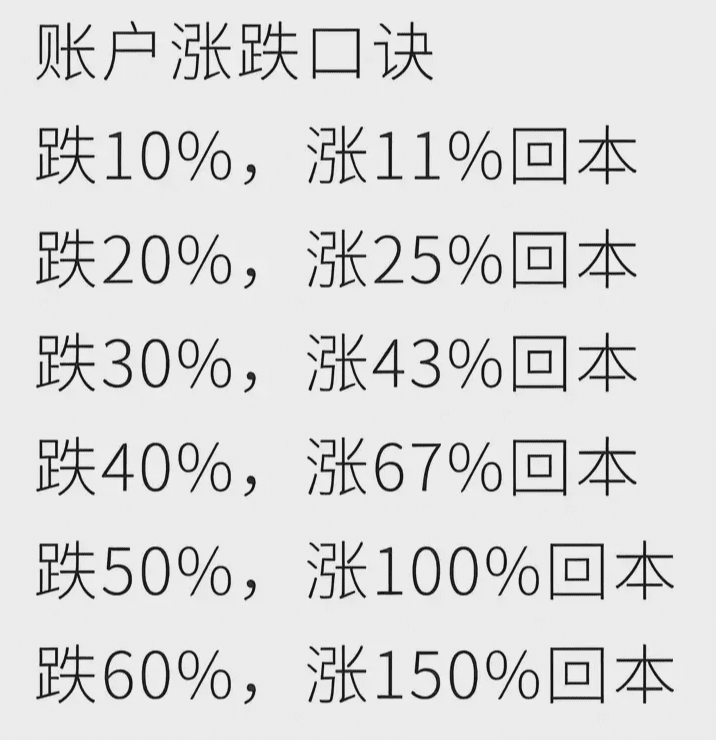
If your account balance drops by 10%, meaning you've lost 10%, you need to earn 11% to break even. If it drops by 20%, you need to earn 25%. If your account loses 70%, it needs to gain 233% to break even.
After a series of losses, your principal shrinks, but it becomes more difficult to recover your losses. In other words, you have to do more difficult things with less money.
Therefore, if you suffer two consecutive losses, which is 10%, you must adjust your strategy and reduce your position size.
So, after a 10% loss, the total capital remaining is 1285.2u. Following the plan of using 1/10 of the position with a maximum leverage of 10x, our contract position after opening the order is 1285.2. Similarly, even after ten consecutive losses, the account balance is 842.21, meaning a further loss of 584.796, or 59% of the total capital, a loss of 41%. At this point, there's still nearly 60% of the account balance remaining. Most people using full-margin, high-leverage trading would likely have been wiped out countless times. But that's not what I want to discuss. According to the formula, a 67% increase is needed to break even, which is quite difficult at this point.
The best approach would be to use the remaining two-thirds of your off-exchange funds to replenish your position and funds.
How much exactly should you top up? Don't exceed 1428u, which is the maximum amount you topped up last time.
Based on this calculation, the account has 1428u + 842.21 = 2271.2u.
Based on this, a 26% increase is needed to recover the losses. Once the losses are recovered, the additional funds will be used to replenish the position. This involves the second withdrawal of 1428u, returning the funds to the off-exchange market. This is how off-exchange funds are used.
If you continue to lose money, then continue with the original plan. In that case, you will have at least 30 consecutive opportunities to lose money.
I don't believe you can get it wrong even once out of thirty attempts. If you really can't get it right even once, then you should withdraw your money as soon as possible and go back to work honestly. You're really not suited for this industry.
Now that we've covered the loss-reduction strategy, let's move on to the profit-expanding strategy. Using 1428u as an example, after a 10% profit, our capital reaches 1570.8u. At this point, we can choose to expand our position, increasing the original single contract position from 1428u to 1576u, and so on. Assuming a minimum profit/loss ratio of 1:1, we can double our position in 14 wins. With excellent profit/loss control, we can double our total position in just 4-6 trades. Sounds tempting, right? Yes, that's the advantage of this strategy—it's versatile, offering both offensive and defensive capabilities.
I won't disclose the specific amount, but in the past year, I've achieved a return of over 400% using this strategy, not only making up for the losses of the past few years but also generating considerable profits.
With position management in place, the next step is time management. This is where a particularly useful feature available on every exchange comes in handy: the contract cooling-off period.
What is the purpose of a cooling-off period?
First, it can help you calm down and prevent further massive losses.
Secondly, after calming down, use this time to re-observe the market and formulate a strategy. Here's a reference for everyone. First, you must choose one day a week as a rest day to calm down. Even those working 996 jobs in China have rest days. The cryptocurrency market trades 24 hours a day, which can easily lead to exhaustion, so a rest day is essential. You must give yourself one day off regularly; I would choose Monday. Because the market is likely to see a significant increase every Saturday and Sunday, and I would stay up all night monitoring the market, Monday is my rest day. I give myself a day off to calm down, not to look at the exchange, and not to read any related news. Besides rest days, after closing each profitable trade, you can choose to enter a 24-hour cooling-off period. This is to preserve your gains, rather than impulsively opening a second trade and then losing it all. Anyone who experiences gaining and then losing will feel unspeakable pain and discomfort, and it's easy to lose control and turn profits into losses.
The third scenario is when you make two consecutive profitable trades but don't close your position in time to lock in profits, only to see the price drop back down and you have to break even. After all that effort, it's all for naught, and you haven't made a single penny. In this situation, you absolutely must activate a 24-hour cooling-off period. Similarly, watching profits slowly disappear is a very painful experience. This is extremely dangerous.
Finally, after two consecutive stop-loss orders, you must have a 48-hour cooling-off period, or two days. This goes without saying. According to our plan above, consecutive losses have already wiped out 10% of your principal. If you lose 10% every day, what are you waiting for if you don't rest and adjust? At the same time, use this time to formulate a strategy for resuming positions. Many people worry about missing out on market opportunities, but even the biggest market movements only happen once a day. You make money during this cooling-off period, and then wait 24 hours to start the next wave. There's absolutely no problem with that.
The same logic applies to losses. Losing money means you're stuck in an in-between market position, and a cooling-off period is necessary. Moreover, most of the time in the crypto market is essentially wasted time; prices rise and fall rapidly, so patience is key – opportunities will arise eventually.
This means I'm getting between 1 and 4 orders per week, keeping the frequency within a reasonable range, and controlling both emotional fluctuations and financial burdens. If I keep this up, I'll get closer and closer to success.
These are the trading experiences the instructor shared with you today. Many times, you've missed out on numerous money-making opportunities because of your doubts. If you're afraid to try, to explore, and to understand, how will you know the pros and cons? Only by taking the first step will you know what to do next. A cup of warm tea, a word of advice—I am both a teacher and a friendly friend.
Meeting is fate, understanding is destiny. The instructor firmly believes that those destined to meet will eventually meet, even from afar; those not destined will simply brush past each other. The road to investment is long, and temporary gains or losses are merely the tip of the iceberg. Remember, even the wisest can make a mistake, and even the most foolish can sometimes succeed. No matter your emotions, time will not stand still for you. Pick yourself up from your troubles, stand up again, and move forward.
I am Yiyan, with extensive market experience across multiple bull and bear markets and various financial sectors. Here, I cut through the fog of information to uncover the true nature of the market. Seize more opportunities to unlock wealth and discover truly valuable opportunities—don't miss out and regret it!
Giving a man a fish is not as good as teaching him how to fish. Whether you're a novice or an expert, cryptocurrency investors will gain more than just financial returns from our instructors; they will also grow in investment knowledge and experience. Following our instructors, you'll not only receive analytical thinking on market trends, basic chart reading skills, and how to use various investment tools, but also insightful fundamental analysis, a clear understanding of the complexities of the international situation, and the ability to identify various investment forces. We'll help you become both a winner and an expert in investing!
To navigate the cryptocurrency market effectively, mastering the seven key trading principles is essential for understanding the art of investment—entering and retreating, attacking and defending. This allows one to remain steadfast amidst opportunities and turn danger into safety when facing pitfalls. Having navigated the market for many years, I, the instructor, am well-versed in its opportunities and pitfalls. If you are experiencing investment setbacks and are unwilling to accept your losses, contact me, and I will correct your past mistakes. If you are already profitable, I will teach you how to protect your profits. If you are still struggling and lost in the market, I am willing to guide you forward. The true tragedy of trading lies not in how much suffering you endure, but in how many opportunities you miss! Seize the present and let's move forward together. I am Yiyan, someone who will leave a mark on the cryptocurrency world in the future.


