How did that money disappear?
At the end of 2021, I had 350,000 in my hands. That was the entire savings from four years of working in Shenzhen, not much, but enough for a down payment on a small two-bedroom apartment back home. Then I encountered a project called "On-chain World of Warcraft." KOLs were promoting it, the community was celebrating, and the roadmap was beautifully crafted like a piece of art. I invested 80,000. The next month, the project team ran away, the official website turned into a 404, and they couldn't even be bothered to release an announcement. Then there was a "3A shooting masterpiece," I put in 120,000, bought a few "epic weapons," and to this day, I still haven't figured out how to shoot in that game. Finally, I dumped 150,000 into a "metaverse real estate" project, bought three pieces of "land," and now the price has dropped by 95%, with no one asking about it for half a year. In three months, 350,000... gone. The most ironic part? I never really "played" any of those games from start to finish. I logged in, took screenshots, calculated profits, and then waited for prices to rise. I can't even tell you what the BGM of those games sounds like because I never even turned on the sound. I'm not a player; I'm an accountant with a calculator.
Later, I was drinking with a friend who works in game design. After I finished speaking, he laughed and said, "What you bought wasn't a game, but an investment product called 'Get Rich Quick.' The game is fake, and the dream is fake. Putting two fake things together, who else would lose money but you?" I drank three glasses of wine and couldn't say a word.
Later, someone recommended Pixels to me. My first reaction was to refuse—I had sworn never to touch any GameFi again. But that person said something that made me hesitate: "Don't worry about the tokens for now, just think of it as QQ Farm from when you were a kid, play for a couple of days and try it out. It doesn't cost any money." I thought about it, and since it didn't cost any money, I figured I might as well give it a try. So I went in.
Is pixel art a fig leaf or a true skill?
When I first opened Pixels, to be honest, I almost laughed. The little character, the land, the hoe's movement reminded me of those Flash games I played on 4399 back in 2009. My immediate thought was: Is this all? This is what you call "the next generation of GameFi"? The graphics are as rough as something from the last century; the characters are blocky, the crops just change color when they ripen, and there aren't even any decent special effects. But one detail kept me from immediately turning it off—it doesn't require me to connect my wallet to play.
I thought about this detail many times afterward. Pixels allows you to experience the game as a "completely free player" without connecting a wallet or holding any tokens. You can farm, harvest crops, wander around, and visit other players' homes in the game without spending a single penny. This design is almost unique in the GameFi community. Think about it: if you want to play Axie Infinity, you first need to buy three pets, starting at several hundred US dollars—the barrier to entry is ridiculously high. If you want to play other blockchain games, you either need to buy land or equipment, costing thousands of dollars at the very least, without even being given a chance to try them out. But Pixels says: play first, and we'll talk about money if you have fun.
This sounds like common sense. In any traditional game, it's the same principle—play for free first, then spend money on skins, items, and battle passes if you get hooked. But in the GameFi community, "free trial" has become "innovation." This makes me reflect deeply. How far has GameFi come over the years? To the point where even the most basic "letting players try it out" has become a luxury. How many "AAA titles" have we been fooled by? Those beautiful promotional posters, explosive trailers, the collective hype from KOLs, only to find that there's not even a complete tutorial. Pixels, at least, didn't fool you; it tells you right from the start: This is what I look like, play it or not.
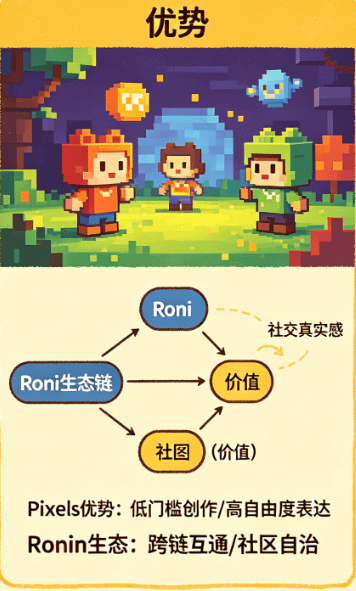
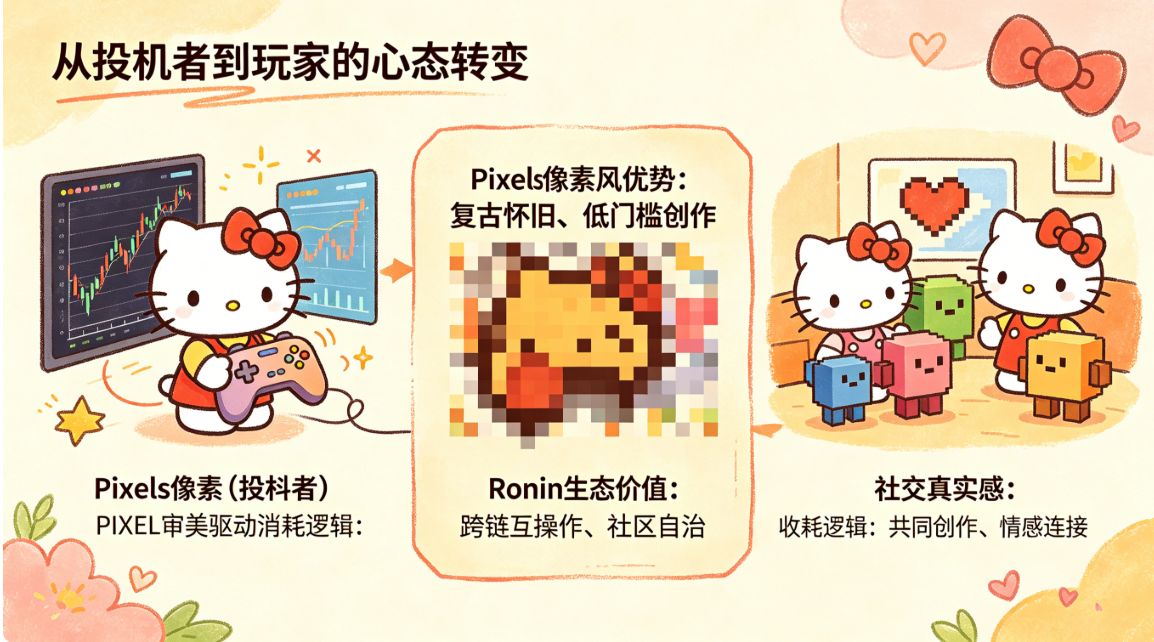
Many people criticize Pixels for its "pixelated" style, saying it's too rough, lacks sincerity, and looks like an antique from the last century. But I think the pixelated style might be the smartest decision Pixels has ever made, even its "strategic weapon." It's not because it lacks the funds for high-definition graphics, but because it has realized a truth that many AAA teams haven't grasped: in blockchain games, graphics quality isn't the moat; playability and accessibility are.
Why? I'll give you three reasons.
First, pixel art games have lower development costs and faster iteration speeds. This isn't an insult to Pixels; it's a fact. The development cycle and financial investment for a pixel-art game are far lower than for a 3D game. Pixels uses the money and time saved to refine gameplay and update content. Look at its update frequency—there's something new almost every week—new crops, new decorations, new events, new maps. In contrast, those "AAA" games take three years to develop, producing a demo, then another six months to produce a bug-ridden beta version. Then, a year later, the project team disappears under a different name. Pixels takes a small, rapid approach, offering something new every week, so you don't feel like "this game is dead."
Secondly, the pixel art style has zero hardware requirements. If you can open a webpage, you can play Pixels. No dedicated graphics card, 16GB of RAM, SSD, or any client downloads are needed. This means Pixels can reach users with older laptops, office computers, or even internet cafe computers. While traditional games are focused on graphics quality, system requirements, and ray tracing, Pixels goes against the grain, lowering the barrier to entry to "anyone with internet access can play." This isn't a step backward; it's a game-changer. Think about it: how many people worldwide have computers that can't run AAA titles? Too many. But these people also want to play games; they are Pixels' target users.
Third, pixel art actually helps retain players because it manages expectations well. This is my own honest feeling. With pixel-art games, you don't have high expectations. You don't expect stunning graphics, complex effects, or immersive storylines. You come in to farm, chat, wander around, and decorate. This low expectation makes you more easily satisfied. On the other hand, the trailers for AAA games raise expectations to 100%. When you enter and find it's only 60, your disappointment is enormous. This huge gap will quickly cause you to leave—you'll feel cheated, you'll think "this game is no good," and then you leave and never come back. Pixels doesn't have this gap because it never makes empty promises. It says, "I'm a pixel farming game," and when you enter, it really is a pixel farming game, exactly as advertised, no deception whatsoever.
So I say, Pixels' pixelated style isn't a fig leaf, it's genuine skill. It's not that it can't create more "beautiful" visuals—look at its later updates with rare decorative items; pixel art can also achieve a sense of refinement. It chose a smarter, more sustainable path that respects players' time and devices. This path isn't easy, because many people will swipe away at first glance at pixel art, thinking, "What garbage!" But those who stay are the ones who are truly willing to continue playing. Pixels isn't looking for clicks; it's about retaining genuine players.
There's a logic hidden within the Ronin ecosystem that no one has ever spoken of.
When discussing Pixels, Ronin Network is unavoidable. Many people, upon hearing Ronin, immediately think: "Oh, the Axie chain? The one that got hacked for 600 million dollars?" Yes, that's Ronin. But I believe Ronin is precisely Pixels' strongest asset, and the key reason why many people don't understand why Pixels has survived.
Here's a perspective that might have been overlooked: Ronin is the only gaming blockchain that survived a near-catastrophic attack and is now thriving. In March 2022, Ronin was hacked, losing 173,600 ETH and 25.5 million USDC, worth over $600 million at the time. It was one of the largest hacks in crypto history, surpassing many well-known hacking incidents. Everyone thought Ronin was finished, Axie was finished, and the entire GameFi ecosystem would be dragged down. The community was in despair, KOLs were predicting its demise, and liquidity dried up instantly.
But look at it now? Ronin is still here, and doing quite well. Axie is still here; although the price hasn't returned to its peak, the game is still running, and people are still playing it. Pixels are still running on Ronin, and very stably. What does this show? It shows that Ronin's node validators and community users are people who have been repeatedly "cleaned up" and "filtered" by extreme market conditions and black swan events. Those who remain are not short-term speculators who come to grab freebies and run; they are true "veterans" who have taken root in this ecosystem, have feelings for it, have assets, and have social relationships.
This screening mechanism is brutal, but very effective. The bear market weeded out all speculators for Ronin, and the hacking incident further eliminated a group of panickers. After these two rounds, what remains are those who "wouldn't leave no matter what." You might say this isn't a good thing; it's "passive loyalty trapped in losses." But from the project team's perspective, these people are a thousand times more valuable than any "fresh investors." Why? Because they've weathered storms and won't be scared off by short-term fluctuations. They won't dump their tokens and run just because the price drops by 20%—not because they don't want to, but because they know there's little difference between running and not running, so they might as well stay. Their familiarity with the Ronin ecosystem might even surpass that of the project's operations staff. They are true "ecosystem residents," not "passing tourists."
Pixels' decision to run on Ronin, in my opinion, stems from their recognition of these "veterans." For a brand new game, the hardest part isn't writing good code, creating great art, or designing a sound economic model; it's launching—the "cold start problem." You need your first batch of users, you need people in your game to make your virtual world feel less deserted and less like a ghost town. If you launch on a public blockchain filled with script users and airdrop-hunting studios, your cold start will be incredibly painful. Because those users won't interact with you, won't chat, won't explore the map; they'll only do one thing: create dozens of accounts, calculate which task yields the highest reward, and then run it with scripts. Your game will be full of bots, not a single real person.
But the veterans on Ronin are different. They genuinely chat with you, visit your farm, tag you in the group chat for "you stole my crops today," and stand in your farm for two minutes just to see your heart-shaped planting area. The social atmosphere of Pixels owes much to the veterans on Ronin. They are the "first residents" of this world; they farm, decorate, make friends, and then tell their friends, "This game is really fun, you should try it." This word-of-mouth marketing is more effective than any marketing campaign.
This experience taught me that in GameFi, choosing the right blockchain is a million times more important than choosing the right investment firm. No amount of funding or top-tier VC backing you is as crucial as selecting the right blockchain. The user profiles on that blockchain directly determine the future of your game. If you choose a blockchain full of speculators, your game will become just a mathematical tool for calculating returns. Only by choosing a blockchain with real users can your game become a true "game." Ronin's users have been thoroughly tested; they know what a bubble is and what's real. They won't rush in because of a flashy promotional video, but once they're in, they won't leave easily.
A token perspective no one has ever talked about—why PIXEL's consumption logic is different.
Before discussing tokens, I want to address a phenomenon. Think back to the price movements of all the GameFi project tokens you've seen. Don't they all look the same? A sudden surge at the open—due to high market enthusiasm, early adopters holding back their tokens, and market makers pumping the price. Then comes a period of consolidation—a battle between bulls and bears, with some taking profits and others buying the dip. Then comes a gradual decline—production increases while buying pressure can't keep up. Finally, it goes to zero—the project team runs away or the community dies completely. The only difference is that some projects can survive for three months, some for six months, and very few for over a year. Why is this? Because the tokenomics of most GameFi projects makes the same mistake: unlimited production and limited consumption. Production happens every day, every hour—players are mining, machines are running scripts, and tokens are flowing out like water from a tap that's been turned on, unstoppable. But what about consumption? Consumption is infrequent and one-off. Upgrading equipment only requires spending money once, buying land only requires spending money once, and participating in events is occasional and based on mood. The frequency and scale of consumption are far less than the rate of production. This leads to a perpetual "supply exceeding demand" situation—totaling the number of tokens increases and wallets become increasingly full, but demand does not grow in tandem, and is even shrinking, so prices can only continue to fall.
Does Pixels have this problem? Yes, all tokens that generate revenue will inevitably face inflationary pressure; it's mathematics, and no one can escape it. But the degree varies. I spent three months pulling through PIXEL's on-chain data, examining each transaction, consumption, and staking record, and discovered a very interesting, and rarely mentioned, pattern: PIXEL's consumption peaks don't occur when "the project team is running promotional events," but rather when "in-game content is updated to be purchasable."
This distinction is subtle, but extremely important. Let me explain. The expenditure from "project-organized events" is passive, calculation-based, and utilitarian. A project announces: "For the next three days, you can spend 100 tokens to participate in a lucky draw for a limited-edition skin." Upon seeing this, players immediately start calculating: "How much value can I get by spending 100 tokens? If the expected return is greater than 100, I'll spend; if it's less than 100, I won't." This is arithmetic, not a consumption behavior. Players aren't "buying what they like," they're "calculating the return on investment." This kind of expenditure is fragile; once the expected return falls below the cost, the expenditure stops.
However, the expenditure on "in-game updates that include purchasable content" is proactive, aesthetically pleasing, and emotionally driven. The project team didn't hold any events, promotions, or lotteries. They simply added a new piece of furniture, a new crop, a new skin, or a new fence set to the in-game store. When players saw it, their eyes lit up, and they thought, "This is so beautiful, I want it." "The fence color matches my house perfectly, I'll buy it." "This new furniture would look so cool on my farm." Then they actively spent their tokens to buy it. No one forced them, no one calculated the return on investment for them; they simply felt it was "worth it."
Pixels excels far beyond most GameFi projects when it comes to "voluntary consumption." Its decorations, furniture, skins, fence colors, and floor materials, while pixelated, are undeniably tasteful, aesthetically pleasing, and stylish. I once saw a player's farm in the game where every plot was meticulously planned, crops arranged in rainbow colors, fences painted white, two rows of flowers at the entrance, and a stone path running through the middle. I asked him how many tokens he spent on these renovations, and he replied, "I haven't calculated it, but it's worth it." Worth it. These two words are the ultimate code for all consumer behavior. When a player feels it's "worth it," they won't do the math, compare prices, or hesitate. They'll only do one thing: pay up. This kind of consumption is emotion-driven, not arithmetic-driven. And emotion-driven consumption has stronger stickiness, higher frequency, and a higher ceiling.
If PIXEL's consumption logic could be summarized in one word, it would be "aesthetically driven." This isn't a particularly sophisticated term, but it's a true competitive advantage. Because aesthetics are subjective, personalized, and difficult to replicate. You can copy Pixels' gameplay—anyone can copy farming. You can copy Pixels' economic model—anyone can design token production and consumption. But you can't copy its aesthetics, its pixelated charm, or the players' love for its art style. This kind of aesthetic accumulation is built over time, honed through countless updates and iterations; it can't be bought with money.
Of course, I'm not saying PIXEL is without risk. Its biggest risk, which I call "Schrödinger's liquidity," is this: when market sentiment is good, PIXEL's liquidity seems plentiful, with thick buy and sell orders, making you feel ready to sell at any time. But when market sentiment suddenly shifts, liquidity evaporates instantly, disappearing like magic. You see millions of dollars worth of buy orders on the order book, feeling reassured. But when you actually dump your holdings, those buy orders vanish without a trace, as if they never existed. This isn't just a problem with PIXEL; it's a problem with all GameFi tokens, and arguably a problem faced by all altcoins and all assets with insufficient liquidity. Liquidity is borrowed, not your own. When market sentiment is good, liquidity will come to you; you don't need the money. When market sentiment is bad, you can beg for liquidity, but it won't come; if you dump your holdings, the price will plummet.
So my attitude towards PIXEL can be summed up in one word: wait. Wait for market sentiment to recover, for the game content to become richer, for more consumption scenarios to emerge, and for its "voluntary consumption" logic to be validated and accepted by more people. Now is not the time to go all in—going all in at any time is a mistake. But now you can start paying attention, start playing, start experiencing. When you truly love the game, when you genuinely think, "This fence color is so beautiful, I'll buy it," then you can consider whether to hold PIXEL. Because at that point, you won't be speculating; you'll be paying for your own enjoyment.
The secrets of social interaction are hidden in a corner I never noticed before.
Let's discuss a topic that many GameFi projects completely ignore, or even deliberately overlook: social interaction. Why don't many GameFi projects include social features? Because social interaction doesn't generate revenue; the return on investment is too low. Developing a chat system is costly, requiring servers, approval processes, and maintenance, but its direct monetization potential is almost zero. Players having a great time chatting in the game won't spend an extra penny to buy your tokens. Therefore, many project teams' logic is: first, make the economic model work, first, raise the token price, and then worry about social interaction later. And "later" means they'll never do it. Because by the time they wait "later," the project team will already be working on the next project.
But Pixels did something that really surprised me: you can visit other people's farms. This feature sounds incredibly simple, even a bit silly. It's just visiting someone else's farm, right? QQ Space could do that back in 2005, what's so special about that? But when I actually browsed around in Pixels, I discovered something very interesting, even a bit philosophical. One day, I was aimlessly clicking around on the Pixels map and randomly entered a stranger's farm. The layout was completely different from mine—he had designed the planting area into a giant heart shape, with flowers planted around the edges and a golden wheat field in the center, with a chair and a table in the middle. I stood there, looking for about two minutes, without moving. Then the farm owner returned, saw me standing in the center of his heart-shaped farm, and sent a smiley face. I said, "How did you plant this heart shape? How long did it take?" He said, "I planted it one by one, about three days, planting a little bit every day after get off work." I said, "Are you studying landscape architecture or garden design? You planted it so professionally." He said, "No, I drive an excavator."
I laughed. A man operating an excavator, spending a whole day digging earth at a construction site, then going home, turning on his computer, and spending three days in a game planting seeds one by one to create a heart-shaped farm. This made me think a lot. The "virtual space" in games can hold real emotions and personal expression. In the real world, you might live in a rented room with nothing but a bed and a table, afraid to even hammer a nail into the wall for fear the landlord will take your deposit. But your farm in Pixels can be anything you want. You can plant flowers, arrange furniture, paint the fence your favorite color, and sit in the middle of a wheat field watching the sunset. This virtual space is your "creation," your "business card," your "little home."
When you own a "creation" in a game, you care about it, want to improve it, invite your friends to visit, and secretly feel happy when they compliment your farm. At that point, the game is no longer just a "tool." It's a "place." The difference between a "place" and a "tool" is this: you use a tool and throw it away, replace it when it breaks, without any emotional attachment. But you want to go back to a place, you miss it, and you want to "go back and see" it after a while. Pixels' social features are essentially helping players build "places." Your farm is your place, and other people's farms are their places. You visit other people's places, and others visit yours. You meet, chat, exchange seeds, and steal each other's crops in each other's places. This feeling of "visiting" is something that WeChat, Discord, and Telegram can't provide. Text chat is one thing, but when you stand in the center of someone else's heart-shaped farm, and they stand in front of you, both looking at the same pixelated sunset, the connection is different. You share the same virtual space; you meet in someone else's "creation." This is not a technical problem; it's a human problem.
Pixels may not realize how amazing it's done, or it may realize it but just choose not to say it. But it did do one thing right: it gave players a "place," not a "tool." This "place" might be small, rough, and pixelated, but it's yours. You spend time, effort, and emotion in this place. You meet people, grow flowers, and paint a fence color you like. These things aren't valuable in monetary terms, but they're real. In a world rife with bubbles, lies, and short-sightedness, "authenticity" is more precious than gold.
Three "counterintuitive" suggestions for beginners
After all that abstract analysis and observation, let's get down to something practical, useful, and down-to-earth. The following content is a summary of my own experiences after months of struggling with Pixels, losing time and money, but also gaining some enjoyment. It may not be entirely accurate or suitable for everyone, but it's all based on my own lessons learned; none of it is copied from anyone else.
My first piece of advice: Don't join any "Pixels money-making groups," "Pixels strategy groups," or "Pixels mining groups." You might think I'm joking, or that I'm being pretentious, but I'm serious—I'm serious with real money to back it up. There are tons of these groups out there—paid, free, created by influencers, spontaneously organized by the community—a real mixed bag. What they all have in common is that everyone discusses the same topic every day—how to maximize profits. Which crops yield the highest returns? When is the best time to log in and steal the most crops? Should I stake my tokens? Should I sell if the price goes up today? Will it drop tomorrow?
My advice is simple: stay away from these people, the further the better. Why? Because when you're calculating rewards every day, you're no longer a "player." You've regressed, you've become a "miner." Miners have no loyalty; they're a nomadic tribe that follows the grass and water, going wherever the pastures are most fertile. Once the rewards for Pixels decrease—which is inevitable, as rewards for all games decrease over time—you'll leave without hesitation, without looking back, just like you left all the GameFi games you've played before.
But if you're a "player," and your reasons for logging in each day are: "I want to plant something new today," "I want to visit my friend's house to see what new furniture they bought," "I want to renovate the empty space in front of my farm," or "I heard there's a new blue fence; I want to save up to buy one." Then your mindset is completely different. You won't run away just because the returns are slightly lower, because you're not here for those returns. You're here to "play," and the returns are a byproduct, not the main product. Pixels' returns aren't high to begin with; that's a fact, not meant to discourage you. If you're here to make money, you'll be disappointed; you'll feel, "I've spent so much time and only made this little bit of money; I might as well be delivering food." But if you're here to "play," you might actually make money—because you'll stay longer than others, and long-term holders are the ultimate winners in any game or investment. Those who bought Bitcoin at $10 and have held it until now aren't doing so because they can calculate short-term returns, but because they believe in it.
Second piece of advice: Play the free version for a month without spending a single penny before deciding whether to invest. The free version of Pixels offers far more content than you might imagine. You can farm, harvest crops, complete daily quests, wander the map, visit strangers' farms, add friends and chat, and participate in community events. You can even decorate your own farm quite nicely without spending a single penny. If you play the free version for a month and maintain a daily login habit, even thinking about "what to plant when I get home" while slacking off at work, then you genuinely enjoy the game; it's not just a passing fad or a three-minute fad. Only then should you consider buying land, decorations, in-game purchases, or acquiring a PIXEL. If you play the free version for a week and then lose interest, finding it "uninteresting," "the graphics too rough," or "uninformed," then congratulations, you've saved money and several months of time. This advice sounds utterly obvious, even insulting to intelligence—"Who doesn't know to try before you pay?" But in the GameFi community, very few people adhere to this basic common sense. Most people's strategy is: buy the token first, then enter the game, find it's not fun, lose money, and then go to Twitter to curse the project team as scammers. Who can you blame? You dared to buy the token without even playing the game; how could you not lose money?
My third suggestion: Treat your wallet address as your "identity," not your "bank card." This is a rather abstract suggestion, but I'll try to explain it clearly. In traditional games, your identity is a "username + password," which is given to you by a centralized server and can be taken back at any time. Today you might be "Illidan Stormrage" in World of Warcraft, but tomorrow on a different server, you'll be a level 1 alt. Your gear, level, friend list, and guild contributions will all remain on that new server and cannot be taken with you.
But in Pixels, your identity is your wallet address—like a string of random characters starting with 0x. This address is cross-game and is your unique ID across the entire Web3 world. The friends you make while farming in Pixels today might be encountered again in a new blockchain game tomorrow. You'll recognize each other because the wallet address hasn't changed; you chatted, farmed together, and liked each other's posts in Pixels before. This ability to "carry social relationships" is something traditional games can never achieve. The social relationships you build in Pixels can be "taken away"—they can be cross-project, cross-chain, and cross-application. The long-term significance of this may not be fully understood yet, because the entire Web3 gaming industry is still in its early stages, and everyone is feeling their way forward. But I vaguely feel that this is one of the most fundamental characteristics that distinguishes GameFi from traditional games. Games die, projects disappear, tokens go to zero, but the social relationships you build on the blockchain are always there, and no one can take them away. Therefore, I suggest that in Pixels, you treat your wallet address as your "name," your "identity," and your "social calling card." Take it seriously; use it to make friends and express yourself, rather than just treating it as a "bank card" for buying and selling tokens. Because tokens will run out, but friends won't.
I'm still playing it, not because I believe in it, but because I like it.
That's about it for now. I've been reflecting on my initial motivation for writing this article. It wasn't to promote Pixels—nobody's funding me, and the project team doesn't even know who I am. It wasn't to prove how great or visionary I am—I lost 350,000 yuan; there's nothing to prove. I'm just an ordinary, erroneous, and impulsive retail investor. And it wasn't to attract traffic—I haven't even posted my own Twitter account.
To those who, like me, have lost money, been misled, been scammed, and once utterly despaired of this field in the GameFi world, I want to say this: There are genuinely people in this world who are seriously making games. Not all GameFi projects are Ponzi schemes, and not all teams are thinking about releasing white papers, issuing tokens, listing on exchanges, and cashing out. Not all pixel art is a cover-up, and not all "free trials" are traps. Pixels isn't perfect. Its graphics are rough, its content is shallow, lacks depth, its economic model is still unproven, and bugs pop up from time to time. But it has one quality that is extremely rare in this circle—it's real. It's truly playable, people truly play it, people truly make friends in it, and people truly spend three days just to grow a heart-shaped farm. People truly log in every day not to calculate yield, but to see if "Old Wang stole my crops today."
In this circle rife with lies, bubbles, short-sightedness, and hype surrounding the "next 100x coin," the word "real" is more valuable than gold and more convincing than any KOL's hype. I'm still playing Pixels. Not because I believe its token will skyrocket—frankly, I'm not sure, and nobody can be. It's because every morning when I turn on my computer, log into Pixels, see my little farm, see the crookedly planted crops, see the fence I spent an hour refreshing to achieve my desired color, and I can't help but smile. That smile isn't the smile of seeing your account balance grow—I haven't felt that way in a long time. It's the smile I had as a child playing Super Mario, jumping over a particularly difficult level. It's a pure, simple joy, devoid of any ulterior motives.
That smile is worth 350,000. Because it tells me that I haven't become a machine that only looks at candlestick charts, calculates profits, and chases highs and lows. I'm still a person, someone who can be happy over a pixelated farmland.
In closing: I'm not a KOL, nor do I make any investment recommendations. If you've read this article and are thinking of trying Pixels, remember what I said: Play first, then buy. Like it first, then hold onto it. If you don't like it, leave. Your time is more valuable than your money.