



When I looked at many projects before, I had a very intuitive habit:
As long as there is a core indicator, my first reaction is whether this thing has already run through.
Later I gradually discovered that most of the time, what is more worth watching is not whether it has run through, but where it is stuck.
For example, when you look at a business with negative annual profits, many people will directly conclude: it doesn't work.
But if you break it down further, you will find that some projects are -50%, while others are -5%.
These two situations are completely different things.
The former is a pattern issue, while the latter is more like just missing a breath.
I see that in the recent white paper, that RORS feels somewhat like this.
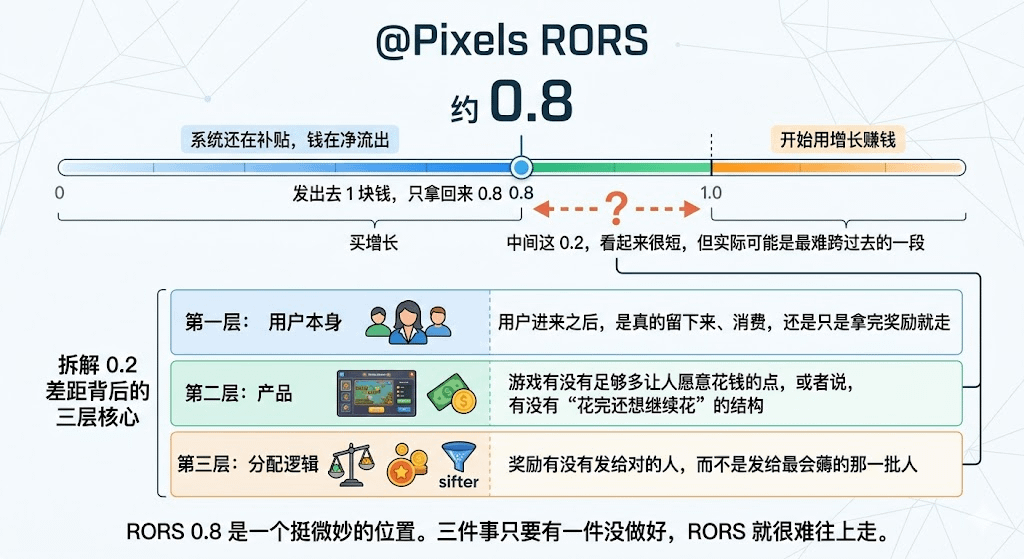
The number it currently provides is around 0.8
If translated in the most straightforward terms, it is:
If you spend 1 yuan, you only get back 0.8 yuan.
This matter itself doesn't look good.
Because it indicates that the system is still subsidizing, with money net flowing out.
But the interesting point is not here.
Interestingly, it's not 0.2, nor is it 0.05, but 0.8.
You can imagine this line as a very realistic boundary:
Below 1, the essence is buying growth;
Only above 1 does it start to approach making money through growth.
This 0.2 in the middle looks very short, but it might actually be the hardest part to cross.
Because if you break it down further, you'll find that this 0.2 is not a single variable.
There are at least three layers of things acting simultaneously behind it:
The first layer is the users themselves.
After users come in, do they really stay and consume, or do they just take the rewards and leave?
The second layer is the product.
Are there enough points in the game that make people willing to spend money, or is there a structure where people want to continue spending after spending?
The third layer is the distribution logic.
Whether the rewards are given to the right people, rather than to those who are best at exploiting.
If any of these three things are not done well, RORS will find it hard to climb.
So from this perspective, 0.8 is actually a rather delicate position.
It indicates one thing:
The model is not completely invalid, but it's far from being self-consistent.
At this point, a typical state of divergence will appear.
There is a group of people who see it this way:
Since it has reached 0.8, it shows the direction is correct; the remaining issue is optimization, and it will eventually reach 1.
Another type of person will be more cautious:
If it's below 1, it indicates that the essence is still subsidizing; as long as the subsidy exists, the risk remains.
Both views actually make sense.
The key lies in which side you believe more.
I personally tend to treat this interval as a gaming zone.
Because between 0 and 1, the market is easiest to tell stories.
When close to 1, the story will turn into one that is about to run smoothly;
But as long as it hasn't truly passed, reality can still bring expectations down at any time.
This state has actually appeared in many industries.
For example, some internet platforms tend to have the most significant valuation fluctuations when nearing breakeven.
Because a slight change in data could switch the market from 'the future is a positive cycle' to 'it's still a burning money logic.'
Pixels now somewhat resembles this stage.
RORS provides a very clear observation point, but it does not provide answers itself.
You can check which way this number goes every day,
But you can't assume that just because it's close to 1, it will definitely exceed 1.
Conversely, if it really stabilizes above 1 one day,
Then the logic will undergo a fundamental change.
By then, rewards will no longer just be a cost,
And it has turned into a budget that can be invested and recovered repeatedly.
But before that, it resembles a line still probing.
So now I view this range from 0.8 to 1.0, I won't take it as a result.
It feels more like observing a system stuck near the critical point.
Taking a step forward, it's another kind of structure;
Staying in place or falling back leads to completely different outcomes.
The space in between is the biggest variable right now.#pixel $PIXEL #广场征文