

Most Web3 gaming projects follow the same pattern. Launch a token, attract players with high rewards, watch the economy inflate, then quietly move on. Pixels has been doing something different for four years, and the proof of that is what they just launched publicly: Stacked.
Stacked started as an internal tool built inside Pixels to solve a problem every Web3 game eventually hits — how do you reward players in a way that actually sustains the economy instead of destroying it? The team spent years figuring this out inside a live game with real money on the line. The Pixels ecosystem has crossed 1 million daily active users and generated over $25 million in revenue. That is not a whitepaper number. That is a real product with real players and a real economy that had to be managed carefully every single day.
What Stacked does is replace the old model of blanket rewards with something smarter. It tracks player behavior in real time through an SDK integration, then uses an AI engine to decide who gets what offer, when, and for how much. The founder Luke Barwikowski described it simply: most reward systems treat every player the same and optimize for the wrong things. Stacked rewards the actions that actually matter — coming back, progressing, spending, contributing to a healthy economy.
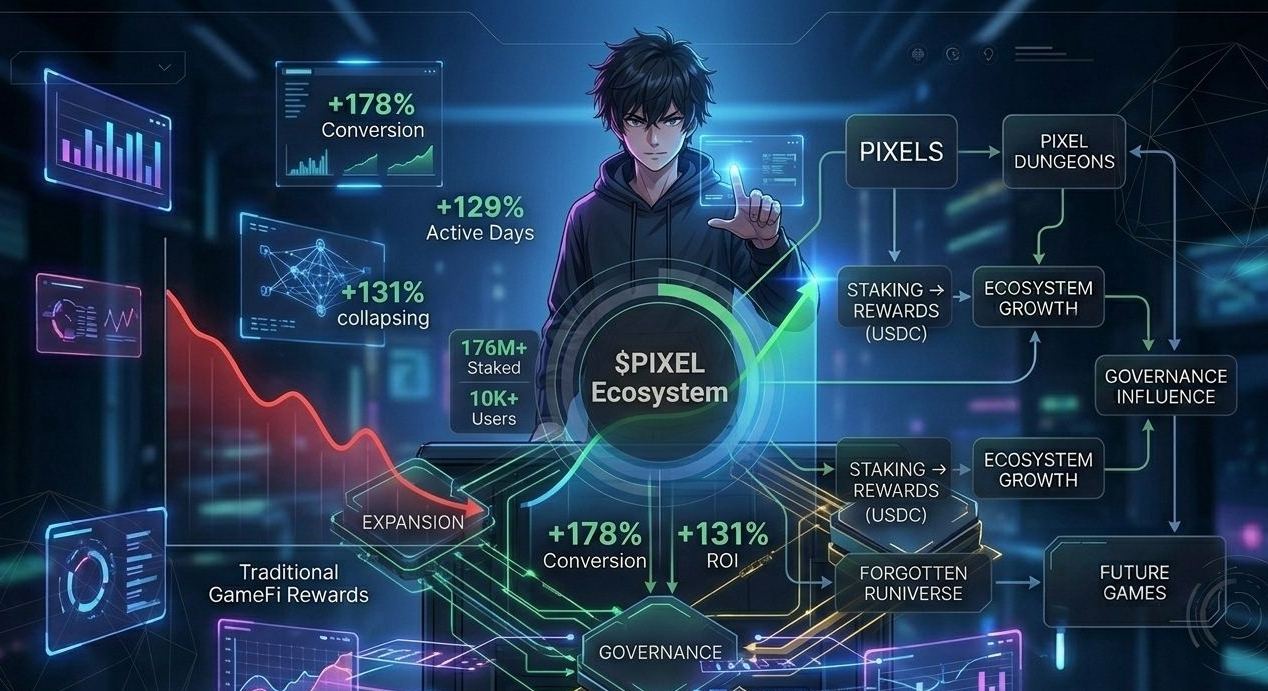
The results from inside Pixels speak for themselves. When the team used Stacked to target veteran players who had not made a purchase in over 30 days, they ran personalized re-engagement campaigns without any manual segmentation. The outcome was a 178% lift in conversion to spend, a 129% increase in active days for those players, and a 131% return on reward spend. These are not projections. This happened inside the live Pixels game before Stacked was ever offered to outside studios.
Now it is open to anyone. Game studios can integrate through a simple SDK and access the same AI-driven offer engine that Pixels has been using internally. Studio operators can query the system using plain language, identify where players are dropping off, find where reward budgets are being wasted, and deploy targeted campaigns without needing a data science team. Stacked is currently live inside the main Pixels game, Pixel Dungeons, and the early access title Chubkins.
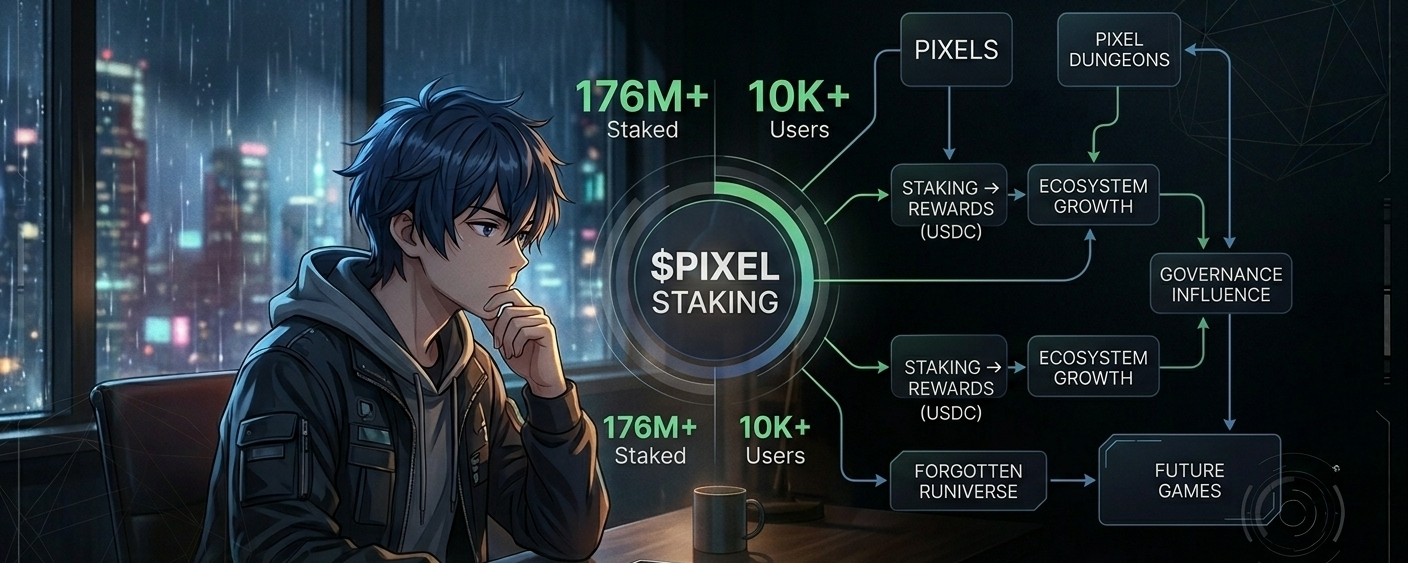
On the $PIXEL token side, the roadmap is also shifting in a meaningful direction. The plan is to gradually move $PIXEL toward a stake-only model. Rewards inside the ecosystem will transition to USDC for players who want straightforward cash value, while $PIXEL becomes the token you hold and stake to participate in governance and ecosystem growth. Staking is already live across three games — Pixels, Pixel Dungeons, and Forgotten Runiverse — with each game offering different APR based on how much $PIXEL has been staked to it and how much of that reward pool the game chooses to share with stakers. Over time, more games will be added, including titles running on chains outside Ronin. Any game that hits a minimum activity threshold will eventually be eligible to join the $PIXEL ecosystem.
The staking architecture itself was built for long-term expansion. It uses a cross-chain interoperability protocol that allows the system to grow beyond Ronin without requiring users to migrate their funds. Over 176 million $PIXEL has already been staked by more than 10,000 users, which is a meaningful signal of community trust in the direction the project is heading.
What makes all of this interesting from a holder perspective is the underlying logic. $PIXEL is not being positioned as a reward token you farm and sell. It is being positioned as the stake that determines which games in the ecosystem get resources, which studios get exposure, and eventually how the community governs the platform. The more the Stacked ecosystem grows — bringing in new game studios, new players, and new revenue — the more central $PIXEL becomes to the whole system.
Pixels took four years to build something that actually works at scale. Stacked is the product of those four years now being offered to the rest of the industry. For anyone holding $PIXEL, that is not a small thing.