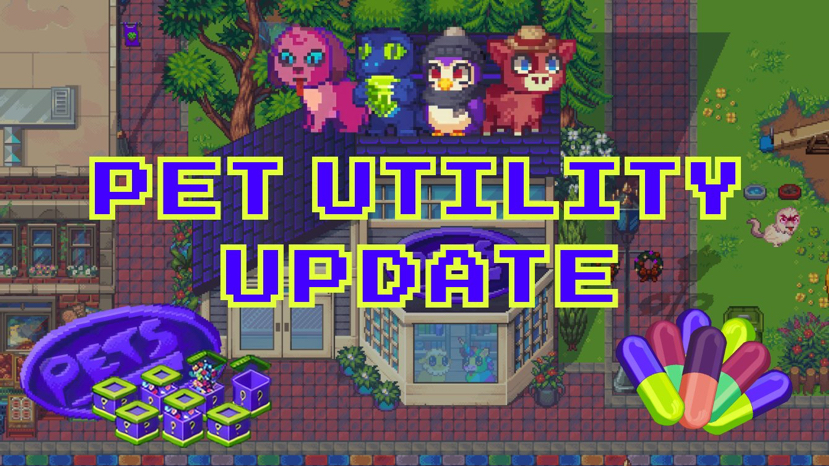
Brothers, these days the market's attention is like short videos, a new meme every three seconds. One moment we're discussing AI, and the next we're chasing other hot coins, and many people have casually swiped away the GameFi section. It's precisely during this time that I've refocused on @Pixels . The reason is simple: in this half-bull, half-bear phase, the most valuable thing is not who can tell a story, but who is still buried in system modifications. There are too many projects shouting slogans, but very few can break down and redo the economic model, shifting the reward method from 'throwing coins at faces' to 'sustainable distribution'.
First, let’s look at the market without beating around the bush. On April 18, CoinGecko reported $PIXEL at $0.008532, with a 24-hour trading volume of about $29.49 million, a daily increase of 2.8%, and a 7-day increase of 24.2%, with the 24-hour range between $0.008007 and $0.009164, and a market cap of about $6.576 million, with a FDV of about $42.64 million. Moreover, in the past 7 days, it has clearly outperformed the broader cryptocurrency market. I don’t want to force this market to be labeled as a 'bottom reversal,' but at least it indicates one thing: the market is beginning to regain trading activity for it, no longer treating it as a mere corpse. For low-priced, low-market-value coins, volume returning is more important than beautiful candlesticks.
But don’t rush to conclusions; tomorrow is the stress test. CoinGecko's unlocking calendar shows that the next unlock for PIXEL is on April 19, with a scale of about 91.18 million coins, accounting for 1.8% of the total supply, worth approximately $778,000 at current prices, allocated to consultants, ecosystem rewards, private placements, the team, and the treasury. The tokenomics also provides close estimates: about 89.37 million coins, approximately 3.4% of the current market value. Why is this data crucial? Because PIXEL is not one of those large coins with tens of billions in market value where unlocking has no visible impact; its market cap is not thick, and the unlocking will amplify the short-term emotional impact. Therefore, this recent price rebound is certainly worth watching, but anyone who directly interprets it as 'the project has completely turned around' is somewhat mistaking rehabilitation training for a sprint.
What truly deserves attention is not 'how the coin price has rebounded,' but what Pixels is actually pushing forward. At the end of March, the team clearly laid out their thoughts in an interview: they have extracted the most challenging aspects of play-to-earn operations, reward attribution, and on-chain economic coordination that they have dealt with in Pixels over the past few years and created a new product called Stacked. More critically, the team plans to gradually shift Pixels towards a stake-only direction, with player rewards transitioning to USDC and Stacked points, the latter of which can be exchanged for gift cards, PayPal dollars, or converted into cryptocurrency for instant withdrawal. If you think about it, this is no longer the traditional old P2E loop of 'playing games—earning project coins—project coins crashing' but rather an attempt to separate the reward layer from a single token and shift the token from a distribution tool to an equity and staking layer. If this action is truly realized, the valuation logic of $PIXEL will gradually shift from 'how many coins are issued today' to 'is there a demand for the entire reward network.'
So now I see @Pixels , and I no longer view it as just a farming game; it resembles an attempt to transform itself from a 'single Web3 game' into 'game reward infrastructure.' According to the direction released so far, Stacked not only supports the core of Pixels but has also covered Pixels, Pixel Dungeons, and Chubkins, with plans to onboard more projects in the future and even support white-label SDKs. To put it bluntly, what Luke wants to do is not just beautify a game patch but to package the economic pitfalls, retention issues, and reward distribution problems that Pixels has faced into tools that others can use. Why have most Web3 games died quickly in recent years? A lack of gameplay is part of it, but the bigger issue is that project teams fundamentally do not know how to operate long-term rewards, ultimately reverting to the most primitive tactic: just distributing more. The most respectable aspect of Pixels now is that it finally acknowledges that this routine does not work and then begins to systematically change.
Looking at the content updates, they are not merely superficial. On April 15, Pixels launched Tier 5. Many people might yawn at this version number, thinking it's just the old news of 'new materials and new formulas.' But this time, Tier 5 is not just about stuffing in new content; it’s more like re-establishing pipelines for high-tier land, production, consumption, and payment efficiency. According to the announcement, Tier 5 brings 105 new formulas, new task board tasks, and a Deconstruction system, and it requires NFT Land to use T5 Slot Deeds to unlock the corresponding Tier 5 space, with these slots being valid for only 30 days and needing renewal fees to maintain. This design essentially strengthens the operational properties of land assets while increasing the time and maintenance costs of high-tier production. The benefit is that high-level production is not a one-time transaction; it will continuously generate resource consumption and behavioral stickiness; the downside is also evident: the efficiency gap between ordinary players and asset-heavy players will continue to widen.
Looking back, the major update to Animal Care in January has already been paving the way for today’s logic. That update was not just about adding a few cute animals but transforming the animal system from 'decorations' to real components participating in daily production cycles: new animal types, feeding and gathering mechanisms, offspring hatching, related industry facilities, over 150 new formulas, and several economic balance adjustments, plus added convenience features for VIP users like HUD direct task boards. If you look at the updates over these months together, you will find that Pixels has not just been changing on a whim; it has been steadily pushing its originally light and casual gameplay towards a more layered, efficient, and resource-flow-dependent system.
The problem lies exactly here. Once a complex economic system is pursued deeply, retention and thresholds are always a pair of brothers pulling each other's hair. If the system is too shallow, players find it uninteresting; if too deep, newcomers may feel overwhelmed. The strength of Pixels over the years has been its ability to tap into the genuinely rare true users and interactions in Web3 games, but its issues have also been apparent: the token price has retraced too sharply from its highs, and the external market has almost developed a conditioned reflex of skepticism towards 'GameFi sustainability.' Therefore, looking at $PIXEL now cannot be done with ordinary token methods. Its most sensitive point now is whether the team can successfully transfer the 'in-game economic pressure' to a 'platform-level reward network' without losing the native token's presence. In short, if Stacked succeeds, it does not necessarily mean PIXEL will succeed automatically; but if Stacked fails, PIXEL will likely struggle to maintain itself.
My attitude towards @Pixels is actually very simple: I'm hesitant to blindly go long, but I definitely don't want to treat it like last year's old corpse. Let's start with the advantages. It's not completely reliant on hype; there have indeed been consistent version updates over the past few months, with Animal Care, Tier 5, and Stacked being connected; its reflection on the old P2E structure is much more honest than many projects still shouting about 'user growth' and 'ecosystem prosperity'; moreover, at this price level, the market's expectations for it have been heavily suppressed, and once a low-expectation project has even a somewhat decent new structure, it can easily see a valuation recovery. The downsides are not to be ignored: the unlocking pressure is still there, with April 19 being a current variable; the valuation narrative for Pixels is in a transition phase, with half of the old logic discarded and the new logic not yet fully recognized by the market, making this phase prone to the situation where 'the project is clearly evolving, but the coin price first educates you'; additionally, the idea of platforming game rewards sounds sophisticated, but in practice, it's very messy—attribution, anti-cheat, retention, settlement, partner integration, and withdrawal experience, none of these are easy.
So my conclusion still stands: professionalism is key, and safety first. Currently, Pixels is worth a second look, but it’s more suitable to focus on structure rather than getting carried away by emotions. In the short term, monitor whether the unlocking pressure is heavy after the release and whether the volume can continue to stay in the market; in the medium term, keep an eye on updates like Tier 5, which are more operationally intensive, to see if they can indeed boost the resource cycle and payment willingness of high-tier players; in the longer term, what one should watch is not how hot the game itself is today, but whether Stacked has the potential to elevate Pixels from 'one project' to 'a layer for reward distribution.' If this path really works, what we see for $PIXEL will not just be a piece of land but a system of bound rights. If it fails, then even if it talks about 'community' and 'ecosystem,' it ultimately returns to the familiar road of old Web3 games.
Personally, I won't hype it up just because of the rebound over the past two days, nor will I directly sentence it to death because of past declines. To put it bluntly, @Pixels is currently interesting precisely because it stands in an awkward yet critical position: everyone is tired of the old GameFi script, and this new script of 'reward networkization, token equity, and continuous content stratification' is one of the few that is genuinely being performed. As for whether it can turn around, let's not rush to call it; first, let's see if it can withstand the unlocking, whether it can truly turn updates into retention, and whether $PIXEL can be more than just a nostalgic coin but one that can be repriced.