

I think the market is still reading Pixels through the wrong frame. Most people look at the chart, see a token that ran hard on narrative and then gave most of it back, and conclude that the story is over or at best waiting for the next catalyst. I disagree with that reading, not because I think price always follows quality, but because I think the thing Pixels built between 2022 and 2026 is genuinely different from what most crypto gaming projects attempted, and the market has not fully priced what that difference means.
The easiest version of the Pixels story is a farming game on Ronin that attracted a lot of daily active users, launched a token, rode the GameFi narrative, and then struggled when emissions outpaced real demand. That version is not wrong but it is incomplete. The more interesting version starts with what the team did after the easy part ended. Instead of chasing a new narrative or launching a second token or pivoting to AI branding, Pixels spent the next phase of its life trying to understand why Web3 game economies kept failing and building something designed to fix the underlying problem rather than paper over it.
That something is Stacked, and I think it is the most serious product decision Pixels has made.
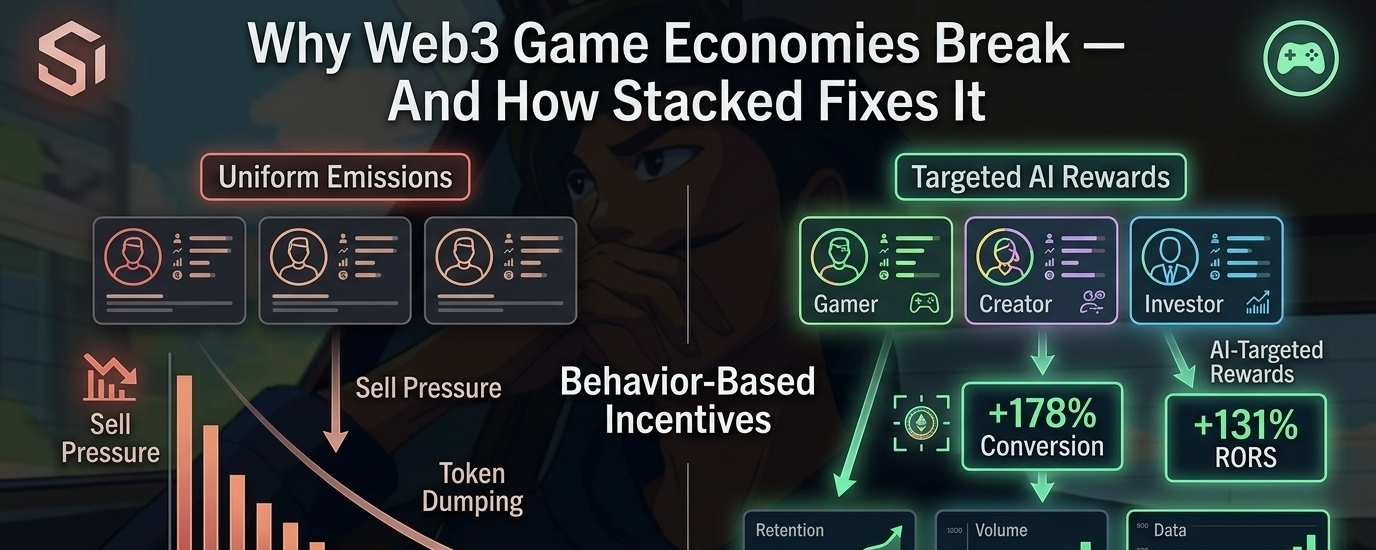
To understand why Stacked matters you have to understand what it is replacing. The standard approach to rewards in Web3 gaming is essentially an emission schedule. The game decides how many tokens to distribute per day, attaches those distributions to activities like completing quests or farming resources, and hopes that enough players find the game fun enough to stick around even as the reward pool dilutes over time. The problem is that this model treats every player identically. A player who farms for eight hours a day to extract maximum tokens and immediately sells them looks exactly the same to a blanket emission system as a player who logs in three times a week, spends tokens on upgrades, brings friends into guilds, and contributes to a growing in-game economy. Both players trigger reward events. Only one of them is actually building the ecosystem.
Pixels lived through the consequences of that design. When token price was rising, it attracted both kinds of players and the distinction did not matter much. When price started falling, the extractors left first and fastest because they had no attachment to the game beyond the yield, while the genuine players stayed but their contributions were increasingly crowded out by the damage the exit wave caused to the economy. That cycle has played out in almost every significant Web3 game and it is not a coincidence. It is a structural problem with how incentives were designed.
Stacked is Pixels' answer to that structural problem. At its core it is an AI-powered rewards platform that tracks player behavior in real time and uses that data to deploy personalized incentives rather than uniform payouts. Instead of asking how much did this player do today, Stacked asks what kind of player is this, what behavior do we want to encourage, and what offer is most likely to convert them toward contributing more value to the ecosystem. The difference sounds subtle but the outcomes are not. When Pixels used Stacked internally to target veteran players who had not made a purchase in over thirty days, the campaign produced a 178 percent lift in conversion to spend and a 131 percent return on reward spend. Those results came without any manual segmentation, without a data science team running analysis, and without changing the underlying game. The targeting engine found the signal in existing player behavior and acted on it.
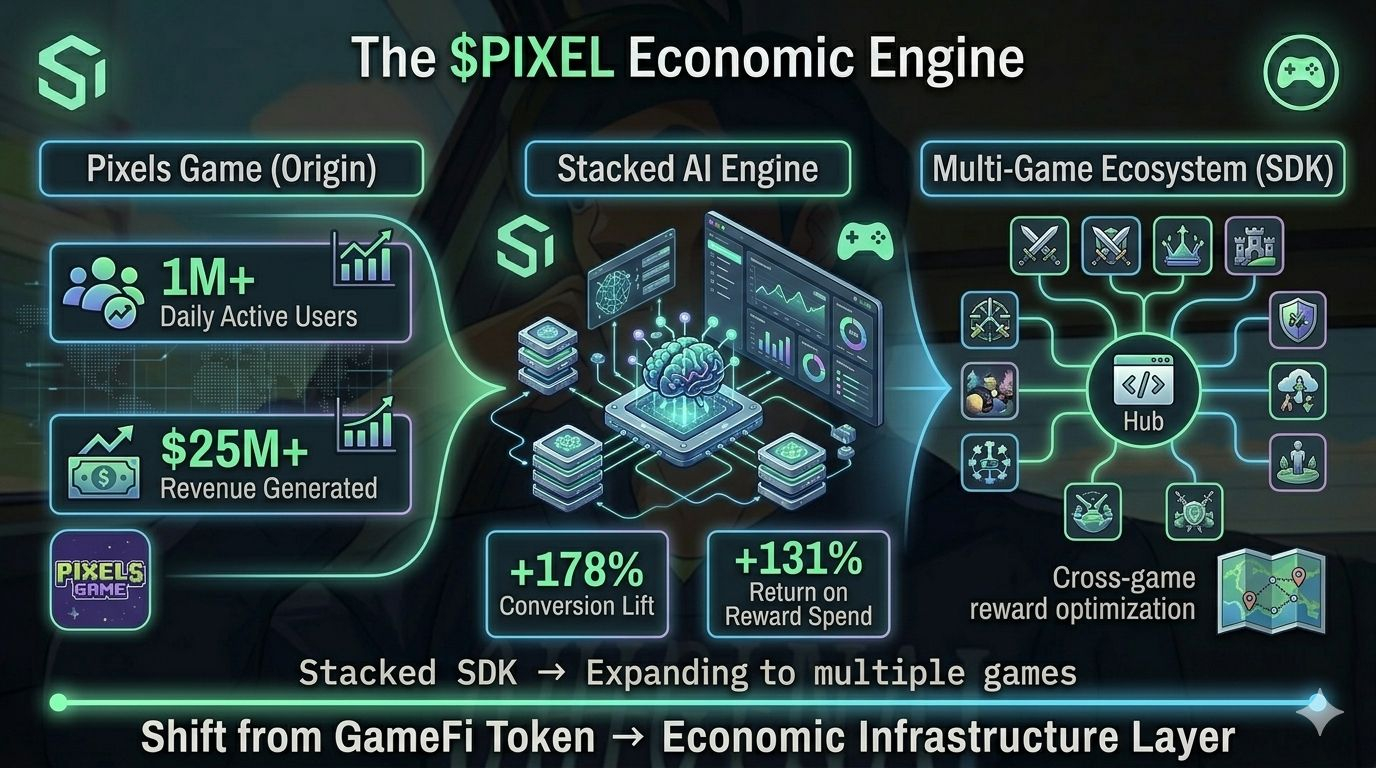
The metric Pixels uses to evaluate all of this is called Return on Reward Spend, or RORS. The idea is simple and I think it is the most honest framework any Web3 gaming team has publicly committed to. RORS asks whether every token distributed as a reward generates at least one dollar back in ecosystem revenue through fees, spending, and retained player value. If the answer is yes, the reward system is sustainable. If the answer is no, the project is slowly liquidating its treasury to pay players who are leaving anyway. Most game economies never asked this question because the answer was too uncomfortable during the growth phase. Pixels is asking it publicly and building infrastructure around making the answer yes.
What makes the Stacked launch in early 2026 more significant than a typical product update is that Pixels opened the platform to outside studios. This is the detail I think the market is underweighting. A team that spent four years solving the hardest operational problem in Web3 gaming, developed a system that measurably works inside a live game with over one million daily active users and more than twenty-five million dollars in generated revenue, and then packaged that system as an SDK that any game studio can integrate is not just running a game anymore. It is building infrastructure. The business model is different. The addressable market is different. The relationship between the platform and the token is different.
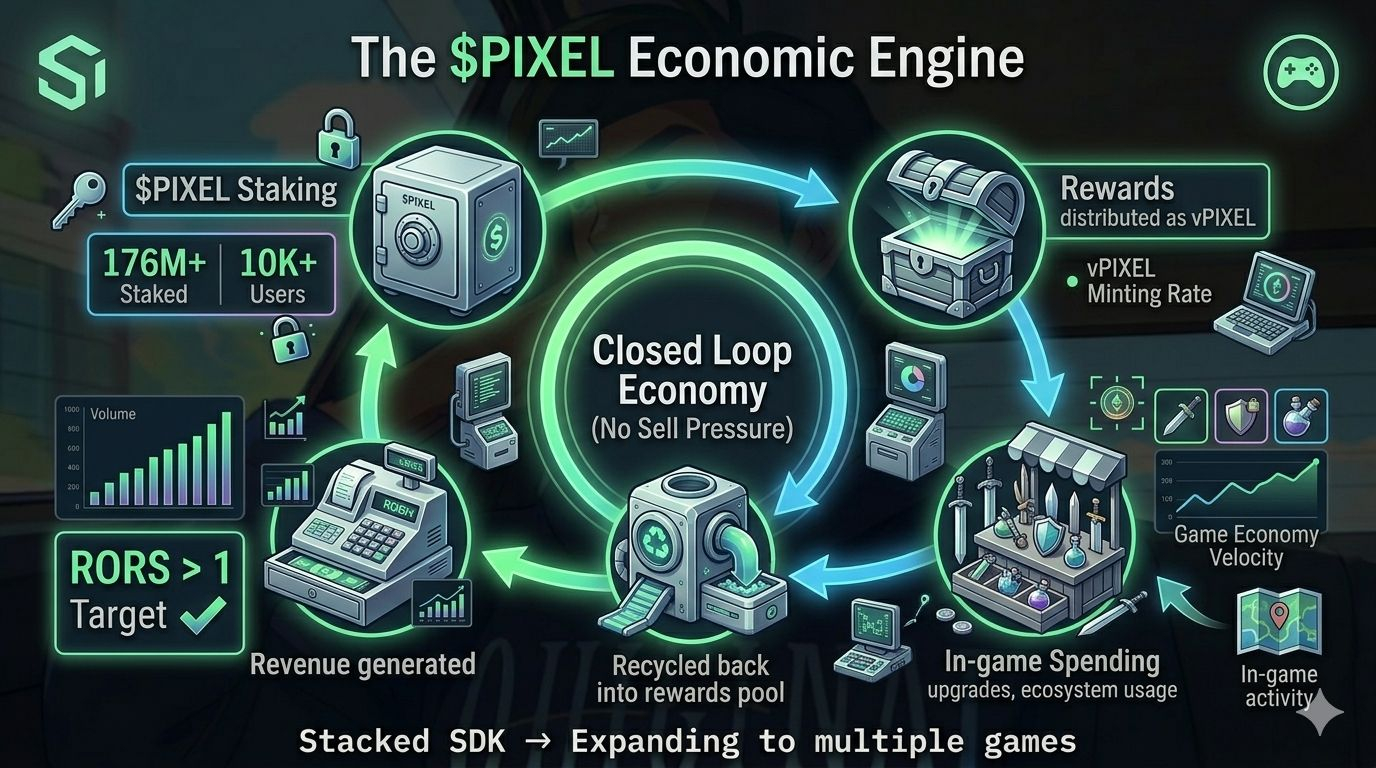
For $PIXEL specifically that last point matters most. The token's role is being repositioned deliberately. The old model had $PIXEL functioning as a premium in-game currency that players earned through activity and sold when they needed liquidity. The new model is moving $PIXEL toward a stake-and-hold asset that sits at the center of ecosystem coordination. Staking is already live across three games including the core Pixels game, Pixel Dungeons, and Forgotten Runiverse. The multi-game staking system lets $PIXEL holders direct ecosystem resources toward games they believe in, effectively turning staking into a market for publishing support. Over 176 million $PIXEL has already been staked by more than ten thousand users, which tells me the community is taking the repositioning seriously even if the broader market has not caught up.
The vPIXEL design is where the economic logic gets most interesting to me. Pixels introduced vPIXEL as a spend-only token backed one to one by $PIXEL, designed to solve a specific problem. When players earn $PIXEL rewards and withdraw them to sell, that selling pressure works against the ecosystem. vPIXEL gives players a way to access reward value without creating that selling pressure because vPIXEL can only be spent inside the ecosystem or restaked. Every time vPIXEL is spent, the backing $PIXEL is recycled back into user acquisition rewards or treasury operations. That is a closed loop rather than a leak, and closing loops is exactly what sustainable game economies need.
I think the bull case for Pixels is stronger than the market gave it credit for a year ago but I also think the risk is more serious than simple execution risk. The harder challenge is whether Stacked can convince outside studios that targeted rewards are worth the integration cost, whether the $PIXEL staking model can stay credible as more games enter the ecosystem, and whether the core game can keep retaining players on its own fun-first merits without relying on reward inflation to mask declining engagement. All three of those things have to work together for the long-term thesis to hold.
My practical view is that I would not evaluate Pixels primarily on price or even on token staking numbers right now. I would watch three things. First, whether daily active spenders inside the core game are growing or shrinking, because that number tells you whether the game loop is actually improving independent of rewards. Second, whether Stacked attracts meaningful outside studio adoption in the next two quarters, because that is the test of whether the infrastructure thesis is real or just a rebranding of internal tooling. Third, whether the RORS number stays above one across the main reward surfaces, because that is the only metric that proves the economic redesign is working rather than just sounding better than the old model.
The reason I find Pixels genuinely interesting in 2026 is not that I think a farming game on Ronin is going to dominate crypto markets. It is that the team identified a real problem, lived with the consequences of that problem long enough to understand it deeply, built something designed to fix it from the inside, and is now testing whether that fix can scale beyond their own ecosystem. That is a harder and more honest path than most projects in this space have chosen. Whether it works depends on execution, not narrative. And that is exactly why I would rather watch the spending data than the price chart.
@Pixels #pixel #PİXEL #web3gaming #GameFi #Ronin #BinanceSquare