Brothers, the market has been quite interesting these past few days. On one side, some people are shouting, 'The blockchain games are doomed,' while on the other side, some are secretly revisiting Pixels. The reason is not complicated. Today is April 19th, and the market is already reflecting unlocking expectations. The price is just crashing down, and the easiest way to generate buzz in the plaza is simply to say: 'It's over.' But I actually think that if you view Pixels as just a simple blockchain game token chart, you're really missing the point. Because the focus of Pixels now is no longer whether 'this game can become popular again,' but whether it can turn the systems of staking, consumption, reputation, Guild, VIP, and pets—scattered like a Mahjong table—into a self-sustaining economic layer. Today, PIXEL is around $0.0076, with a 24-hour trading volume of about $17.6 million, and a daily drop of around 13%. The sentiment is indeed not very good; however, the official homepage also straightforwardly presents 'Pixel Economy': earning rewards through staking, enhancing gameplay, and shaping the ecosystem together. You might say it tells a story, but at least what it's telling now is not the old cliché of 'play to earn.'
Let me throw my conclusion out first: I currently view Pixels not just as a pure chain game, nor just as a pure token. I prefer to see it as a 'game distribution system' that has been repeatedly experimenting on Ronin, and PIXEL staking is the most crucial master switch in this system. The official white paper states very clearly that it wants to turn 'the game itself' into a validator: you are not voting for an abstract public chain, but are using $PIXEL to choose which games, which project pools, and which gameplay should receive more ecological resources. Those who retain high retention, have strong net consumption, and better utilize ecological tools will have rewards directed towards them. In simple terms, what Pixels wants to do is not 'one game issues one token', but 'one token selects the games worth nurturing'. Once this logic is established, the valuation of PIXEL will not only depend on the popularity of the main game but also on whether it has the ability to bring in external projects, internal mini-games, and user consumption.
So why do I keep saying that the most worthy aspect to focus on in this round of Pixels is not the APR on the surface but rather 'how selling pressure is handled'? Many projects' staking, to put it bluntly, is to first suppress the circulating supply and then use annualized rates to entice people; once rewards are issued, the market continues to take the hit. Pixels at least has designed a layer of buffer in its mechanism. It has included a concept of $vPIXEL in its white paper: when rewards are claimed, players can choose to withdraw tradable PIXEL but must pay a Farmer Fee; or they can withdraw a 1:1 backed, but cannot freely sell on CEX/DEX $vPIXEL, which means you don't pay the fee but can only continue to spend within the ecosystem or stake more. This design translates to: if you want to cash out, you can, but you need to pay a toll; if you want to stay and continue playing, I’ll give you a more convenient internal currency. It does not guarantee the price will rise, but at least it tries to make 'receiving rewards = immediately dumping' not so smooth.
More importantly, this Farmer Fee is not a random tax; it is tightly bound to Reputation. The official FAQ states clearly that the higher the reputation, the lower the fee rate; currently, different tiers range from about 29%-49%, 10%-19%, 8%-9% to 5%-6%, and these fees are 100% returned to the ecosystem's staking reward pool. Hidden within this is actually the most interesting aspect of Pixels right now: it does not only reward 'big players,' but it rewards 'players who are more like normal players'. If your reputation is high, it indicates you are more like a long-term participant; if you participate long-term, the friction of withdrawing tokens is lower; and if your ongoing costs are lower, it will reinforce your motivation to continue completing tasks, consuming, and trading. The benefit is that the project finally starts to distinguish between real players and pure 'wool addresses'; the downside is also very real — new users, if they lack patience, may easily feel that the threshold is high, because they are not just playing a farm, but a system that is half game, half finance, and half risk control.
This is also why I have always felt that many people underestimate the systems of Guild, VIP, and pets in @Pixels ; they may seem scattered, but they are actually all helping to support the staking ecosystem. Guild Shards are not ordinary group badges; the official statement is very clear that they are essentially your supportive assets for a certain guild, and can only be pledged to one guild; the price is not decided randomly, but increases according to the bonding curve — the first shard costs 1 $PIXEL, and for each additional member, the price increases by 1. Then look at VIP; the official statement now is that it is worth about 10 dollars in $PIXEL per month, giving you extra backpacks, reputation points, energy, more tasks on the taskboard, and market listing positions. Plus, pets can provide extra storage and expand interaction radius. In reality, what Pixels is doing is quite cunning: the more you participate deeply, the more you'll feel that 'the PIXEL in my hands is not for selling, but for exchanging efficiency, identity, and convenience'. The real support for the token price in chain games has never been slogans but rather these small scenarios that make people 'reluctant to sell'.
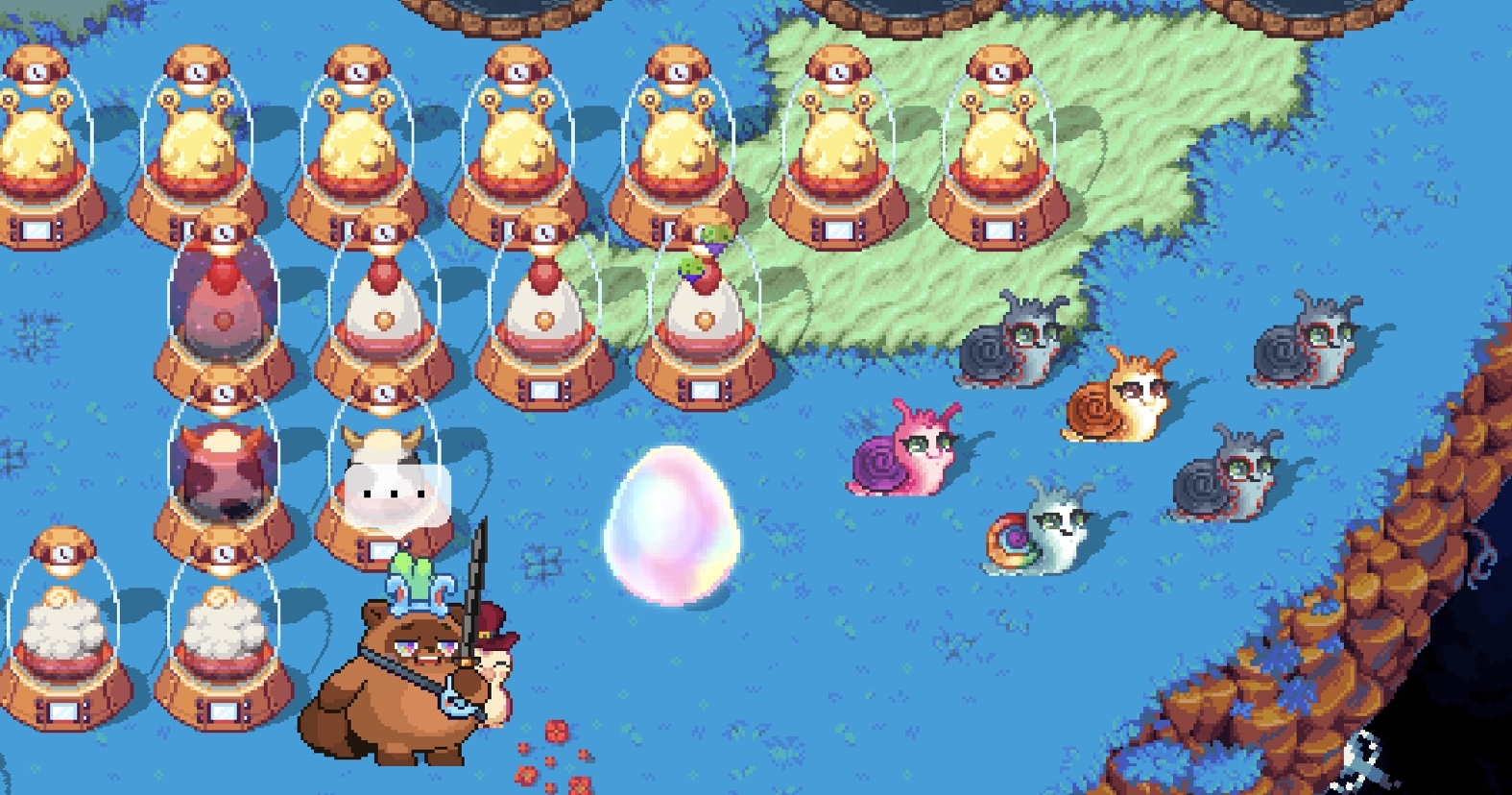
Looking deeper, Pixels has not concentrated all its output on one main farm image. The official homepage displays 'Chapter 2', 'Pets Have Arrived', and 'Updates Every Two Weeks', and in the help center, you can also see gameplay like Pixel Dungeons, which can be played in two minutes and can directly earn PIXEL. Many people may feel that these mini-games are not grand enough, but I actually think this is key to its survival. Because a single farming loop is most afraid of fatigue; players may verbally express their love for pastoral life, but their bodies are very honest; if there are no new and exciting things in three days, they want to escape. Gameplay like Dungeons, which is short, can be PvP, can be looted, and can pay a small entrance fee to increase rewards, is essentially adding new emotional consumption scenarios for $PIXEL. It is not about stuffing tokens into players' hands but rather slicing players' attention throughout the day into more segments that can be charged, diverted, and retained.
Of course, no matter how elaborate the mechanisms are, if the market can't withstand it, it won't give you much patience. The fact that today's PIXEL line looks bad is true; the third-party unlocking tracking page has indeed marked April 19 as the next unlocking node. This position is most prone to two extreme emotions: one is 'it's already dropped this much, buy the dip and wait for recovery'; the other is 'the unlocking isn't finished, don't touch it.' Personally, I lean a bit more towards the middle. Because the most awkward yet most real aspect of Pixels is here: it does not lack products, nor does it lack mechanisms; the problem is that these things are currently still not enough to form an overwhelming, sustained buying expectation. The official homepage states over 10 million players; this number is fine for branding, but the trading market looks at another matter: the market does not reward 'many people have come before', it only rewards 'whether these people are willing to continue spending money today, stay, and continue locking rewards back into the system'.
If you ask me, the real advantages of the staking ecosystem in @Pixels are: first, it is finally seriously addressing selling pressure, rather than pretending it doesn't exist; second, it is transforming in-game identities into economic variables; the Guild, VIP, pet, and reputation systems combined together can be summarized as: the more one resembles an ecological resident, the more qualified one is to enjoy lower friction and higher efficiency; third, its ambition goes beyond just one main game; the white paper states very clearly that different games will compete for staking resources, and good projects can receive more distribution and incentives, which is essentially creating an ecological distribution layer.
But I must also lay out the drawbacks; otherwise, it would just be promotional writing. First, the system is becoming increasingly complex, and the understanding cost for newcomers is rising. Second, its approach to filtering 'high-quality players' is correct, but it may sacrifice some extensive growth. Third, the market remains very fragile; if you look at its price and volume structure today, you can see that the market's current valuation of it is still closer to 'a weak asset with a product' rather than 'a strong ecological token that has escaped the death spiral'. To put it bluntly, people still don’t fully believe this system can truly thicken internal consumption.
So my attitude is very simple: I won't condemn @Pixels to death just because of a negative line today, nor will I blindly support it just because its mechanism is well-written. The current Pixels is no longer a project that can survive just by relying on 'farming + airdrop nostalgia'; it is moving towards being more like a platform, more like a distribution layer, and more like a behavioral finance laboratory. Once this direction is running smoothly, the value of the $PIXEL staking ecosystem will be repriced, because it is no longer just a reward pool, but an entire system for controlling selling pressure, guiding consumption, filtering users, and supporting new games; but if it doesn't run smoothly, the market will also be very cruel, directly treating it as a 'complex but poorly executed old chain game'. My conclusion for survival is: it can be observed, it can be studied, and it can even be put on the watchlist, but don't automatically translate 'mechanism upgrade' into 'price will reverse immediately'. In this market where liquidity is not abundant, any chain game token must first prove one thing — it's not that it will issue rewards, but that it can prevent rewards from quickly turning into sell orders. #pixel #BTC #ETH