

Main Takeaways
API keys can grant powerful account access without triggering login alerts, making them targets by scammers today.
Scammers exploit trust through social engineering, hoping to steal API keys from unsuspecting users, be it via screen share or through a malicious third party tool.
Hence, strong API key hygiene is critical. Never share your API keys, disable withdrawals, whitelist IP addresses, create keys privately, regularly review and delete unused keys, and use a separate key for each service.
Imagine this scenario: a message comes in from someone who seems to know their way around crypto. They reference real market trends, speak with confidence, and offer to run an automated trading strategy for you – completely free. Friendly, patient, and professional, they quickly earn your trust.
However, hours later, your account is empty – not because your login was compromised, but because you unknowingly handed over access through an API key.
What is an API Key?
API stands for Application Programming Interface, allowing apps to access your account automatically, without you needing to log in manually each time. It’s like giving someone a remote control to your account. They don’t need your password – they can execute actions directly, as long as the permissions allow it. While it’s designed for convenience, this access is more than enough to cause harm in the wrong hands.
Using API keys to access your account does not trigger typical login alerts, making them especially dangerous. There are no obvious warnings, no suspicious login history, and no immediate signs of intrusion, as the system simply treats the activity as an owner authorized action from an application. As a result, scammers can carry out harmful actions without your knowledge.
What Can an API Key Actually Do?
When you create an API key for your Binance account, you choose what permissions it has, which commonly includes the following.
Reading: Allows apps to view your balances and trade history, which may seem harmless but exposes valuable information that attackers can use to plan targeted exploits.
Trading: Enables apps to place and cancel orders on your behalf, which can be abused to execute unauthorized trades, manipulate prices, or drain your portfolio.
Withdrawals: This the most dangerous permission, as it allows funds to be sent to external wallets, giving attackers direct and irreversible access to move your assets out of your account.
How the API Key Scam Works
Here’s the full playbook of how the API key scam can silently drain your account.
Building trust
A “quant trading expert” reaches out via social media, messaging apps, or even within a CEX platform. They sound credible, referencing real market trends and insights, and may even make accurate market predictions. This perceived “track record,” combined with their patient approach, engineers trust over time.
Adding credibility
To appear even more legitimate, they introduce additional “team members,” such as an assistant or senior manager to create the impression of a structured and professional operation.
The guided setup to downfall
They claim you can replicate their success through a simple setup and offer to guide you via a screen-sharing video call that feels like friendly, legitimate help. During this process, they walk you through creating a Binance API key while watching your screen, capturing the key the moment it appears.
Third-party tools
In some cases, they may encourage you to install a third-party “trading platform” or “strategy tool.” These apps can capture your API credentials or prompt you to grant account permissions without fully understanding what you’re approving.
The silent drain
Once they have your API key, they no longer need your password or two-factor authentication. Using the granted permissions, they can quickly execute transactions and drain your account, often within minutes.
Spot the Red Flags
Remember, your API key is effectively a master key to your account. Never share it with anyone – including “traders,” “helpers,” or anyone claiming to represent Binance. Binance will never ask for your API key, and no legitimate service requires it. If someone does, walk away immediately. Here are key red flags to watch for:
A stranger proactively offers to “manage” or automate your trading
Multiple unverified “team members” are introduced
You are invited to a screen-sharing call to “assist with setup”
You are asked to create and share a Binance API key
You are prompted to install an unfamiliar third-party app or tool
There is a sense of urgency, with pressure to act quickly due to “market movements”
Promises sounds too good to be true, such as “guaranteed profits” or “risk-free returns”
If You Think You’ve Been Targeted by the API Key Scam
If you think you’ve been targeted by an API key scam, act immediately and follow the steps below to secure your account.
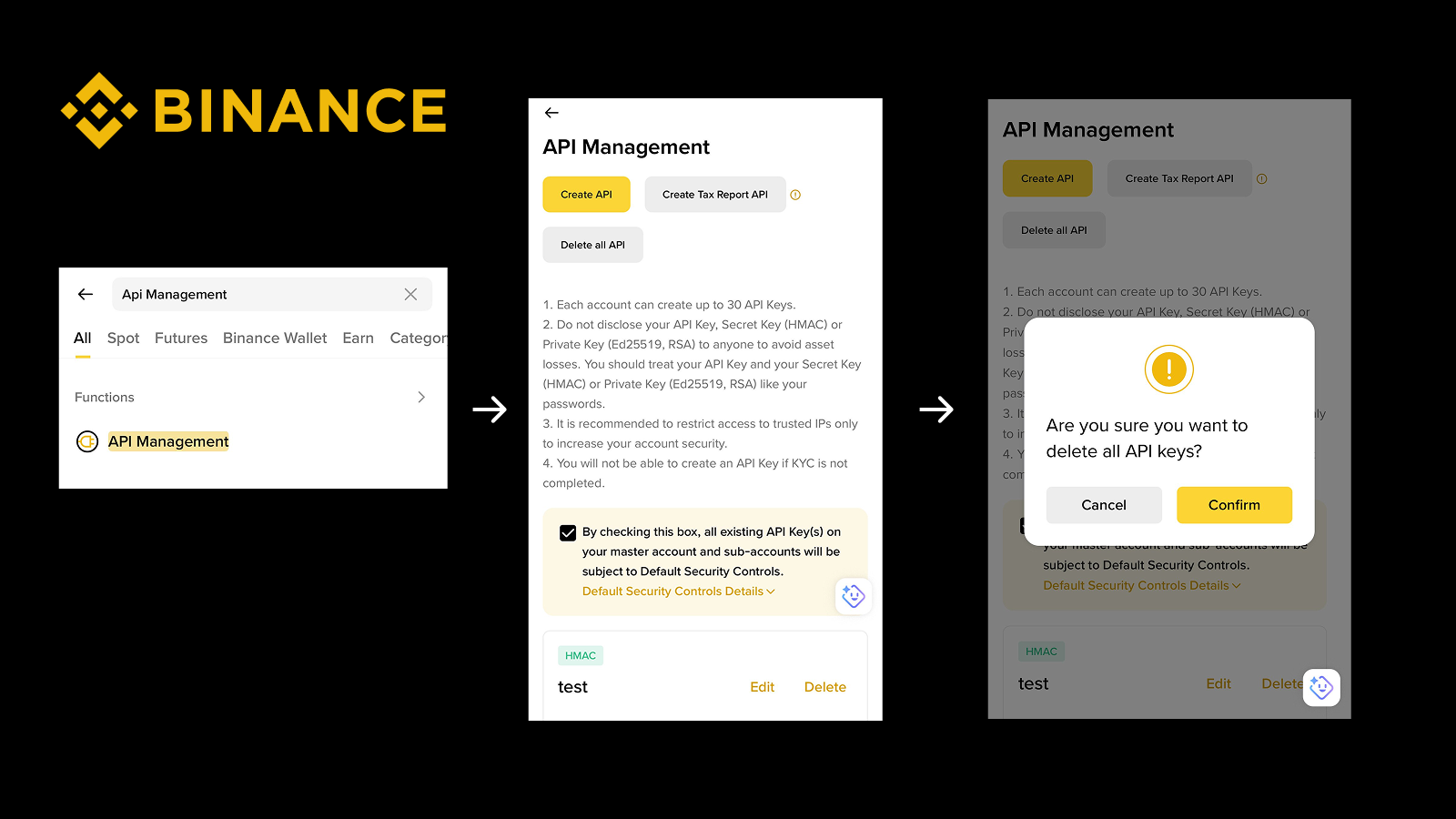
Delete the API key now by logging into your Binance app and typing API Management in the search bar → [Delete all API] → [Confirm]. Alternatively, click here to change it on Binance Web.
Check your withdrawal whitelist and review recent withdrawal history.
Change your password and review your 2FA settings
Contact Binance Support through our official app (available on Apple App Store or Google Play Store) or binance.com
Report the scam to your local cybercrime authority
The API Key Safety Checklist
API keys are a useful feature when used correctly with trusted trading tools or bots. To stay safe, follow these guidelines:
Disable withdrawals unless you have a clear reason to enable them, and a trusted and secure way to do so
Whitelist IP addresses to restrict access to approved devices only
Never create API keys during a screen-sharing session; always do it privately on a secure device
Regularly review and delete unused API keys
Use one API key per service and avoid reusing keys across multiple applications
Final Thoughts
Scammers are getting smarter. They study real markets, build genuine rapport, and know exactly how to make you feel like you’re in safe hands. Outsmart them by remembering this simple rule: no legitimate person or service should ever ask for your keys. Not your house key, and definitely not your API key. Sometimes, they may not ask directly. If anything feels off or you spot a red flag, walk away immediately.
The more informed you are, the faster you will spot red flags and stop an attack before it becomes a loss. If you have encountered a scam or anything suspicious, report it through our official Binance support. For practical guidance and the latest best practices, read our security blogs and stay safe series.
Further Reading
Account Security, 2026 Edition – Early Alerts, Simple Setups, and Scam Awareness to Protect Your Binance Account
Binance Wallet Security Center – Designed to Identify, Assess, and Manage Potential Threats Across DeFi
What Is Smishing? How to Protect Your Binance Account With an Anti-Phishing Code