
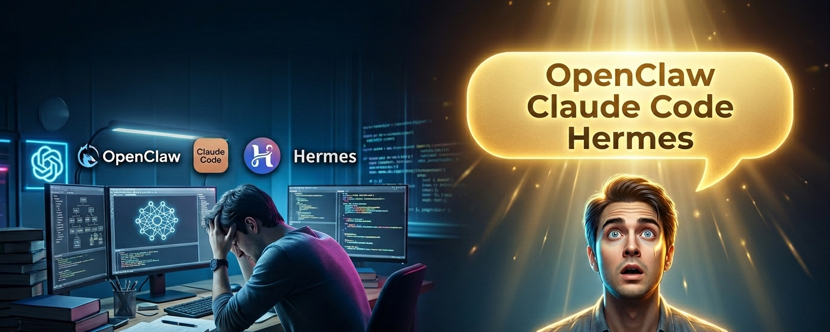
Started tinkering with OpenClaw in February this year.
Although I have been in the Web3 and AI industry for many years and have been closely following the development of AI Agents in 2024, it is only now that I truly understand the value of Agent's birth.
I have always been curious about new things and am accustomed to deeply studying the logic behind a product. So during the time I have been using OpenClaw, I often find myself not just completing tasks but researching why it works the way it does. I carefully read through each session and constantly validate it against my past experiences and knowledge. The result is that a task that could have been completed faster ended up taking me more time.
Later, Claude Code became popular, so I studied Claude Code; Hermes became popular, and I studied Hermes again. Along with other Agent products, I gradually became an AI Agent experience officer: constantly comparing, deconstructing, and recording their differences, assessing whose path is more reasonable and whose design is more advanced. Looking back now, I was more like a user of the product, rather than completing tasks.
Until today, I was chatting with an AI enthusiast. She has no background in the AI industry, but she told me that she finds Hermes more user-friendly than OpenClaw. I asked her why, initially wanting to validate my understanding of the product. Her answer instead enlightened me.
She said that Hermes requires almost no training, is easy to get started with, and has good memory function and automatic evolution. She doesn't like to research too much and only cares about one question: which tool is more user-friendly, which tool can help her complete tasks more easily, which is valuable. Her standard for using Agents is very straightforward - it's about turning herself into a 'waste material', with everything oriented towards task results.
In that moment, I suddenly realized:
Isn't the role of Agents just to make people lazier?
We are users, not developers.
There is no need to delve into the operating principles every time, nor to constantly examine and differentiate all products. What truly matters is whether it can help you complete tasks in a simpler and more efficient way.
In the AI era, knowledge itself will become increasingly cheap.
What is truly scarce, on the contrary, is the ability to think, create, and mobilize knowledge to solve problems.
What drives the continuous progress of AI is precisely this lazy demand; after all, this is almost a fundamental driving force behind the evolution of human civilization and commercial development.