

AAVE is navigating one of its most turbulent weeks in recent memory. On April 18, attackers exploited KelpDAO's rsETH bridge, depositing stolen tokens as collateral on Aave V3 to borrow roughly $196 million in wrapped ether, leaving the protocol carrying bad debt it did not generate.
Aave has lost $8.45 billion in deposits over 48 hours, and AAVE is currently trading near $96, having shed between 14–18% from pre-incident levels.
The damage is real, but so is the signal emerging from the chart.
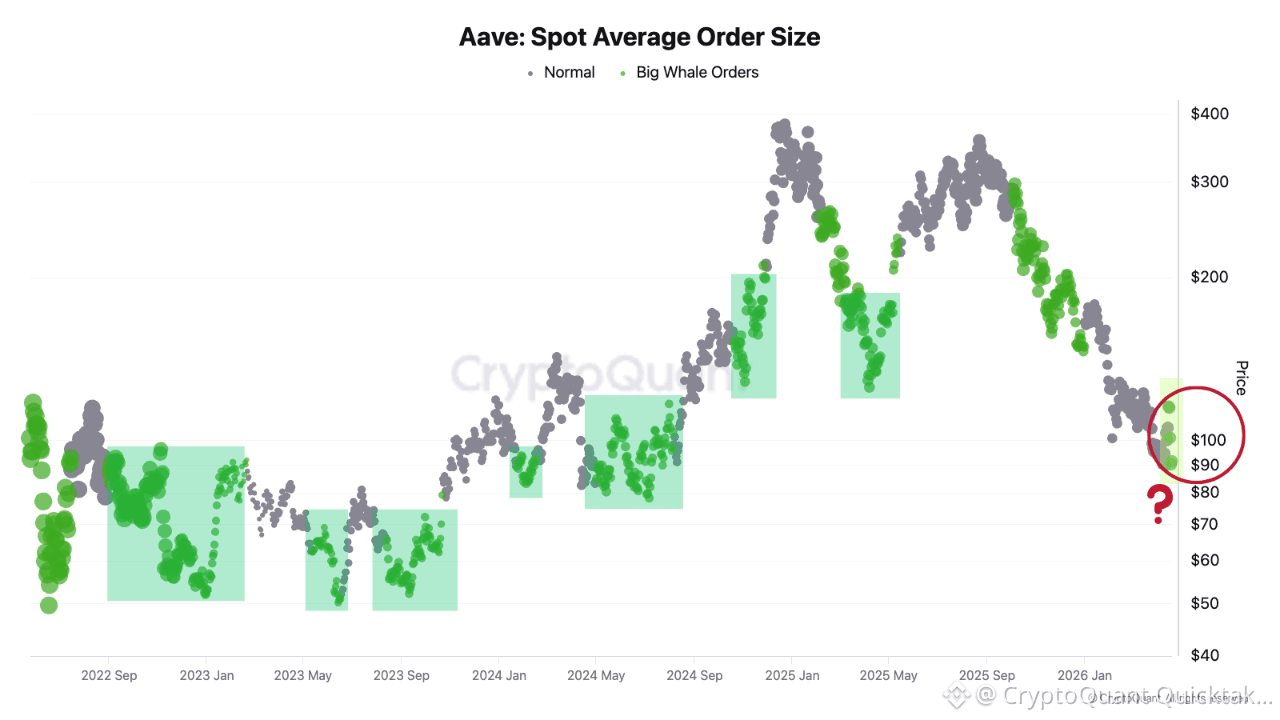
Aave's Spot Average Order Size tracks the average size of executed spot trades, dividing total volume by trade count. Elevated readings in the "Big Whale Orders" category indicate outsized participation from deep-pocketed buyers, investors who don't react to noise, but position through it.
Since late 2022, every major cluster of elevated whale spot orders has coincided with a local or market-wide bottom in AAVE's price. These highlighted zones, recurring across the 2022 bear lows, the mid-2023 consolidations, the 2024 corrections, and again in early 2025, did not guarantee an immediate reversal, but they consistently marked zones where asymmetric risk/reward setups emerged.
Right now, with AAVE trading in the $90–$100 range and fear metrics near their highest readings since the 2022 bear market, whale order size is spiking again, annotated with a "?" on the chart because the outcome is still open.
Historically, this is precisely when the smart money has acted. The pattern doesn't guarantee a bottom, but it demands attention.
What to Watch:
Resolution of the Umbrella reserve coverage for the ~$196M deficit, and whether whale order size remains elevated into the $85–$95 range. A sustained cluster here would mirror every prior accumulation window.
Written by MorenoDV_