The DeFi space just got a harsh reminder: risk doesn’t disappear — it moves fast.
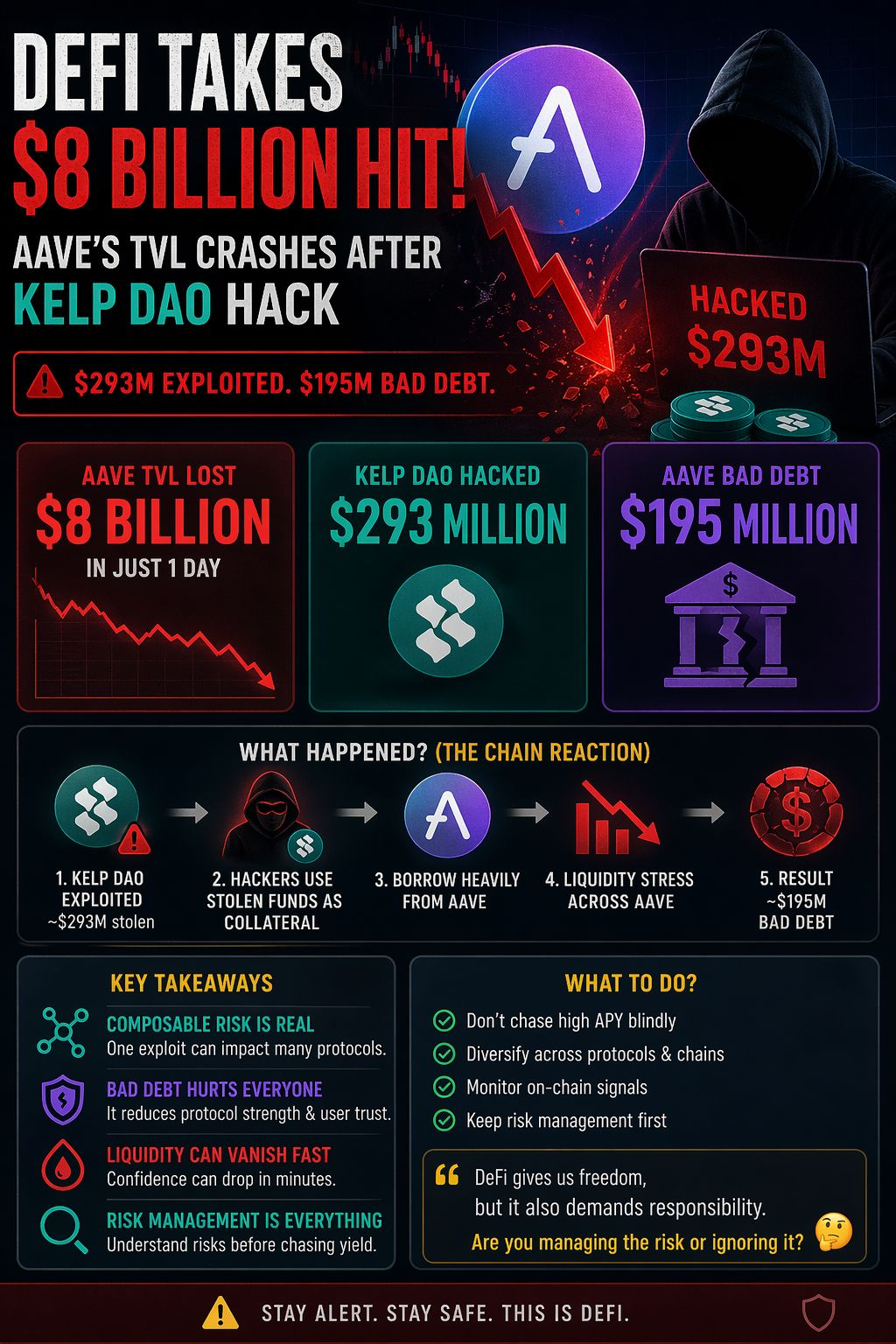
In the last 24 hours, Aave saw its Total Value Locked drop by nearly $8 billion. This wasn’t just market noise. It was triggered by a serious exploit involving Kelp DAO, where hackers drained around $293 million.
But what made things worse?
The attackers didn’t stop at the exploit. They leveraged Aave itself, borrowing against the stolen assets — creating a ripple effect across the system.
🚨 What Actually Happened
Let’s break it down in simple terms:
🔓 Kelp DAO gets exploited → ~$293M stolen
💸 Hackers use stolen funds as collateral
🏦 They borrow heavily from Aave
📉 Aave faces liquidity stress + forced reactions
⚠️ Result: ~$195M in bad debt
This isn’t just a hack. It’s a chain reaction inside DeFi.
📊 Why This Matters (Beyond the Headlines)
Aave is one of the most respected lending protocols in crypto. When something like this happens, it exposes deeper structural risks:
1. Composable Risk is Real
DeFi protocols are connected.
One exploit in a smaller protocol can:
Spread into lending markets
Impact liquidity
Create systemic stress
👉 This is the downside of DeFi’s “money lego” design.
2. Bad Debt is a Silent Killer
Bad debt means:
Borrowed funds are no longer fully recoverable
Protocol reserves take the hit
Confidence gets shaken
Even strong protocols aren’t immune.
3. Liquidity Can Vanish Fast
$8B TVL drop isn’t random.
It shows:
Large players pulled funds quickly
Risk-off behavior kicked in
Trust temporarily declined
DeFi moves at internet speed.
🧠 Lessons Every Investor Should Take
I’ve seen cycles like this before — and the pattern is always the same.
Here’s what actually matters:
✔️ Don’t Chase Yield Blindly
High APY often comes with:
Smart contract risk
Dependency risk
Liquidity risk
If you don’t understand where yield comes from, you are the risk.
✔️ Diversify Across Protocols
Never park all capital in one ecosystem.
Spread exposure across:
Lending
Staking
Layer 1s
Stable assets
✔️ Monitor On-Chain Signals
Before major events, signs are usually there:
Sudden liquidity shifts
Unusual borrowing spikes
Smart contract interactions
Smart money watches data — not just price.
✔️ Accept That DeFi is Still Experimental
Even top protocols can:
Face exploits indirectly
Take unexpected losses
Experience liquidity shocks
This is not TradFi. Risk management is your responsibility.
⚖️ Is This a Black Swan or a Warning?
In my view, this isn’t a one-off event.
It’s a stress test.
DeFi is evolving, but events like this show:
Security still lags innovation
Interconnected systems amplify damage
Risk is often underestimated
At the same time, strong protocols usually adapt, recover, and improve after events like this.
🔍 What I’m Watching Next
Will Aave cover the bad debt smoothly?
Does liquidity return or stay cautious?
Are other protocols exposed to similar risks?
These answers will define short-term sentiment.
💬 Final Thought
DeFi gives us freedom — but it also demands responsibility.
The question isn’t “Is DeFi risky?”
The real question is:
Are you managing that risk — or ignoring it? 🤔
#defi #AAVE #CryptoRisk #Web3 #BinanceSquare