

"In the crypto world, the most dangerous thing is not losing money, but thinking you understand when you actually don't understand anything."
1. First, pour a bucket of cold water: don't be fooled by 'one million DAU'
Let's state the conclusion first, then explain why.
The Pixels project, if you jumped in during the TGE in February 2024, you are likely still enjoying the breeze at the peak now. Binance Launchpool 7% share, private placement round 14% share, team 12.5% share—behind these numbers is a linear unlocking mechanism lasting 60 months. As of April 2026, the total supply of 5 billion PIXEL, with a circulating supply of only about 771 million, accounting for 15.42%. FDV is about $35 million, and the circulating market value is about $26 million.
What does this mean? What you bought is not a coin, but a futures contract.
As an old player who has experienced Axie Infinity rising from 0.1 USD to 160 USD and then falling back to 5 USD, I have an instinctive caution towards this "long-term unlocking + high FDV" combination. The scar from the 625 million USD theft that Sky Mavis (the parent company of Ronin) suffered is still fresh, and now Pixels is on the same boat. You call this "ecological synergy"; I call it single point failure risk—if Ronin encounters another mishap, Pixels won't even have a place to escape.
But again, if this project is really that bad, how can it surge 193% in a single day in March 2026?
This is what I want to talk about—Pixels is no longer the Pixels you think it is.
Two, from "farming games" to "data-driven publishing platforms": Chapter 2 is a genetic mutation.
Before 2024, Pixels is essentially a Web3 version of Stardew Valley—planting Popberry, chopping wood, completing tasks, and exchanging BERRY (which later changed to PIXEL). Is it fun? It's okay. Can it make money? It could in the early days, but later it became as competitive as food delivery.
But Chapter 2, from the end of 2025 to the beginning of 2026, completely changed the DNA of this project.
The team did something that many GameFi projects wouldn't even dare to think of: they admitted that their previous economic model was wrong.
It's not about patching things up; it's about starting over.
The core transformations of Chapter 2 can be summarized in three points, each of which deserves to be discussed separately:
1. RORS metric: turning "Play-to-Earn" into "Play-to-Not-Die."
RORS, Return on Reward Spend, the return rate of reward expenditure. The team publicly declared that the target is greater than 1.0—that is, for every 1 USD of token rewards issued, the ecosystem must generate more than 1 USD in transaction fee income.
This sounds like a true cliché, but in the GameFi field, there are no more than five projects that dare to write this phrase into their white papers and publicly track it.
How do most P2E projects die? Infinite money printing, player arbitrage, tokens going to zero, games becoming ghost servers. Pixels' solution is not to "issue fewer coins" as a trick, but to link token issuance with actual economic output. The orders on your task board are essentially creating transaction fees for the ecosystem; the PIXEL you stake is voting for the quality of other games.
This is not a game; it is an economic experiment wrapped in a game.
2. $vPIXEL: a "phantom token that can only be spent and not sold."
This is the operation I find most impressive.
Directly withdrawing PIXEL incurs a "farmer tax" (Farmer Fee) of 20%-50%, but switching to vPIXEL for withdrawal incurs zero fees. vPIXEL cannot be traded, and can only be used for in-game upgrades, pets, and staking.
What’s harsh about this move? It physically separates "selling pressure" from "usage."
The death spiral of traditional GameFi is as follows: players earn tokens → withdraw tokens → dump tokens → token price drops → players leave → game dies. Pixels' solution is to separate "earning" from "selling"—you can earn, but if you want to cash out without loss, you must first become a "consumer" within the ecosystem.
This is not about plugging leaks; it's about reshaping player behavioral economics.
3. From "a game" to "a publishing platform": multi-game staking validators.
This is the most underrated transformation of Chapter 2.
Pixels is no longer "that farming game"; it is now a multi-game publishing hub based on Ronin. Developers can bring games in, and players stake PIXEL into specific game's "validators," with the amount staked determining how many ecosystem rewards that game can obtain.
What does this mean? PIXEL holders have become venture capitalists in the gaming industry.
If you are optimistic about a new game, stake PIXEL to support it; if the game performs well, attracting more players, ecosystem rewards increase, and your staking returns rise. This is a positive filtering mechanism—bad games naturally have no stakers, while good games receive resource bias.
From "player" to "curator," from "consumer" to "investor," this identity transformation is what fundamentally distinguishes Pixels from all other GameFi projects.
Three, Chapter 3: The Union War and the ultimate weapon of "social retention."
The Chapter 3 launched at the end of 2025 introduced three major Union systems—Wildgroves (advocating for natural harmony), Seedwrights (intentionally shaping land), and Reapers (sacrificing for success).
After players join the Union, they contribute Yieldstones (a non-tradable resource) to advance the alliance's progress, and they can also use Yieldstones from rival alliances for sabotage.
Where is this design brilliant?
It turns "social pressure" into game mechanics.
You are not farming alone; you are fighting for the alliance. Every time you gather, every crafting, every login, affects the alliance ranking. This combination of collective belonging + competitive anxiety is the retention secret that Web2 games took ten years to figure out—Supercell's (Clash of Clans), Tencent's (Honor of Kings), fundamentally operate on this logic.
But Pixels goes further: your "labor" is verifiable, quantifiable, and rewarding.
Yieldstones are non-tradable, meaning they cannot be contaminated by RMT (real money trading); Union rankings are open and transparent, meaning the cost of cheating is extremely high; and the final alliance rewards will flow back to players in the form of PIXEL or $vPIXEL.
This is a closed-loop, witch attack-resistant, self-incentivizing social system.
In January 2026, Pixels launched a major update called Animal Care, introducing new animal types such as pigs, goats, ducks, and dragons, implementing a breeding system that turns animals from "passive assets" into an "active gameplay loop." Combined with the output bonus from NFT land, the depth of the entire economic system has far surpassed the original version of "exchanging Popberry for coins" in 2024.
Four, the "Stacked" AI reward infrastructure in March 2026: a stealthy revolution.
This is a nuclear-level update that many people didn't notice.
On March 27, 2026, Pixels announced the launch of the AI-driven reward infrastructure "Stacked," and clarified that part of the rewards would be issued in USDC.
Let me translate the value of this statement:
Pixels no longer fully relies on the PIXEL token to incentivize players.
What does this mean?
Selling pressure separation: USDC rewards go directly into players' wallets, without going through the secondary market of PIXEL. You earn stablecoins, and the price impact on PIXEL is zero.
Cost reconstruction: the fatal flaw of traditional P2E is "tokens equal costs"—issuing tokens dilutes the rights of token holders. USDC rewards change costs from "token inflation" to "operational expenses," which is a qualitative distinction in financial modeling.
AI optimization: Stacked uses AI to dynamically adjust reward distribution based on player behavior data, in-game economic state, external market conditions, and other multidimensional factors. This is not "issuing tokens based on whims"; it is data-driven precise distribution.
To be honest, when I first saw this news, my reaction was: there are experts in this team.
They are not making "blockchain games"; they are creating "game economic systems verified by data using blockchain." AI is responsible for optimization, blockchain ensures transparency and rights confirmation, and USDC stabilizes value anchoring—this three-layer architecture is more mature than 99% of GameFi projects.
Five, the "social hub" in the Ronin ecosystem: the subtle relationship between Pixels and Axie Infinity.
Now we must talk about Ronin's "mother family."
Axie Infinity is the "economic anchor" of Ronin—over 150 million USD in war reserves, 4 billion USD in lifetime NFT trading volume, and the myth that allowed Filipino players to buy houses. But in 2026, Axie is undergoing a structural overhaul—launch of the bAXS token, reform of the Origins model, and transition from "P2E" to "competitive gaming."
And Pixels is playing a completely different role.
If Axie is the "Wall Street" of Ronin—hardcore, competitive, high stakes, and high volatility—then Pixels is the "Central Park" of Ronin—casual, social, high-frequency visits, and low barriers.
Data does not lie: Pixels' DAU stabilizes between 150,000 and 500,000, while Axie's total user base is larger, but its daily active users fluctuate more violently. More importantly, Pixels' players stay longer, have more frequent social interactions, and more stable paid conversion rates—these are core metrics of a "platform product," not of a "hit game."
Sky Mavis is clearly aware of this. At the beginning of 2026, Mavis Market (the NFT trading platform of the Ronin ecosystem) began to consistently exceed Axie’s dedicated marketplace in trading volume—this means Ronin is transforming from "Axie's subsidiary chain" to "multi-game ecological hub." And Pixels is the most active traffic entry point in this transformation.
But there is a hidden risk: if the bAXS reform of Axie Infinity fails, or if there are security issues again in the Ronin network, Pixels, as a member of the "parasitic ecosystem," cannot remain unscathed. This is a systemic risk that all native Ronin projects face.
Six, the "chronic poison" of Tokenomics: the unlocking schedule is a sword hanging over your head.
Now let's return to that uncomfortable topic: token unlocking.
As of April 2026, the unlocking progress of PIXEL is as follows.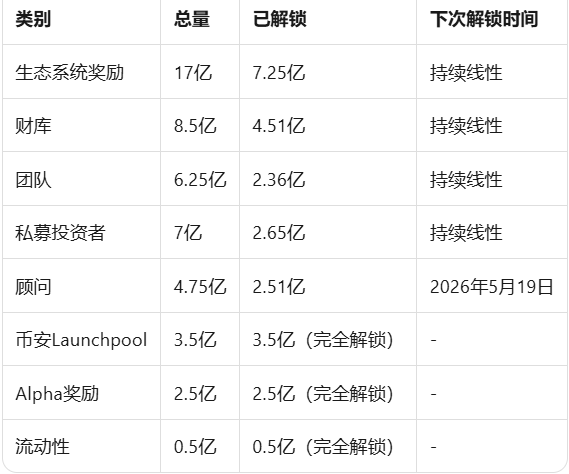
A total of approximately 2.58 billion tokens have been unlocked, accounting for 51.56% of the total supply. But note that the circulating supply is only 771 million tokens—this means a large number of unlocked tokens are staked or locked in contracts and have not entered the market.
This is both good and bad.
Good news: it shows that holder confidence is still there, staking rates are high, and selling pressure is effectively absorbed.
Bad news: once market sentiment turns, these "sleeping tokens" could wake up at any moment. According to Tokenomist data, Pixels' historical price volatility seven days after unlocking is "relatively low"—but history does not guarantee the future, especially in today's uncertain macro environment.
As an old investor, my attitude towards "long-term unlocking" is always: I'd rather miss the early gains than catch the last wave before unlocking. The private placement cost of PIXEL was in the range of 0.005-0.01 USD, and now the price is about 0.007-0.008 USD—early investors are either at a loss or barely break even. If the market continues to stagnate, the selling motivation for these chips will rise exponentially.
Seven, price trends: it’s not technical analysis, it’s "emotional game theory."
I don't chart K-lines, but I observe sentiment.
On March 11, 2026, PIXEL surged 193% in a single day, with trading volume skyrocketing over 6000%+. This is clearly not "fundamentally driven" but rather a narrative-driven speculative rotation—overall recovery of the GameFi sector, with funds flowing from overvalued AI tokens to undervalued gaming coins.
Is this kind of increase sustainable? Historical experience tells us: it is not sustainable.
But more importantly: this kind of volatility itself is a signal.
It indicates that the market has not forgotten Pixels. In the "graveyard" of GameFi, projects that can attract funds for a wave signify that they still possess liquidity, attention, and narrative reserves. Many GameFi projects from 2021 now don't even have anyone to pull them up—that would be the real death.
From a valuation perspective, PIXEL's FDV is about 35 million USD, which is considered a small to medium target in the GameFi space. Compared to Axie Infinity's AXS (ranking around 50th in market cap), PIXEL's market cap ranks around 150th—this implies it still has enough market cap elasticity, but also means its liquidity depth is insufficient to support large capital inflows and outflows.
For retail investors, this is a double-edged sword: it can double when it rises, but can also be halved when it falls. There are no institutional backers, no market makers to protect it, relying solely on community sentiment and the fundamental ecosystem.
Eight, my personal judgment: Is Pixels worth betting on?
Writing this, I need to explain myself and give readers an explanation.
Reasons to be bullish on Pixels:
The economic reconstruction of Chapter 2/3 is serious, not just PR rhetoric. RORS metrics, $vPIXEL, multi-game staking, AI reward systems—these changes belong to the first tier of innovations in the GameFi field.
The social retention data is solid. 150,000-500,000 DAU, high-frequency visits, strong guild system—these metrics indicate a game's long-term health better than "transaction volume."
The "default social entry point" status in the Ronin ecosystem. As Mavis Market becomes the main battlefield for Ronin NFT trading, the value of Pixels as a traffic entry point will be further amplified.
Valuation is relatively reasonable. FDV is 35 million, circulating market cap is 26 million—considered not expensive in the GameFi sector, especially considering its active user base.
Reasons to be bearish on Pixels:
The unlocking pressure is real. There is nearly half of the supply yet to be unlocked in the next three years, and any macro wind or grass movement could trigger a stampede.
Systemic risks of Ronin. Single-chain dependency, historical security incidents, and centralized governance issues of Sky Mavis are all swords of Damocles hanging over our heads.
"Farming game" ceiling. No matter how the economic model changes, the core gameplay remains casual farming—this genre has a user scale limit in the Web2 world. It is hard to break into the "non-crypto native user" group like Axie did.
Increased competition. In 2026, the GameFi space sees various games on Immutable X, Solana, and Telegram mini-games (like Hamster Kombat, Dropee, etc.) diverting user attention. Pixels' "retro pixel style" is differential but may also pose audience ceiling limits.
Nine, conclusion: In the pixel field, I learned patience.
Lastly, let me share some personal thoughts.
I started paying attention to Pixels in 2023 when it was still on Polygon, and the BERRY token hadn't been abandoned yet. I witnessed the excitement during its migration to Ronin, the craziness during the TGE in Binance Launchpool, and the despair of the price plummeting during the bear market in 2024.
But looking back now, the most valuable thing about this project is not its token price but its "iterative capability."
From BERRY to PIXEL, from a single game to a multi-game platform, from "token incentives" to "AI + USDC precise distribution"—with every major update, the team acknowledges mistakes, adjusts direction, and continues to experiment. This is a rare quality in the crypto space. Too many projects write their white papers and never revise them, draw their roadmaps and never move, ultimately dying in their own arrogance.
Pixels is not perfect. Its unlocking schedule is a headache, its gameplay depth is limited, and its narrative is sometimes overly grand. But it is moving, evolving, and trying to use data and AI to solve the structural problems of GameFi.
For an old player who has been in the crypto space for seven or eight years and has seen too many "concept coins" turn into "air coins," the very fact that it is "moving" is a kind of scarce signal.
So my final judgment is:
PIXEL is not a target that will make you rich just by buying it. It is an experimental asset that is "worth putting on the watchlist and betting at key points."
If you believe that GameFi has another wave coming, if you believe that the Ronin ecosystem can step out of Axie's shadow, if you believe that "data-driven game economics" is the future direction—then Pixels may be one of the highest odds and highest risk chips in this narrative.
But remember the phrase I said at the beginning:
"In the crypto space, the most dangerous thing is not losing money; it's thinking you understand when you actually don't understand anything."
Pixels' trump card may not even be fully understood by the team themselves. As outsiders, all we can do is keep watching, control positions, and always leave a hand ready.
After all, in this pixel-woven farming game, real farmers never go all in on one plot of land. @Pixels s $PIXEL #pixel