

I think the most important sentence in the Pixels whitepaper is one that most people read past without stopping. The validator is the game. Four words that sound like marketing but actually describe a fundamental redesign of how a token ecosystem decides where resources go, which projects deserve support, and what holding $PIXEL is supposed to mean over time.
Most staking systems in crypto are built around one of two ideas. Either staking secures a network, in which case stakers earn fees for providing that security, or staking locks up supply, in which case the reduced circulating tokens are supposed to create price support while stakers earn emissions for their patience. Both of those models treat staking as a financial mechanism. Pixels is treating it as a governance mechanism, and that difference matters more than most token analyses acknowledge.
To understand what that means in practice you have to start with what Pixels is actually trying to build. The project has described itself not just as a game but as a platform where games can be built that natively integrate digital collectibles. That framing matters because it means the long term vision is not a single game with a token attached. It is a network of games that share economic infrastructure, with Pixel sitting at the center of that infrastructure as the coordination asset that determines how value flows between them. The staking model is the mechanism that makes that coordination real rather than theoretical.
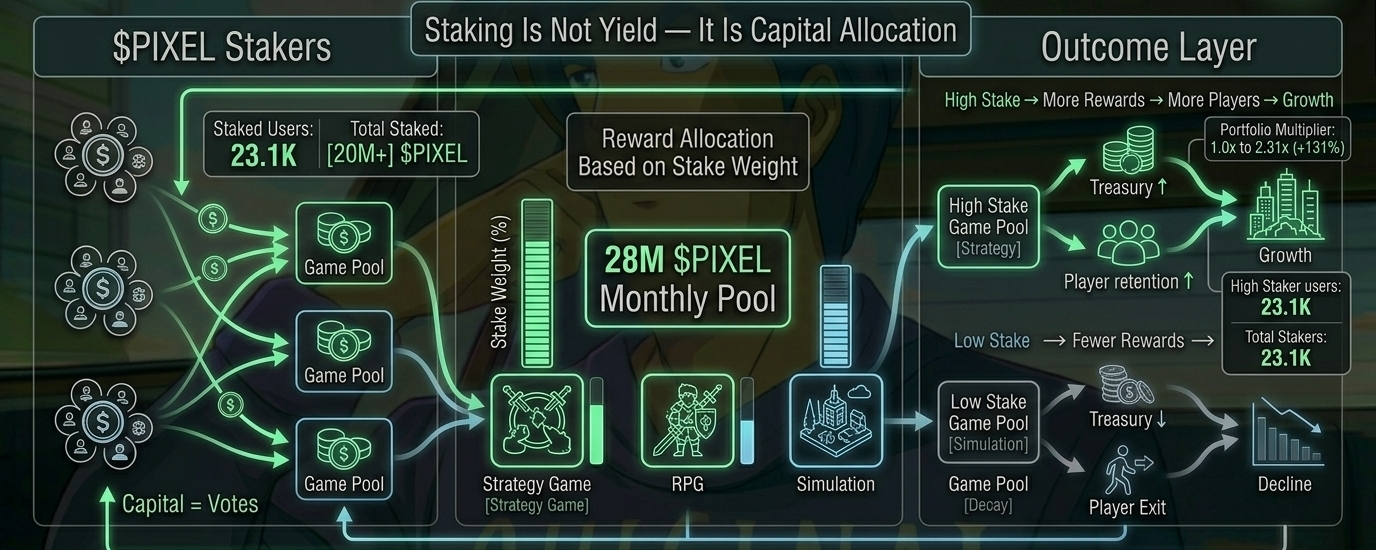
Here is how it works. Players and holders stake Pixel toward specific game pools. Each game in the ecosystem has its own pool and the amount of $PIXEL staked toward a game determines what share of the monthly ecosystem reward allocation that game receives. In the current phase the reward pool is capped at twenty-eight million $PIXEL per month and distributed across games based on their staking weight. A game that attracts more stakers gets more rewards to distribute to its players, which makes it more attractive to new players, which should in theory produce better retention and spending data, which justifies the stakers' confidence in backing that game. The logic is circular in the way that good market mechanisms are supposed to be circular. Success attracts capital and capital enables more success.
What makes this more than a simple popularity contest is the performance layer that Pixels is building into the system over time. The whitepaper describes a progression from the current beta phase, where games are hand-picked and receive fixed allocations, toward later phases where rewards become dynamic based on staking weight, then toward open eligibility based on performance thresholds, and eventually toward a multi-currency model where ecosystem health can be measured across multiple dimensions. The performance thresholds are the part I find most interesting because they introduce something most token ecosystems never attempt: consequences for poor execution. A game that fails to retain players, fails to generate net in-game spending, or fails to maintain healthy reward efficiency should eventually lose staking support as holders redirect their positions toward better-performing alternatives. That is how the validator becomes the game. The staking market is supposed to surface which games are worth the ecosystem's resources and which ones are not.
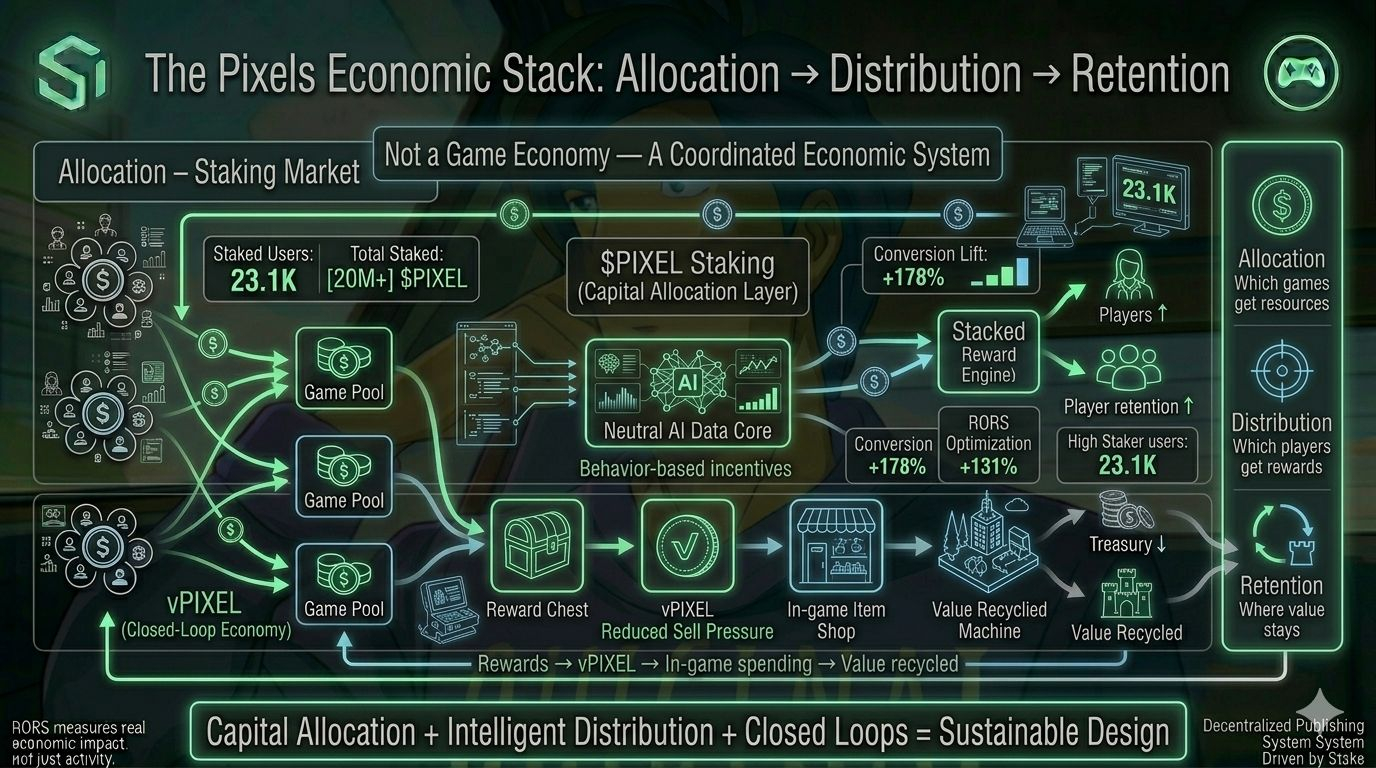
Stacked fits into this system at the distribution layer. Where staking determines how much of the reward pool a game receives at the ecosystem level, Stacked determines how that reward budget gets deployed at the player level. A game in the Pixels ecosystem that integrates Stacked can use the AI targeting engine to deploy its reward allocation toward the players most likely to convert that reward into real spending and retention rather than immediate extraction. The RORS metric runs through both layers. At the ecosystem level, RORS measures whether the reward pool is generating ecosystem revenue. At the game level, Stacked's targeting is supposed to ensure that individual reward deployments justify themselves through measurable player behavior changes.
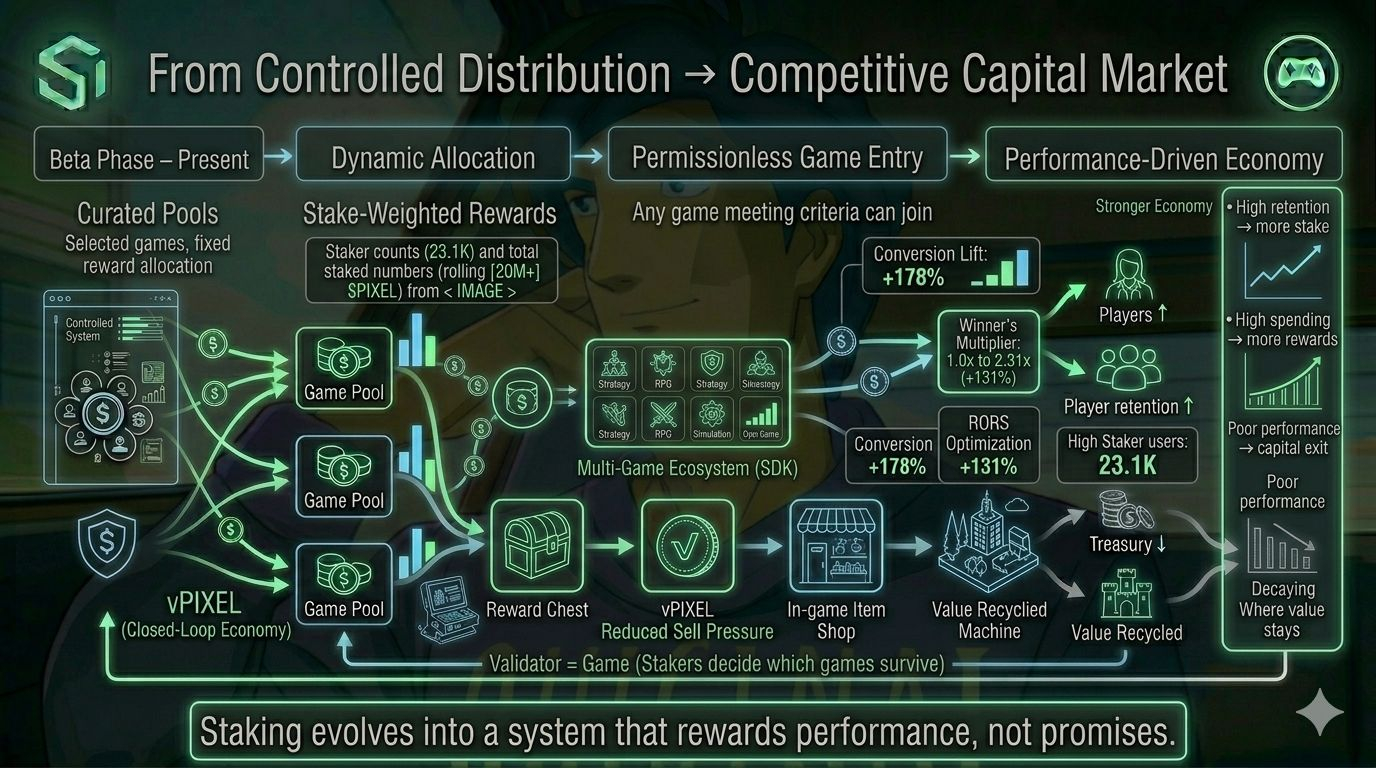
The vPIXEL design connects these layers by handling what happens after rewards reach players. Players who take rewards as vPIXEL instead of Pixel keep their spending power inside the ecosystem while the backing $PIXEL gets recycled into user acquisition and treasury operations. The Farmer Fee on direct $PIXEL withdrawals, which runs between twenty and fifty percent, gets redistributed to stakers. That means the players most invested in the ecosystem, the stakers, are subsidized by the players who are leaving it. Every design choice points in the same direction. The system is trying to make staying inside the ecosystem the rational choice for players who contribute value while making extraction visible and costly enough that it funds the people who stay.
I think the bull case for this architecture is genuinely stronger than the market has given it credit for. If the staking market develops in the way Pixels intends, $PIXEL holders gain a direct stake in platform quality rather than just token price. Their returns depend on whether the games they back can retain players and generate real spending. That creates a class of informed, engaged stakeholders who have both the incentive and the information to evaluate game quality seriously. Over time that should produce better capital allocation across the ecosystem than any centralized publishing decision could, because the people allocating capital are also the people closest to the games and most dependent on those games performing well.
The bear case is that all of this depends on a supply of genuinely good games entering the ecosystem and staying there. A clever staking architecture cannot manufacture fun. If the games available for staking are mediocre, holders will either stake reluctantly toward the least bad option or stop participating in the staking market altogether. In that scenario the validator is still the game but the games are not good enough to make the validator meaningful. The platform thesis collapses back into a single-game story with more complexity layered on top.
There is also a practical risk around the rollout timeline. Pixels has been explicit that the progression from curated pools to open eligibility is supposed to happen gradually and based on demonstrated performance rather than on a fixed schedule. That is the right approach in principle but it means the most interesting version of the staking model, where any game that meets performance thresholds can enter and compete for ecosystem support, is still in the future. The current phase is useful for establishing the mechanics but it does not yet demonstrate whether the competitive dynamics will develop the way the whitepaper describes.
From a market perspective I would evaluate Pixels' staking model along three dimensions. First, whether the games currently in the ecosystem are showing genuine retention and spending growth rather than just attracting staking capital on the strength of the Pixels brand. Second, whether Stacked adoption is expanding beyond the core Pixels game into partner studios, because that is the test of whether the targeting infrastructure is useful to outside developers or only works because Pixels built it for its own specific circumstances. Third, whether $PIXEL stake concentration is developing in a healthy way, meaning that staking is distributed across multiple games rather than concentrated entirely in the core game, because concentration would suggest the multi-game thesis is not actually resonating with holders yet.
My overall view is that Pixels has built something architecturally serious and that the market is underpricing the infrastructure component of the story relative to the gaming component. The gaming component is real and matters for retention and content quality. But the infrastructure component, the staking market, the RORS discipline, the vPIXEL loop, and the Stacked targeting layer, is what determines whether Pixel has a durable role in the ecosystem over a multi-year horizon or whether it eventually gets replaced by something simpler once the gaming narrative runs its course again.
I stay cautious because the hardest part of this story is not the design. It is whether the team can keep executing against a genuinely complex system while also shipping game content consistently enough to keep players engaged. Those two demands pull on resources in opposite directions and the history of ambitious Web3 gaming projects suggests that most teams underestimate how hard it is to do both well simultaneously.
That is why I watch content cadence and RORS together. If content keeps improving and reward efficiency stays positive, the architecture has a foundation to build on. If either one slips, the whole system is harder to justify regardless of how elegant the staking design looks on paper.
@Pixels #pixel #PİXEL #Web3Gaming #GameFi #Ronin #BinanceSquare