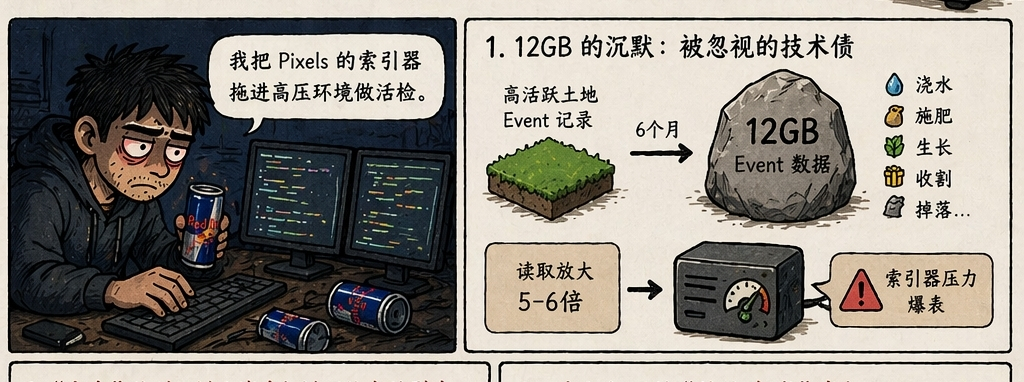
At three in the morning, the blue light from the monitor sliced through my bloodshot eyes like a surgical knife. With my Red Bull running low, I looked at the crazy rolling Event logs on the Ronin chain and could only smirk.
Don’t hit me with any grand scripts about 'metaverse social' or 'GameFi 2.0.' Over the past week, I’ve done one thing: dragged the Pixels indexer into an extreme pressure environment for a biopsy.
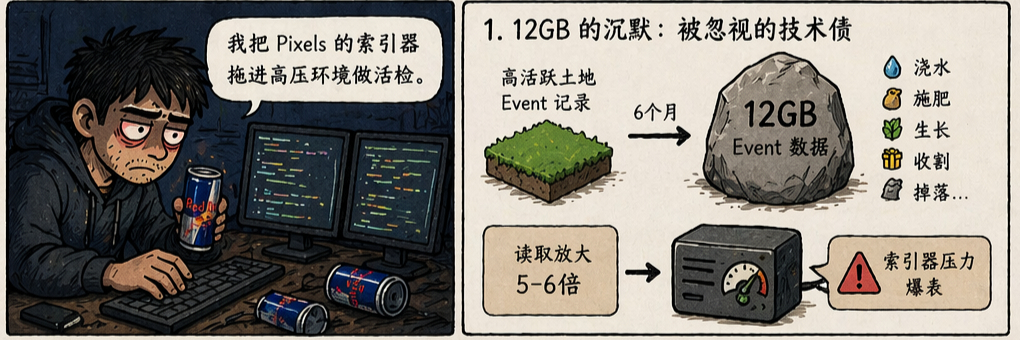
12GB of silence: the overlooked tech debt.
I parsed the log directory of a specific Land contract on Ronin and uncovered a long-ignored fact: the Event records for a single high-traffic plot grew by nearly 12GB in six months. Growing and harvesting crops only requires maintaining the current state, but to ensure 'traceability,' the system throws out every single instance of watering, fertilizing, and intermediate states as Events.
What does this mean? It means read amplification. Since data isn't stored incrementally but as full snapshots stacked up, every time the frontend calls the contract state, the indexer has to backtrack through a ton of redundant logs. I calculated that for the same 10KB of land asset data, the actual index IO pressure at peak is amplified by 5-6 times.
CreatorPad's 15M PIXEL prize pool is hanging out in Binance Square, attracting countless people to complete tasks. But what you don't see is that each task submission and every land interaction is adding bricks to this already overloaded indexer. You're earning tokens while it's gasping for breath.
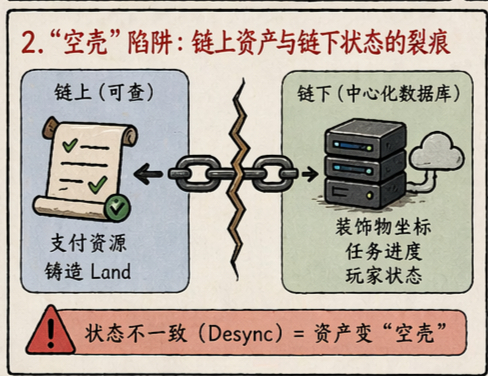
"Shell" trap: the fatal rift between on-chain assets and off-chain states.
The bigger problem is the strong coupling backup. Pixels has placed a lot of game logic—decorative coordinates, task progress—on a centralized off-chain database, only putting the results on-chain. I tested data synchronization under high load, and inconsistencies (Desync) appeared frequently.
If the official metadata server shakes, what happens to the Land held by users? It becomes a shell. Resources paid on-chain don’t take effect off-chain. For a game focused on social assets, this rift between 'distributed consensus' and 'centralized state' is fatal.
The officials talk about sustainability, but this sustainability is built on overdrawing the indexer's unsustainability.
The truth behind the 'pseudo-distributed' model in comparison.
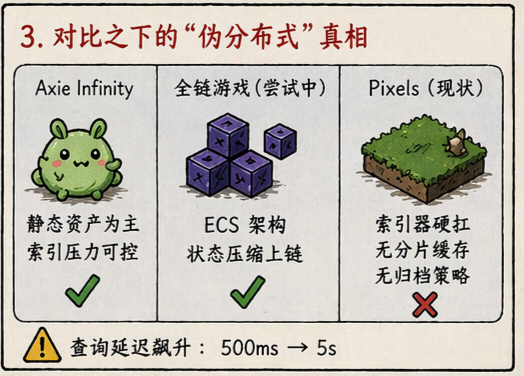
I compared the storage logic of other Web3 games. Axie Infinity tends towards static assets, with relatively controllable data indexing; some full-chain games attempt state compression at the contract layer through ECS architecture. Pixels is still in a 'pseudo-distributed' state—core data relies heavily on a centralized indexer without introducing sharding cache or a data expiration archiving strategy.
Operational costs are an invisible burden. Based on current activity levels, a medium-sized guild managing 50 land parcels faces exponentially increasing index query pressure daily. Ronin node operators need to continuously upgrade hardware to cope with this non-financial-grade 'high-frequency small' data IO. During several network congestion periods, the task board refresh delay shot up from 500ms to 5 seconds—essentially due to the indexer scanning historical redundant data triggering query locks.
Economic subtraction, technical addition: a dangerous imbalance.
Pixels is subtracting in its economic model—Chapter 2.5 slashes 84% daily inflation, with the vPixel plan separating gaming from investment. But in technical engineering, it’s dangerously adding. The 'heavy interaction, light compression' architecture suits early land-grabbing but lacks the support strength for a 'metaverse' infrastructure that needs to sustain millions of daily active users.
My current take: it lacks effective state pruning tools and cross-node incremental sync solutions. If Q3 doesn't roll out ZK-State-Proof or a mature off-chain DA layer to strip redundant logs, this architecture will suddenly choke at some critical point.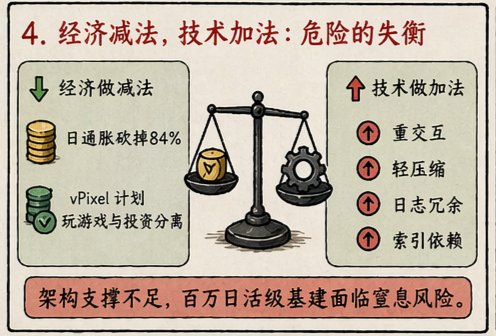
But why am I still keeping an eye on it?
Because I've spotted another possibility. Pixels is making a thrilling leap from 'pixel game' to 'complex social experiment.' It's obsessively hardcoding the credibility threshold into its energy system, making every resource feel like a bloody industrial product rather than just a couple of clicks to generate a color block. This 'math OCD' may scare off speculators in the short term, but in the long run, it's the only way to build a lasting sovereign society in the Web3 wilderness.
If Pixels really reaches the finish line, its greatest moment will ironically be the day it becomes 'completely invisible'—when people stop discussing coin prices and habitually start building social connections and asserting asset rights on it, that’s when it will have secured the taxation rights of the digital world.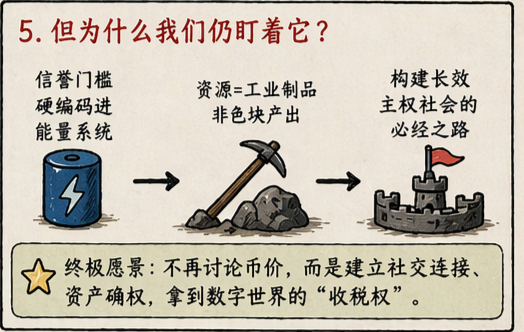
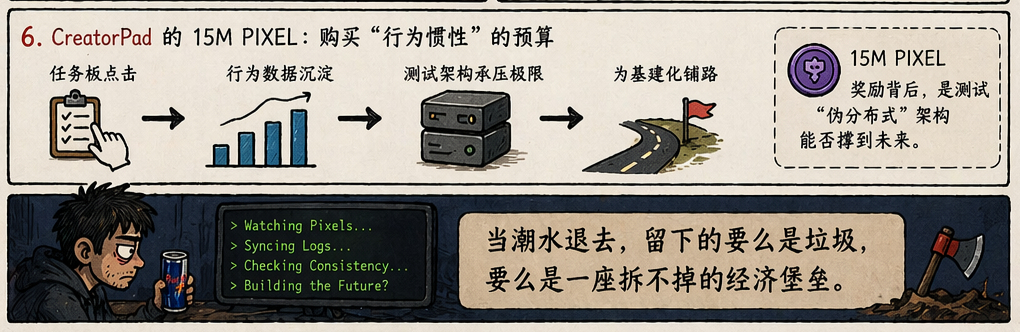
CreatorPad's 15M PIXEL looks like an incentive on the surface, but it's actually a budget for buying 'behavioral inertia.' Every click you make on the task board is helping it test whether this 'pseudo-distributed' architecture can hold up until the infrastructure day amidst real chaos.
So don’t ask me when it will pump. Focus on the energy consumption ratio and dissect task governance rights. When this wave of noise recedes, what remains on the beach is either pixel garbage packaged by scammers or an indestructible economic fortress.
I'll huddle in the corner with the AC cranked up, nursing a warm Red Bull, staring intently at the console. I want to see Pixels drive the stake named 'certainty' deep into the Ronin ecosystem—provided it first clears out that tech jungle.