
First off, let's talk macro—things out there aren’t looking too stable.
The ceasefire agreement is down to the wire, and Iran isn’t even talking anymore; they won’t even sit at the negotiation table. Then, just when it’s crunch time, Trump jumps back in: ceasefire continues, but I need a unified negotiation plan. Simply put—'we can take a breather, but the ball’s in my court.'
Meanwhile, the U.S. military isn’t just sitting around; the naval blockade continues to apply pressure. The pace here is essentially: talks are fine, but the pressure can’t let up.
On top of that, we’ve got another bearish signal: the Fed is starting to 'flip the script.' The new chair candidate Kevin Wash is clearly leaning hawkish in the hearings, and the market gets it loud and clear: rate cuts might not be happening anytime soon.
The result is straightforward — US stocks continue to fall, gold is under pressure, and risk assets are generally uncomfortable.
———
Back to the crypto space, here comes the key point.
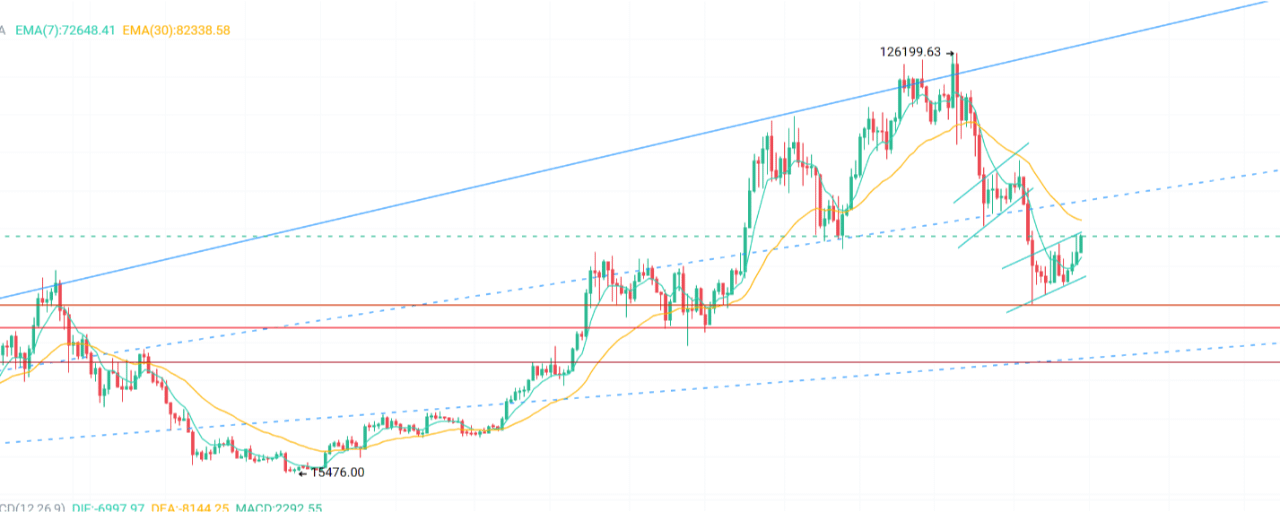
Bitcoin ($BTC ) is currently hovering around 76,000, it was hammered down over the weekend, but the issue isn't too big. From the stage's low point, it has rebounded about 25%.
But here's a key point to watch:
👉 Around 78,000 isn't just an arbitrary resistance level, but a resonance zone combining real cost line + bull market support zone (20-week moving average).
In other words, this is not something you can just break through at will.
Next, the market is actually quite simple, just two scenarios:
1. Rise another 20% → basically confirms a bull market.
2. Retract 20% → could possibly re-enter a deep bear market.
And the critical dividing line consists of a few 'key lines.'
———
For this wave, the next focus should be on these three lines, entering in batches:
1️⃣ 60,000 (200-week moving average)
2️⃣ 54,000 (realized price)
3️⃣ 45,000 (cost line for long-term holders)
The realized price can be understood as the average market holding cost.
Historically, every bear market bottom has 'heavily broken' this line and stayed below it for a while.
So if one day it really crashes to this area, it’s actually giving you time to get in.
———
Let's talk about Ethereum $ETH .
The perspective is also clear:
👉 Below $2000, you can start to accumulate slowly.
Why?
Because the major funds (whales) for ETH have their costs in the range of 2000–2500.
If you start buying from 2000, essentially you’re on the same starting line as the whales.
Another detail: the 'average cost across the network' for ETH is around 2340, and the price has been oscillating around this level.
In the short term, if weakness continues, there's a key reference level:
👉 1640 (negative one standard deviation)
Historically, this has been a very solid bottom (including the 2022 bear market).
But don't be too optimistic — if the market goes extreme, it could still 'falsely support and break through' like in 2018.
———
On-chain data here is actually more interesting.
In the last 30 days, long-term holders of Bitcoin have been hoarding like crazy —
👉 +350,000 BTC
What does this indicate?
It's not about retail sentiment, but rather 'long money is re-positioning.'
A key player here is MicroStrategy.
This year, 140,000 BTC have already been purchased, and the last two weeks were even more outrageous:
One wave of $1 billion.
One wave of $2.5 billion.
Directly hammering the spot market.
But here's the issue — buying might pause this week.
The reason is that their financing tool STRC has dropped below $100, making it a bit tough to raise cash.
Moreover, it's already Wednesday, and there hasn't been any financing this week.
This means:
👉 The market has lost a 'super buyer.'
———
Is there still buying pressure?
There is buying, but not enough strength.
ETFs are still flowing in, close to $1 billion last week, and it's continuing this week.
But on the other side, it's more real:
👉 Some are frantically taking profits.
Short-term holders have been stuck for too long, and once they approach breakeven — they sell directly.
More than 60,000 BTC have already been sold.
And now, there's a very critical piece of data:
👉 Short-term holder cost: 80,500.
In other words —
As long as the price gets close to this area, selling pressure will come again.
———
So what is the essence of the current market?
It's not that no one is buying, but rather: 👉 the buying pressure isn't strong enough to hold off the selling pressure.
What are many people doing?
Deleveraging.
Reducing positions.
Optimizing positions.
This isn't the characteristic of a bull market starting, this is — a rebound and recovery period.
A true bull market should be: 👉 the more it rises, the more people buy in, even willing to chase highs.
And not like now: 👉 the more it rises, the more people want to escape.
———
Lastly, one crucial insight:
Every bear market rebound has a phase — the market starts to 'feel like it has recovered.'
Sentiment is warming up, and more people are calling for a bull market.
But the price is — 👉 getting harder to move up.
Right now, it actually feels a lot like this stage.
———
Of course, this round also has its differences:
Institutions have indeed increased, and ETFs are still sucking liquidity.
This means — 👉 the drop might not be as exaggerated as before.
That's also why I'm willing to start buying slowly from 60,000.
———
To sum it up: it's not that there are no opportunities now, but — 👉 it just hasn't reached the stage of 'mindlessly jumping in.'
Enter in batches when necessary, and wait when needed.
I'm already in the vehicle, but I'm not pressing the gas too hard, saving bullets for the real opportunity.#Arbitrum冻结黑客ETH