

Yesterday, while reviewing the data updates for @Pixels Pixels, I came across a rather interesting number.
Starting in May of last year, the amount of in-game tokens deposited exceeded the amount withdrawn for the first time, meaning players were putting more tokens into the game than they were withdrawing. The amount staked also surpassed 100 million tokens, with over 3.8 million tokens staked in the game daily.
Sounds good, right? The economic model is improving, players are willing to keep their money in the game instead of withdrawing it to sell, and the project team has even added withdrawal fees. Withdrawn money will be redistributed to those who have staked their funds, which is essentially encouraging you to keep your money in the game.
Later they created vPIXEL, which is pegged 1:1 to PIXEL but cannot be sold; it can only be spent in the game. The direction is clear: they want to lock the tokens within the game and prevent them from leaking out. #pixel
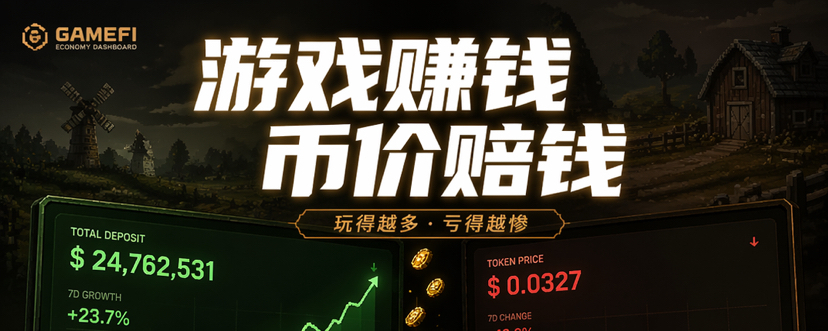
However, throughout 2025, the price of PIXEL dropped from 0.15 to 0.007, a decrease of 95%.
The in-game economy is improving, while secondary market prices are collapsing. These two things are happening simultaneously, which may sound contradictory, but they are not.
The fact that players are depositing more tokens than withdrawing them in the game indicates that those still playing are indeed spending them. However, the problem is that the sell orders on the exchange are not initiated by players, but by newly released tokens each month.
Only 15% has been unlocked so far, with the remaining 85% still in the queue. More than 91 million tokens were released on April 19th, and another round will be released on May 19th, with a similar scale.
For a project with a market capitalization of $5.8 million, nearly $700,000 worth of new coins are being poured in every month, and the buying power simply can't keep up. No matter how healthy the in-game economy is, it can't withstand continuous dilution from the outside world.
This is the core contradiction of blockchain game tokens.
Game economy and token economy are two separate systems. In games, players spend tokens to buy equipment, upgrade, and stake; these actions create in-game consumption.
However, the price of tokens on exchanges depends on the balance of power between buyers and sellers. As tokens are continuously released and added to the sellers' positions, the small amount consumed in the game simply cannot offset this.
The adjustments Pixels made—increasing withdrawal fees, staking rewards, and vPIXEL lock-up—are essentially aimed at reducing selling pressure.
The idea is correct, but the effect is limited. The biggest selling pressure isn't from players withdrawing tokens, but from the token release plan itself. Unless the project team changes the release schedule, or the in-game consumption becomes so large that it absorbs the monthly new supply, the price is unlikely to improve.
The current price is 0.0075, a 66% increase from the historical low of 0.0045 at the end of February, but it is still at the bottom when viewed from a longer-term perspective.
The game itself isn't bad; the gameplay is more decent than most blockchain games, and it has social features. However, a good game and a good investment are two different things. Before the unlocking and release phase ends, the price of this coin will most likely remain suppressed by the supply side.
I think Pixels is a playable game, but buying coins will have to wait until the release schedule changes significantly.
The above are just personal opinions and do not constitute any investment advice!