The real snapshot of the market isn't what the easy headlines sell:
If you've been in crypto for years, you know the issue has never been a lack of movement, but rather an excess of noise. Right now, Bitcoin is trading close to $78,234, with an intraday high of $79,426, and that matters because it confirms something very simple: the asset is still alive, liquid, and capable of moving expectations across the entire market. Plus, institutional interest hasn't disappeared. Reuters has reported in recent weeks the launch of new Bitcoin-related products by major firms like Goldman Sachs, while the flow into ETFs and regulated vehicles remains a key part of the institutional narrative. We're not in a dead market. We're in a market that continues to digest capital, narrative, and fear all at once 📈
The correct starting point remains the halving:
To understand Bitcoin, you need to look at the supply, not just the price. The halving in April 2024 reduced the block reward from 6.25 to 3.125 BTC, and that detail isn’t cosmetic: it changes the pace at which new supply enters the system. In previous cycles, major tops came well after the halving, not immediately. The FTSE Russell study compiled by LSEG shows peaks 367 days after the first halving, 525 days after the second, and 547 days after the third, followed by deep corrections. The lesson isn’t that history repeats itself like a script but that Bitcoin often takes time to show the real top of a cycle. That’s why declaring the definitive end too early has historically been an expensive mistake. ⏳
Why the idea of a last push up isn’t far-fetched?
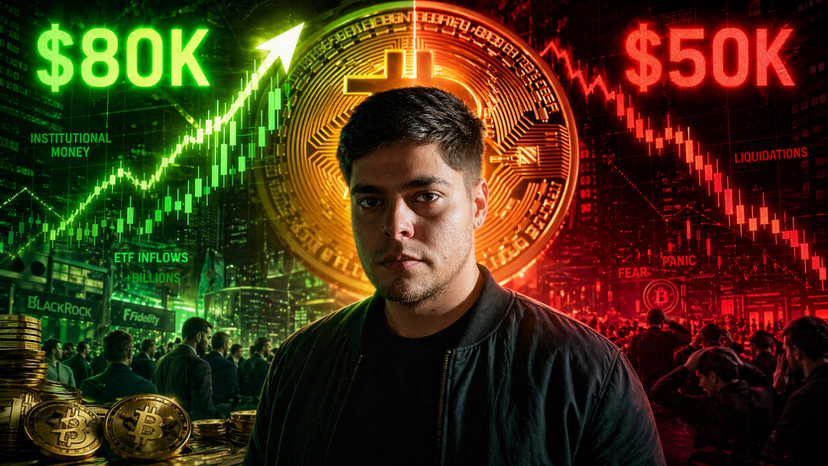
Here’s the part many prefer to ignore: a bearish or transitional cycle doesn’t exclude violent bounces. Fidelity pointed out in its analysis a year after the halving that Bitcoin moved between $82,000 and $85,000 in April 2025, and then returned to above $100,000 while its market dominance surpassed 72% in May 2025. That reading fits with an uncomfortable idea for emotional traders: the market can keep climbing even when it starts to smell like distribution, fatigue, or over-leverage. My take is that a zone between $80,000 and $85,000 could act as a friction area where many take profits, others chase the breakout, and a part of the market gets trapped. If that pressure gets released, an additional leg up before the big correction wouldn’t be a surprise. 🧠
Altcoins don’t lead, they follow Bitcoin:
It’s worth remembering this because many start with altcoins and end up confusing noise with trend. When Bitcoin dominates, altcoins tend to amplify the movement, but they rarely lead the underlying structure. Reuters already noted that small coins tend to move in tandem with Bitcoin, and Fidelity showed that after the fourth halving, Bitcoin gained dominance while Ethereum and Solana lost market share. That behavior doesn’t guarantee an altcoin can’t take off on its own narrative, but it does make one thing clear: if BTC hasn’t finished deciding its top or bottom, the rest of the market is walking on unstable ground. That’s why so many apparent rotations end up being liquidity traps. First, Bitcoin leads. Then, if the market wants, the secondary party begins. 🔥
The correction to $50,000 isn’t a drama, it’s a possible scenario:
You shouldn’t sell that level as a prophecy, but you also shouldn’t hide it for fear of sounding pessimistic. In February 2026, Reuters reported that Bitcoin had suffered a sharp drop after a major prior collapse and was trading around $63,140, and in March, Citigroup lowered its base forecast for Bitcoin to $112,000 with a bearish case at $58,000. That makes one thing clear: even the big names in the market work with ranges and scenarios, not certainties. A pullback to the $50,000 area wouldn’t necessarily invalidate the long-term thesis; it would be more like the kind of sweep that usually cleans up excess optimism, leverage, and weak hands. In crypto, clean rises are rare. The norm is to advance in fits and starts, with pullbacks that seem like the end of the world just before the next expansion. ⚠️
What really separates the investor from the gambler is the time frame:
This is where most people get wrecked. Just staring at small candlesticks leads to poor decisions, and only watching the macro view blinds you to execution. A sensible market read usually starts from the top, looking at weeks and days to understand structure, supply and demand zones, and the real state of the trend. Then you drop down to 15-minute charts for operational context and to 5-minute charts to confirm entries, not to invent them. That order changes everything because it forces you to respect the larger direction before hunting for timing. The classic mistake is buying just because a candle turns green or selling because an intraday correction spooks you. That’s not analysis. That’s anxiety with a screen. The market punishes those who chase emotions much less than those who wait for confirmation. 🧩
My direct read on the current moment:
My conclusion, with the data laid out, is this: Bitcoin remains the asset that sets the pulse of the crypto market, and I still don’t see reasons to call the cycle closed with artificial certainty. The 2024 halving continues to exert its effect, institutions haven’t left the game, and history itself suggests that serious tops take longer than people want to admit. At the same time, it’s important not to romanticize the path. A move towards $80,000-$85,000, followed by a hard correction, aligns better with BTC’s historical behavior than an infinite straight line up. The market doesn’t reward those who guess the exact number. It rewards those who understand the context, manage risk, and know how to wait.
The final thought you should keep:
Don’t buy the quick narrative. Don’t sell the panic quickly. Bitcoin can rise, correct hard, and still be structurally bullish long-term at the same time. That nuance is what separates those who survive from those who get burned. If you’re trading crypto, respect the data, respect the time, and respect the risk. Financial freedom isn’t built by chasing candlesticks; it’s built by using the market as a tool and not as a casino. 🧠📈⏳
#bitcoin #Criptomonedas #trading $BTC $BNB