
First, you need to understand what kind of funds are in the cryptocurrency circle. There is no so-called legitimate capital in the cryptocurrency circle. The circulating funds of cryptocurrency merchants mainly come from trading coins (retail investors), foreign exchange (bulk), online gambling, pyramid schemes, telecommunications fraud, and other types. If you want to refute me, what other funds do you think exist in the cryptocurrency circle?
First, let's look at the perspective of legitimate currency merchants. The risk control standards are: real-name authentication, strict review of transaction flows, no deposits within half a month, risk warning letters, phone recordings, and complete transaction records for filing.
Is it useful? It's just a self-satisfied type of risk control. This blocks off secondary and tertiary black capital, but the only thing it doesn't block is primary black capital; third-party and fourth-party fraud easily bypasses the risk control system of these currency merchants.
How the currency dealer received the first-hand black is unsolvable, leading to retail investors receiving the second-hand black frozen card is also unsolvable.
[Currency dealer's perspective] The dealer Zhang San is a currency dealer at the exchange and has strictly reviewed the buyer's transaction history, added WeChat, and the real-name verification of the exchange, WeChat, and bank card can match. The voice recording of the purpose of buying U is based on voluntary principles, and the transaction history is very clean, as it is money that just came out from a bank loan, which is very high quality and can be transacted.
[Buyer's perspective] Buyer Li Si finally encounters an online big shot Wang Wu who takes me to trade futures (for investment, love, and various reasons), and needs to open an account. So I gave him my phone number, ID card photo, and email. I received a text message asking to register for something like OKX, Binance, Huobi; anyway, I don't understand. Throughout the process, the assistant of the big shot helped me operate, and then I downloaded a futures software that looked formal and proper. The big shot Wang Wu said I could directly recharge to the futures platform, so he asked me to transfer money to someone named Zhang San. After I transferred, the corresponding balance was added to the backend of the futures software.
I want to withdraw. During the test, I smoothly withdrew to my bank card. Looking at the daily earnings, I really feel like I am about to take off.
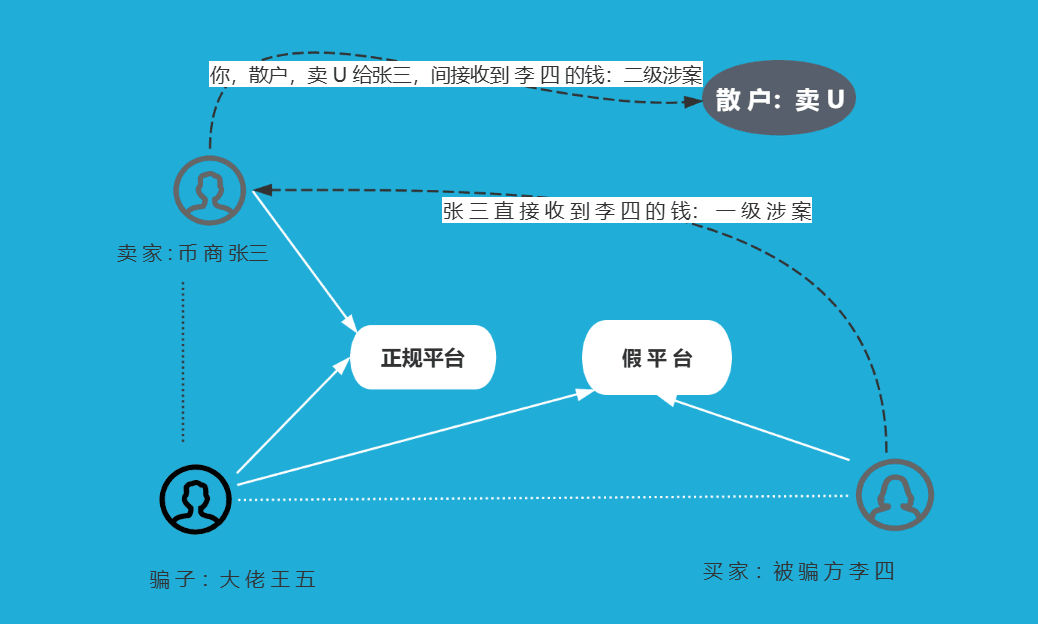
[God's perspective] Buyer Li Si is scammed by an online pig slaughter plate and is taken to a futures platform, then the scammer takes her ID card, WeChat, phone number, email, and other information to register at the OKX exchange. The scammer Wang Wu then uses Li Si's information to randomly find a currency dealer to buy U at the exchange. Since Li Si is a normal person, the information review passes very easily. The dealer asks for what information, and the scammer lets Li Si send that information.
After passing the review, the currency dealer gave the scammer the card number, and the scammer forwarded the card number given by the dealer to Li Si, asking her to transfer money to this dealer. Li Si and the dealer have no contact at all, thinking that this money is transferred to the futures platform. The scammer's futures platform can also display the dealer's card number for a limited time on the platform, which is even more misleading.
After Li Si makes a payment, the currency dealer releases the currency, the scammer takes it away, and then manually adds the digital amount from the futures platform to Li Si's account, completing the scam.
Throughout the transaction process, the currency dealer and the real buyer Li Si are completely independent and do not know each other. The scammer conveys information in between.
[Retail investors selling U are frozen] After the currency dealer sells U, they need to place an order on the platform to receive U. If a retail investor sells U at this time, congratulations, the retail investor takes over the second-hand black, leading to a frozen card. This has nothing to do with the retail investor checking the registration time, transaction volume, success rate, and other data of the currency dealer, because the currency dealer is a legitimate dealer.
Therefore, it is meaningless for retail investors to look at the registration time, transaction volume, success rate, and other data of the currency dealer. The core is to look at the source of the dealer's funds, not these data, because the dealer himself does not even know how he was scammed.
The initial buyer Li Si is still immersed in the joy of daily profits from the futures platform and cannot extricate herself. If she wants to withdraw a small amount, the scammer will recharge the scammed U to the exchange, sell it to the currency dealer to make a payment, and the dealer will pay Li Si. After Li Si receives the money, she trusts this futures platform even more.
The scammer will make Li Si reinvest, with increasing amounts, borrowing, and investing until they find a way to make Li Si incur losses. If Li Si does not incur losses or truly runs out of money, the scammer will close the net, and this may have taken a month.
Li Si finally realized she was scammed and reported it to her uncle. The currency dealer's first-hand black was frozen, the retail investor selling U to the dealer was second-hand black and frozen, and the money from the retail investors selling U that was transferred to their family to repay the mortgage was also frozen...
This is a series of consequences.
No solution.
The currency dealer is placed on a dual-card punishment list, an uncle from another location comes to press him, all bank accounts are frozen, the dealer exits with losses, it takes time and cost to unfreeze the bank card, and the dual-card list cannot be resolved.
This is the underlying logic of the currency dealer and retail investor trading virtual currencies being frozen.