
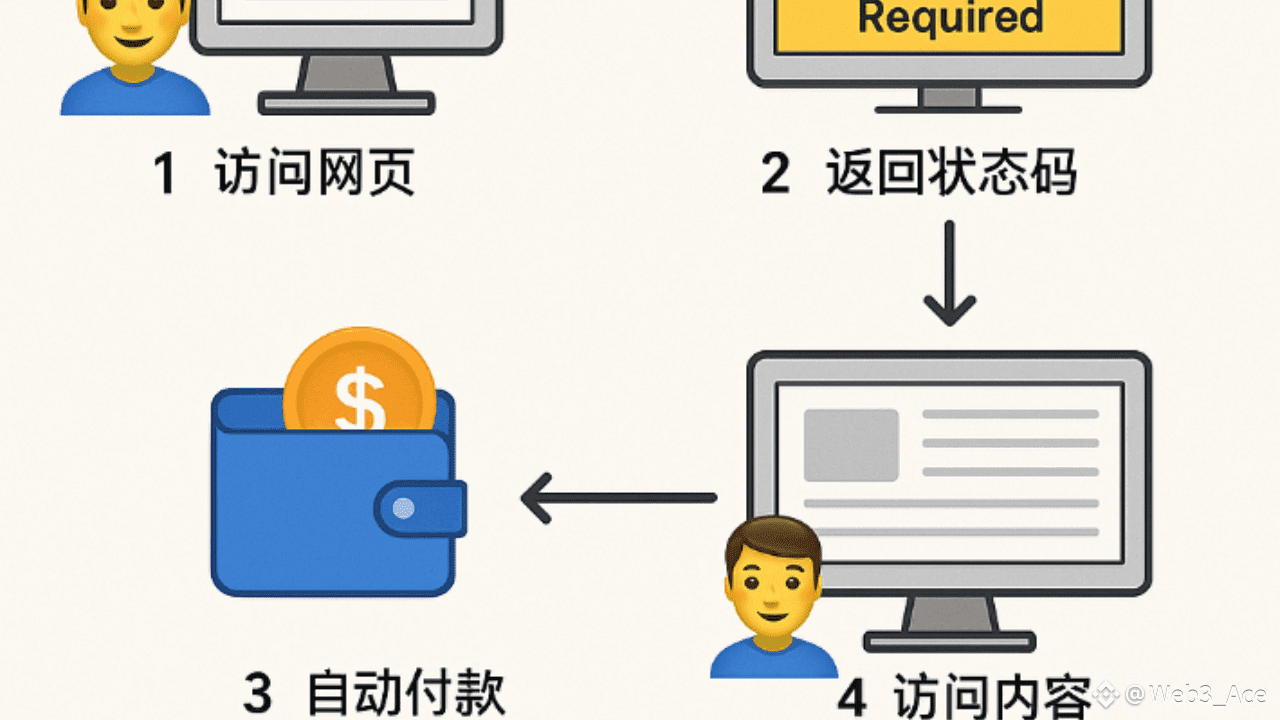
I looked around for the introduction to X402 in Simplified Chinese, and the teachers have all written very detailed information.
But for someone like me who is more of a humanities person, the technical part is still a bit difficult.
Seeing HTTP/API for the first time is really a bit confusing.
I'm sorry, I'm technically illiterate.
I want to write a post about X402, including what this protocol is for, why it's so cool, what the risks and difficulties are, and the corresponding investment targets.
1⃣What is X402?
X402 is an open protocol launched by the @base team.
The original intention of developing the protocol was because they found that
“HTTP allows information to be transmitted freely, but money is still trapped in the old system.”
Coinbase aims to enable the internet itself to recognize payment requests without relying on credit cards, payment gateways, or centralized billing systems.
It's okay if you don't understand these two sentences, just keep reading 👇
Here is a brief introduction to two concepts — HTTP and API.
HTTP can be understood as the language that browsers and websites use to communicate when you surf the internet daily.
It is similar to English or Chinese, except this language is the one used for communication between browsers and websites.
API can be understood as the language for communication between programs.
For example, when you open the built-in weather app on your phone, it doesn't measure the weather itself but looks for the 'Central Meteorological Bureau API' to request data.
Here, the app is not a human user but 'a program' accessing the interface of another program.
Combining the above two concepts helps clarify:
Now the entire internet transmits information through HTTP and API.
However, the problem with this model is in the payment aspect.
The traditional internet payment logic is 'account-driven, centralized, and requires human participation.'
1️⃣ Robots (or humans) access web pages or APIs.
2️⃣ Websites require you to register an account first.
3️⃣ Link your credit card or recharge.
4️⃣ Can use/subscribe to services.
In this case, it will lead to
For AI agents, the operational cost, time cost, and operational complexity are a bit high.
If AI agents want to access a paid service, they must have humans register accounts first, link billing, and then manually allocate tokens and API keys to AI.
For AI, this is equivalent to being 'tied down' — it cannot make autonomous decisions and settlements.
X402 allows machines to pay directly at the HTTP layer without human intervention.
No registration needed, no card linking; AI, robots, and APIs can naturally 'spend money' on the internet like humans.
The above is part of the X402 technology, but the protocol itself is blockchain-agnostic; X402 lives on the chain, and without the blockchain, X402 cannot transmit value.
Its design goal is to enable 'any blockchain payment method' to be understood and triggered by web pages.
Thus, we can see the true value of X402 👋
X402 aims to build a bridge between Crypto and Web2.
Allow all websites to 'access encrypted payments'
—— Just like HTTPS allows websites to communicate securely, X402 enables all websites to receive payments securely.
For example, let's make a comparison: 👇
Without X402: Humans help AI register accounts → link cards → generate API Key → recharge manually when quotas run out.
With X402: AI initiates a request → receives 402 (requires 0.01 USDC/request) → AI pays automatically → immediately gets the data.
In this way, requests are settled instantly, and AI/machines can autonomously consume services without human intervention.
X402 can be roughly understood as AI + Crypto.
It is the key standard for 'allowing machines to spend money' in the AI + Crypto world.
The next update will cover the application scenario value of X402 (mainly three scenarios), industry challenges, and investment targets.
The application scenarios and industry chain logic of the X402 protocol