
Let me set the scene.
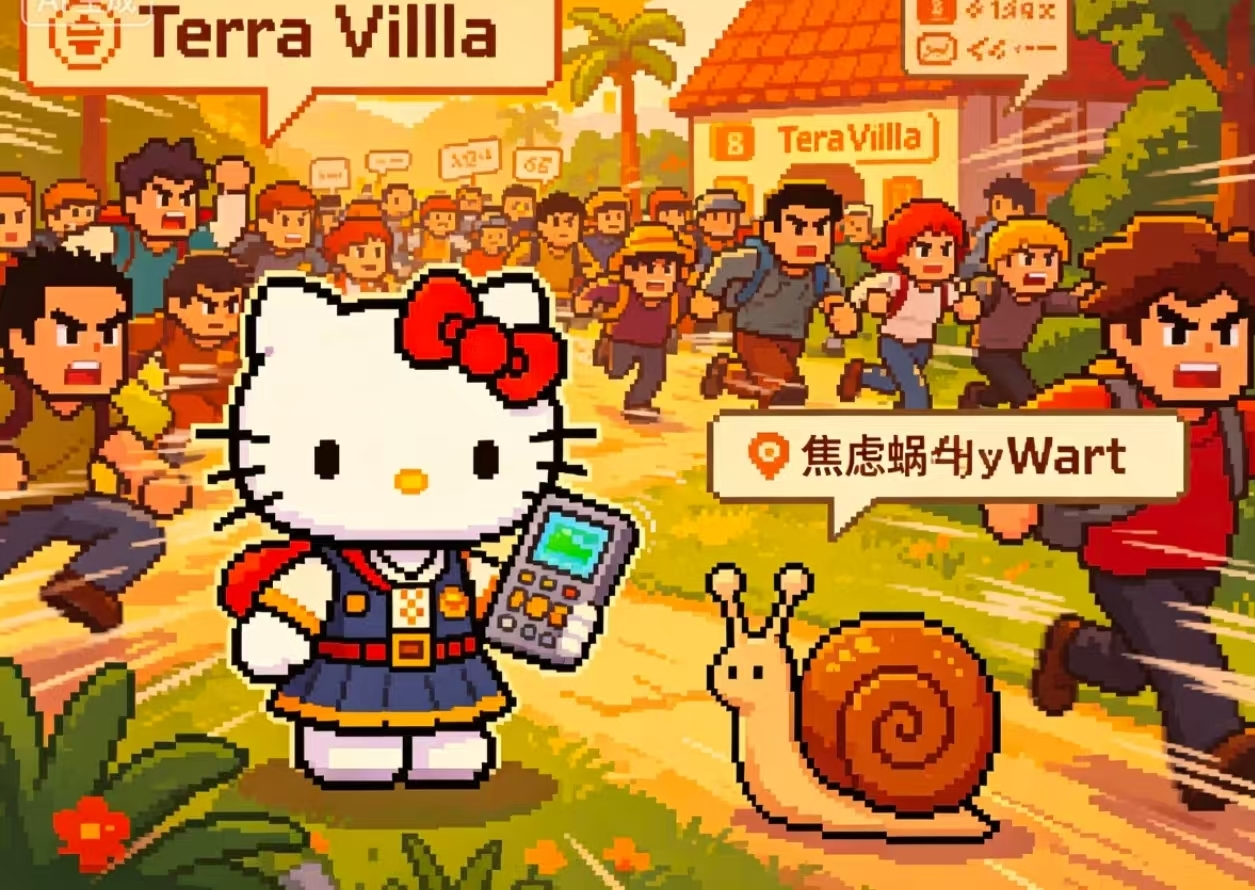
Wednesday night at 11 PM, I fired up Pixels to cash out and hit the sack. Suddenly, the whole Terra Villa went wild, with players running around like crazy. I asked what was going on, and it turned out there was a limited-time quest: help NPC Hantao find a stressed-out snail named Wart, with only 3 spawning daily, hidden randomly across the entire map.
I spent 40 minutes behind the barrel, in the bushes, and even under some NPC's feet, getting sniped twice. In the end, I gathered 3 and traded them for 5 reputation points and a few Moki balls. When I shut down my computer, it hit me: I got played by a well-designed 'behavioral reward system,' and I did it willingly.
It’s not just about good game design.
Point one: The death spiral of traditional P2E isn't rooted in 'price fluctuations' but rather in 'misaligned incentives.'
Most people attribute the collapse of P2E to 'the token price dropping.' That’s the outcome, not the cause.
The real reason: Most P2E designs encourage 'exit' rather than 'retention.'
Let’s break it down:
The incentive model of traditional P2E is a one-way channel of 'behavior → token → cash out.' Players just need to find the 'highest output behavior in a unit of time' (like grinding the same dungeon repeatedly), then infinitely repeat it, and finally cash out. Whether the game is fun or the economy sustainable is irrelevant to the players.
This leads to three fatal problems:
Bot-friendly: As long as the actions can be scripted, there’s no real player involvement.
Marginal returns diminishing trap: Early players mine most of the value, while latecomers become bag holders.
Studios vs. real players: The more efficient the studio, the worse the experience for ordinary players.
The Pixels team summarized a key statement in the official docs, which I think hits the mark:
'Those failed projects treat the economy as a mere atmosphere. Large-scale releases, token pumps, followed by silence.'
Sharp point: It's not that the market is bearish on P2E; it's that most P2E projects have never truly 'designed an economy.' They just filled in a few numbers on the token distribution table and expected the market to buy it.
Point two: The real killer move of Stacked is to turn rewards into retention tools, not just value propositions.
This is my favorite quote from the official docs:
'Rewards become retention tools, not the entire value proposition. Players stay because the game is good. Their earnings come from their participation.'
To put it in plain language:
The logic of traditional P2E is 'You come to make money → you leave → game dies.'
The logic that Stacked aims for is 'You come to play games → play well and get rewards → you want to play more.'
What's the difference? The trigger conditions and calculation methods of the rewards.
Traditional model: Complete action A → receive token B (fixed output).
Stacked model: At the right time, for the right players, the right rewards (dynamic output).
According to the official disclosure, the capabilities that Stacked already possesses include:
Player segmentation: Players with different behavior patterns enter different reward pools.
Churn warning: AI identifies players likely to churn from D3-D7 and triggers recall rewards.
Anti-cheat system: It’s not just about banning accounts, but making the 'effective behavior cost' for bots so high that it’s unprofitable.
These things might not sound sexy, but this is the infrastructure that will keep GameFi alive.
Sharp point: 99% of 'GameFi projects' on the market haven't even run DAU retention curves by time segments before launching their tokens. Meanwhile, Pixels has run billions of reward distributions and made over $25 million in revenue on this system—this isn’t theory; this is a battle report.
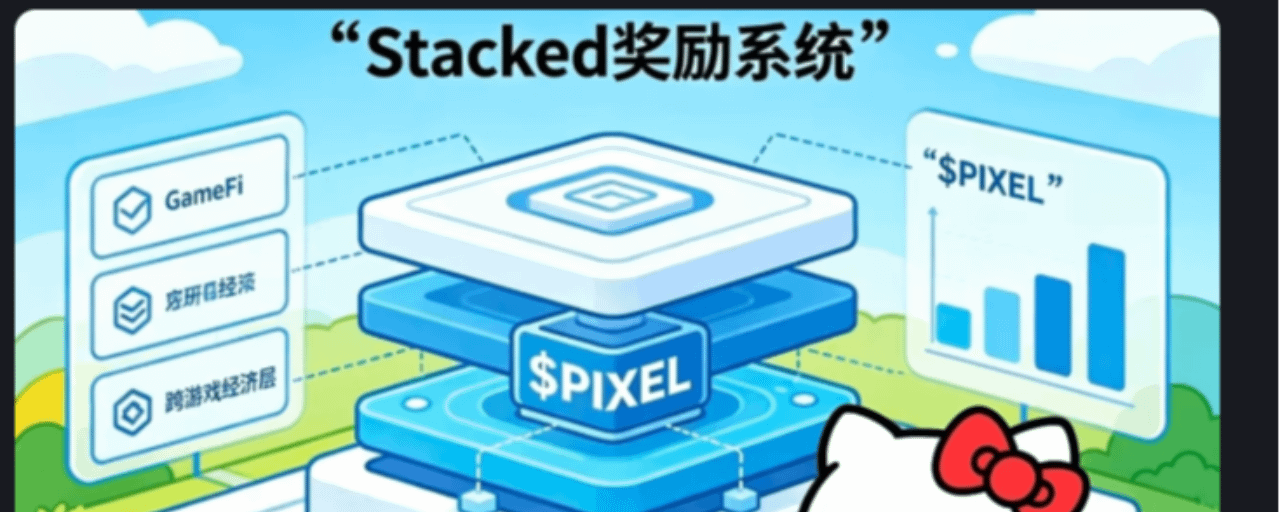
Point three: $PIXEL is not a 'game token'; it is a 'cross-game economic layer.'
Most people look at $PIXEL and compare it to other games' 'gold farming' or 'governance tokens.' That's wrong.
There’s a key statement in the official docs:
'$PIXEL powers the LiveOps that provide rewards for Pixels and studios connected to Stacked. This isn't a speculative tool disguised as a public token; it actually functions within an active, profitable ecosystem.'
Let's break down this positioning:
Layer one: Consumption and application within Pixels games.
This layer is what everyone can see—buying items, speeding up processes, participating in special events. But this layer is just the foundation.
Layer two: Reward settlement within the Stacked ecosystem.
When third-party studios integrate with Stacked, they can choose to use $PIXEL as the reward currency. What does this mean? The demand for $PIXEL expands from '1 game player' to 'all participants across N games.'
Layer three: Value capture integrated with staking.
The official roadmap clearly mentions $PIXEL staking integration. This isn’t just about 'locking assets for interest'; it’s about allowing $PIXEL holders to share in the growth of the entire Stacked ecosystem—more studios onboarded, more rewards distributed, more fees coming in.
To draw an analogy:
Regular game tokens = tokens for a single amusement park, usable only within that park.
$PIX$PIXEL is points from the 'Universal Points Alliance' that can be used across multiple play parks and also provide dividends.
Sharp point: When the market prices $PIXEL, if it's only based on 'the popularity of Pixels games,' it's like selling diamonds as if they were glass. Its value ceiling depends on how many game studios Stacked can onboard and how many players it can cover.
Point four: 'Building in production' is not just a marketing phrase; it's Pixels' biggest moat.
The officials repeatedly emphasize one thing: 'Built in production, not in a deck.'
This statement deserves serious attention.
Let's recap the common narrative in Web3:
Write a stunning white paper.
Token issuance, exchange listings.
Pump and dump.
The community asks, 'What's the progress?' → 'We're working on it.'
Silence, then on to the next project.
Pixels is taking a different path:
First, there’s the game (Pixels goes live).
Identifying economic problems in operation (P2E is unsustainable).
Built a system to solve it (the birth of Stacked).
Iterating through real players, real attacks, and real data (over 200 million reward distributions in practice).
Open the validated system to third parties.
This sequence determines the depth of Stacked's moat:
Anti-cheat system: It's not a third-party solution purchased; it’s developed through real confrontations with studios and bots.
AI economists: Not just a GPT interface; trained on behavioral data from millions of players.
Reward design methodology: Not theoretical deduction, but results derived from real monetary experiments.
Sharp point: Even if someone copies Stacked’s code tomorrow, they can’t replicate the data, experience, and anti-cheat rules that have been honed over time. That’s the real moat—and it’s getting deeper every day.
Finally, back to that snail.
That anxious snail named Wart, only spawning 3 a day, hiding randomly across the map, and getting snatched—isn't that a design to 'annoy players'?
But let's look at it from another angle: why did I spend 40 minutes searching for rewards that I knew were just some reputation points and a few Moki balls?
Because this system precisely activates the psychological mechanisms of 'scarcity + randomness + community competition.' And this is just a tiny task running on the infrastructure of Stacked.
If a small task can yield such effects, then when the entire ecosystem’s reward system is fully operational—
The next chapter of GameFi may not really be about bigger rewards but about smarter ones.