
When you dive into a blockchain game, which one do you open first?
Most people, like me: first check daily earnings, ROI, and calculate 'can I mine a bit more today.'
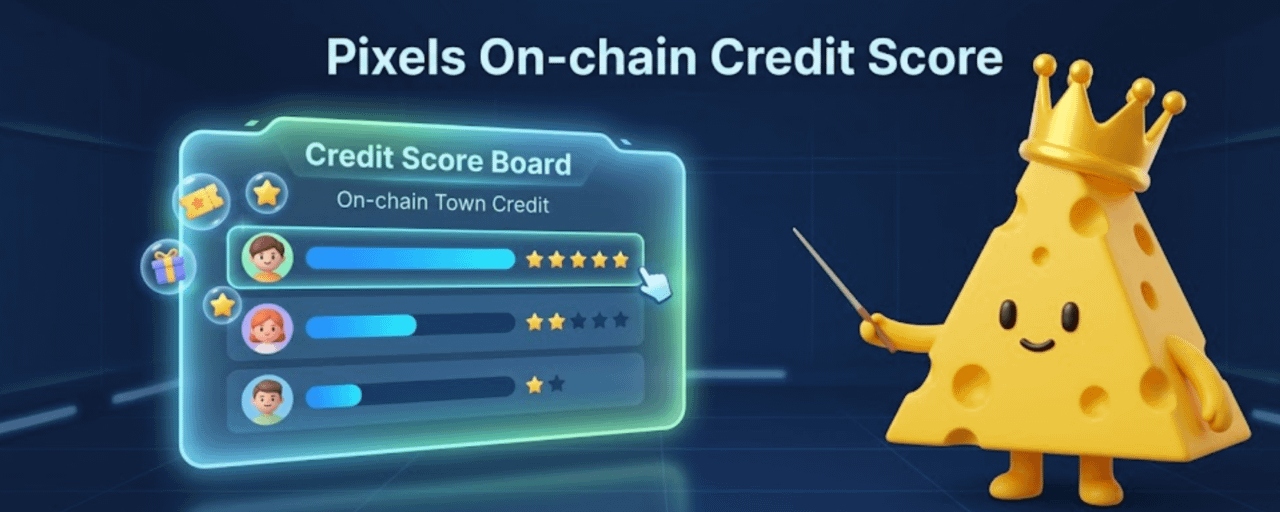
But for games like Pixels, which are climbing to 100k and 1 million daily active users, if we only look at who mines the most to share rewards, the ecosystem would have been wrecked by bots and short-term farms long ago. So they decided to do something that's not very popular but crucial for long-term: they started helping each player build their 'on-chain credit score.'
🧾 Not just a profit report, but a 'micro credit report.'
In Pixels, everything you do daily is actually being recorded:
Are they only appearing in high-yield events, then disappearing when they're over?
Are they answering newbie questions in the guild, helping others through the onboarding?
Are they consistently logging in to do tasks, or are they fishing for three days and letting the nets dry for two weeks?
A lot of people call this kind of thing 'reputation score', but I think it's more like:
Your 'credit score' in an on-chain town.
It won't pop up every day to remind you '+3 points' or '-5 points', but gradually in the background, it's shaping you into a certain type of person.
To the system, are you a 'casual player' or a 'town character'?
👥 Two types of players: short-term gains vs. long-term credit.
Imagine there are two players, A and B.
Player A: Profit-oriented type.
Researching which tasks yield the highest hourly rate daily 💰.
Logging off right after finishing, rarely speaking in the guild.
Only picking activities that have 'clear Token rewards'.
Player B: Credit-oriented type.
Online at similar times, but the pace is more stable.
Used to answering newbie questions in the channel.
Occasionally pulling people together for tasks, organizing information.
At first glance, it seems like A is the 'smarter' one:
With the same one hour of play, A's daily earnings report just looks better.
But when you stretch the time to three months or six months, the differences will emerge.
In events with limited spots, B has an easier time getting in.
When guilds allocate resources or look for officers, they will think of B first.
If later Pixels ties certain whitelists and collaboration opportunities to 'long-term credit', B will almost naturally be at the front of the line.
This isn't luck; it's the system executing a plan:
Shifting from 'how much are you farming now' to 'will you stick around'.
🧠 From the project’s perspective: Who are the credit scores clearing out, and who are they keeping?
From the perspective of the project, the issue is quite realistic:
When the token first launches, all the SocialFi/GameFi funds rush in like a stampede.
Active wallets, daily users, and trading volume can all skyrocket to impressive numbers.
But once the hype dies down, the remaining loyal players are the foundation of the game.
If the system can't tell the difference:
Just people coming in to farm once and then bounce.
Those willing to stick around in this little town for three years.
Then it will crash back down later.
So Pixels made a tough choice using 'on-chain credit scores':
You don't have to please everyone anymore.
If you're just here for a quick farm, taking short-term gains is fine.
But long-term benefits and scarce opportunities will gradually concentrate among those who truly stick around.
It sounds a bit harsh, but for long-term players, it's actually a form of protection; the system is helping you filter out 'those who just want to grab a quick profit and leave'.
✅ As a player, how can you adjust your 'credit gameplay'?
If you believe Pixels is more than just a short-term hype, then what you're looking at next isn't just:
'Is today's event worth it?'
It will come down to: 'In this on-chain town, what kind of person do I want to be recorded as?'
Roughly speaking, behaviors can be divided into two categories:
Actions only useful for immediate gains.
Only grinding the highest yield tasks daily, then disappearing when the event ends.
Actions beneficial for your on-chain credit score.
Consistently online, completing basic tasks.
Willing to help new players get through the onboarding.
During critical updates, actually stepping in to test and provide feedback.
In the short term, both types can make money, but after six months or a year, the system will throw more opportunities to the latter.
So this is how I see Pixels:
You're not just playing for today's earnings; you're building an 'on-chain resume' that future games will see.
🔚 In this article, I want to share a message with you.
As I write this, I actually have a personal expectation; if more and more blockchain games implement 'on-chain credit scores', can we early players figure out earlier than others what kind of people we want to be recorded as on-chain?
$PIXEL @Pixels #pixel #Web3 #GameFi #BinanceSquare #creatorpad
