
I started to notice this question not from the whitepaper but from a pretty regular Pixels gaming session.
When I realized the rewards I got that day were directly influenced by what I did in the game, not just by the amount of PIXEL I was staking.
And the first question that popped into my mind wasn't 'how does this mechanism work' but rather:
'why didn't they keep it simpler?'
Why not completely separate Stacked?
To allow users to stake PIXEL for a fixed APY, done.
Simpler.
Easier to explain.
Easier to attract DeFi users.
But Pixels did not do that.
And I think this is one of the most important design decisions of this project that few people analyze for the right reasons.
The answer doesn't lie in the technical aspects.
It's rooted in a clear failure lesson from the previous generation of Web3 gaming.
Most games die not because of lack of users or lack of tokens.
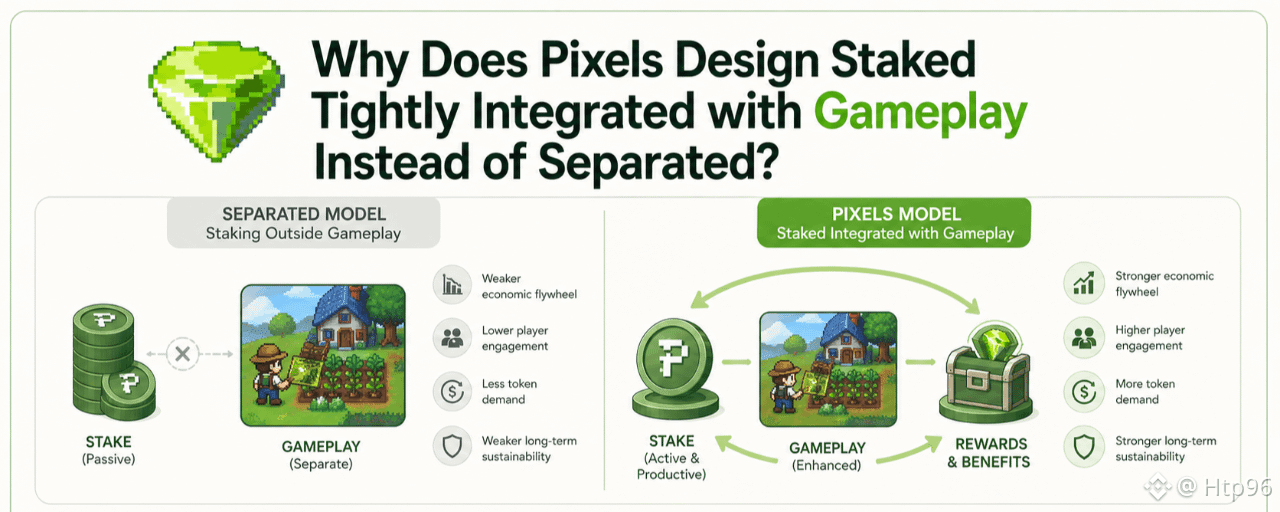
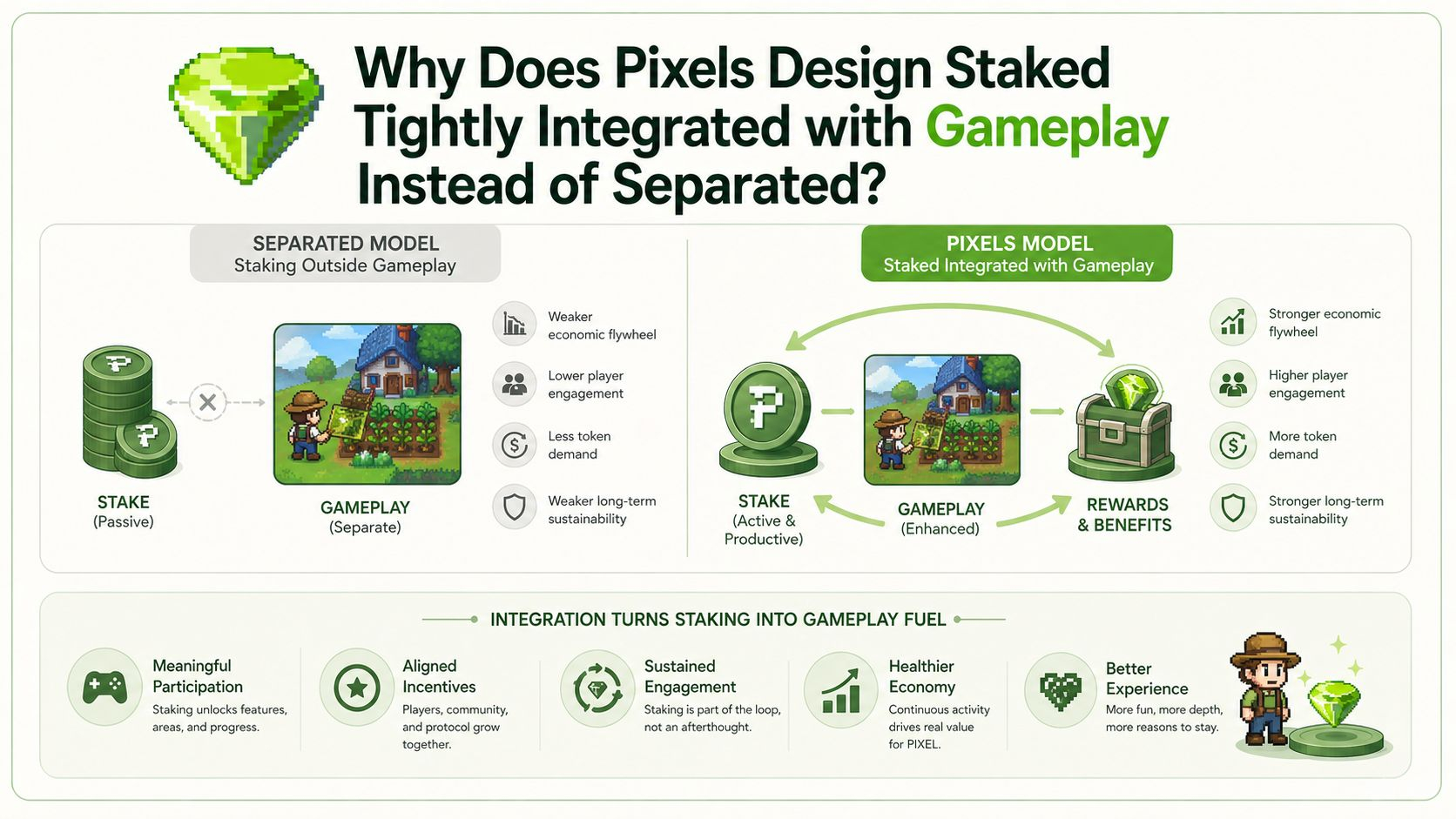
They die because the staking layer and the gameplay layer operate like two separate circulatory systems.
Pure stakers have no reason to care about the health of the in-game economy.
Their returns do not depend on that.
Pure gamers also have no reason to lock PIXEL into the system.
Because doing so doesn't affect their experience.
Those two parallel loops create a structural conflict.
The team benefiting from rising token prices is not the group building real value inside the game.
When that conflict becomes significant enough, selling pressure always prevails.
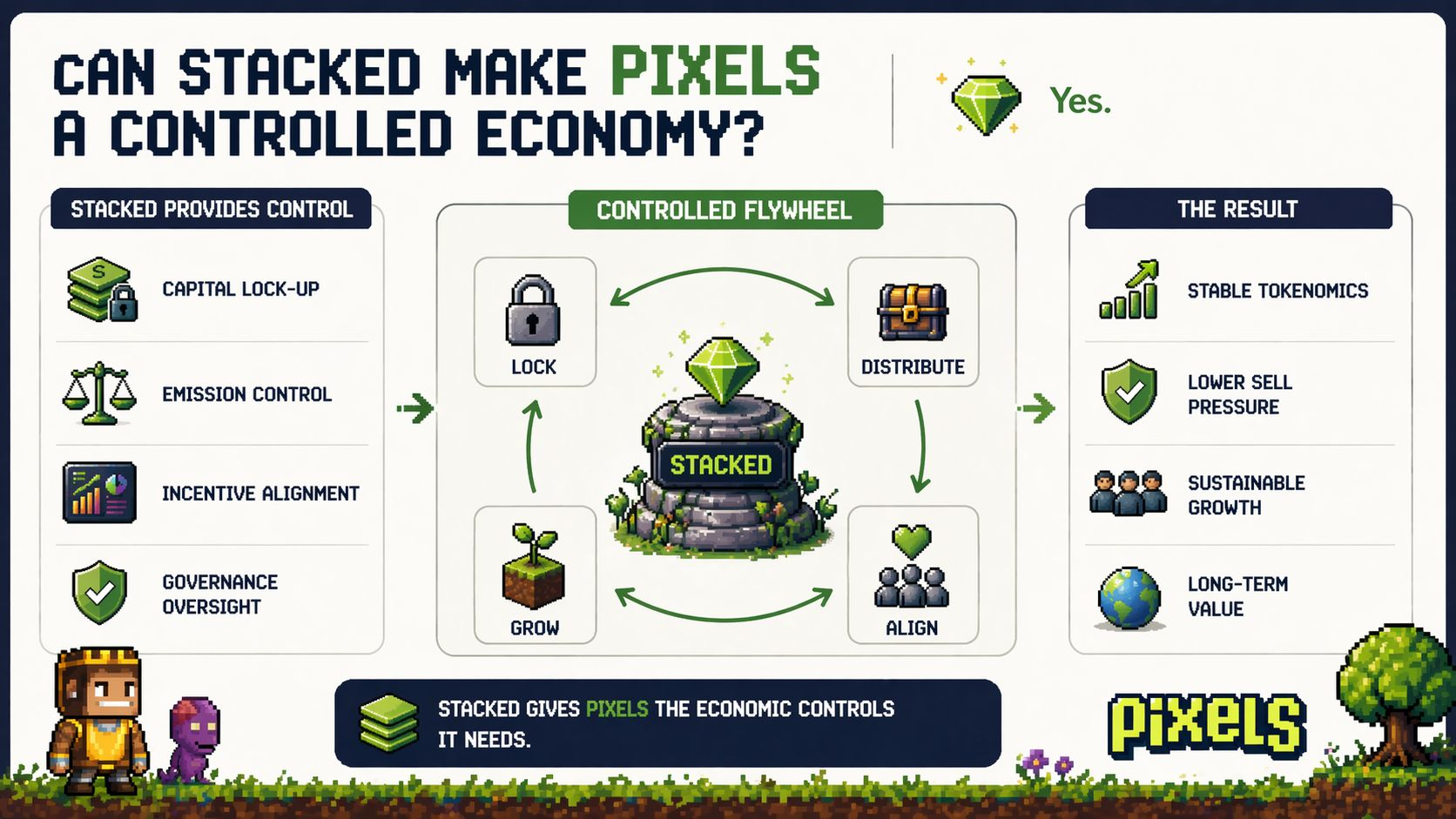
Stacked linked to gameplay is how Pixels breaks this structure at the architectural level.
When the two layers are connected, one thing changes immediately: motivation.
PIXEL stakers now have economic reasons to care about the quality of gameplay.
Because their rewards are no longer fixed but dependent on real activity in the system.
Serious players also have a reason to stake.
Because that directly affects how Stacked evaluates and distributes rewards to them.
In mechanism design, this is called aligned incentives.
When the interests of the parties naturally push them towards behavior beneficial to the system.
No need to enforce with rigid rules.
But the more sophisticated point, often overlooked, is the issue of information.
A separated staking layer only knows one thing:
how many tokens you lock.
No more.
But when Stacked is tied to gameplay, the system starts to accumulate behavioral data.
Where users are creating value.
Which direction are they pulling the value stream?
Are they providing liquidity or extracting from the system?
That data layer allows rewards to be distributed based on behavioral quality.
Not just by the number of tokens.
This is something that an independent DeFi layer can hardly have.
And that's also why a figure like over 25 million USD in revenue can't come from a separated staking layer.
It comes from mining the right intersection between player behavior and the value stream of the system.
Of course, this design isn't free.
It comes with a risk that I see few people talk about directly.
Stacked becomes a mutually dependent system in both directions.
If gameplay weakens, the staking layer loses behavioral data to operate correctly.
If Stacked tiers incorrectly, the reward flows to the wrong place.
Real players lose motivation even if the gameplay is still good.
These two layers can no longer fail independently.
They pull each other down.
Or push each other up.
At the same time.
This is a much more serious design risk than what whitepapers usually acknowledge.
A separated staking layer can exist even if the game dies.
This has happened many times.
But Stacked tied to the gameplay of Pixels doesn't have that option.
If one layer collapses, the whole system collapses with it.
I don't see that risk as a weakness.
I see it as a form of commitment.
When the team chooses a design with no easy exit,
They are betting on their own long-term consistency.
In Web3 gaming,
There’s no signal cheaper than a pretty whitepaper.
And there's no signal more expensive than an architecture that doesn't allow you to exit without losing everything.
That's why I'm monitoring Pixels not because of the roadmap.
But because of how they designed something they cannot easily pull out.
@Pixels $PIXEL #pixel