
In 2025, there was a slowdown in corporate lending growth: in the non-financial companies segment, it was 12.9% compared to 19.5% the previous year, according to data from the Bank of Russia. This restrained dynamics is explained by the persistently high level of rates in the economy.
In a market where credit costs are still high and borrower requirements are tightening up, Russian businesses are increasingly looking for alternative funding sources. For instance, some tools in the debt market are experiencing a real renaissance—the volume of issued corporate bonds has jumped by 40% compared to 2024. This financial instrument has become a "lifesaver" for many companies, allowing them to secure financing for durations that are optimal for their business cycles: from a few months to several years.
Which companies are currently issuing commercial bonds?
Commercial bonds are interesting in current conditions for both large businesses and smaller companies without sector limitations. For example, the latest major issuers include marketplaces, tech banks, developers, and metallurgists. From March 2024 to March 2026, several well-known companies successfully raised over ₽160 billion in debt, with foreign currency placements totaling around 5 billion yuan and 200 million dirhams. These included LLC 'RVB' (United Company Wildberries & Russ), 'Rusal', 'T-Technologies', MFC 'T-Finance', and 'MTS'.
Smaller companies with serious ambitions use commercial bonds not only as a borrowing tool but also as a 'trampoline' to public status. Entering the capital market requires issuers to be transparent, disciplined, and skilled in communicating with investors. Therefore, commercial bonds allow businesses to gently 'try on' the role of a public issuer.
This approach allows them to gradually build capitalization and investor trust on their way to their initial public offering, considering that in 2026 about 20 companies may enter the market.
The largest packaging producer for dairy products in Russia, 'Lambumiz', started its journey towards going public in 2017 by issuing commercial bonds. In 2019, the company entered the market for exchange-traded bonds, and in 2024, it raised over 800 million rubles through an IPO on the Moscow Exchange.
A similar path was taken by the resale market operator 'MGKL', which issued commercial bonds in 2020, exchange-traded ones two years later, and an IPO in 2023 raising over 300 million.
What are the advantages of commercial bonds?
Against the backdrop of increased requirements for obtaining loans, commercial bonds remain a fast and simple tool for companies. Issuers are subject to standard requirements: a stable cash flow, a clear business model for the deal, and alignment with the company's profile. These requirements make the instrument accessible even for young businesses.
Additionally, no audit of financial statements, credit rating assignment, or registration of emission documents with the Bank of Russia is required—the entire registration and placement procedure is conducted by the National Settlement Depository (NSD). The registration period for commercial bonds is up to seven days.
Moreover, bank lending almost always requires collateral in the form of tangible assets: real estate, equipment, or goods in circulation. This puts companies in the IT, services, or those with significant intangible assets, which cannot be pledged in the traditional sense, at a disadvantage. Commercial bonds solve this problem as the lack of mandatory collateral requirements significantly expands the pool of potential issuers. Thus, companies whose main assets are products in high demand by the target audience, technologies, teams, and reputation can count on market financing.
The instrument is also becoming a full-fledged and convenient alternative to targeted and intra-group loans. The possibility of private placements allows companies to work with a limited circle of investors and not enter the broader market.
For large financial-industrial groups, issuing bonds allows them to replace cumbersome chains of bilateral loan agreements between subsidiaries. The ability to structure a loan according to their business profile adds flexibility to the instrument, allowing them to issue commercial bonds not only with a fixed coupon rate but also with a floating coupon linked to the Central Bank's key rate or the RUONIA rate. Nominal values in foreign currencies with settlements in rubles are permitted under the issuance conditions.
Can retail investors buy commercial bonds?
Commercial bonds can also be interesting to retail investors. Buying such bonds is an opportunity to invest in new or well-known companies in the primary market, potentially gaining higher returns.
Moreover, there are several large companies in Russia that are showing confident growth rates but have not yet gone public. In this situation, purchasing commercial bonds is the only way to participate and have the opportunity to profit from their potential growth.
Commercial bonds can be purchased by both qualified and non-qualified investors through their brokers, similar to how other types of bonds are acquired. Currently, many major brokers offer this opportunity to their clients.
At the same time, the National Settlement Depository (NSD) and the Moscow Exchange plan to organize secondary liquidity for such securities, allowing clients of various brokers to trade commercial bonds with each other. The secondary liquidity market fundamentally distinguishes commercial bonds from digital financial assets (DFAs), as DFAs circulate only within a single operator of information systems (IS).
What happened to the commercial bond market in 2025?
The total amount of funds raised through placements reached nearly ₽200 billion, with 45 issues, which is 40% higher than the 2024 figure. Every fifth issue is a repeat placement from issuers who have previously utilized this product. In the first two months of 2026, issuers placed around ₽50 billion.
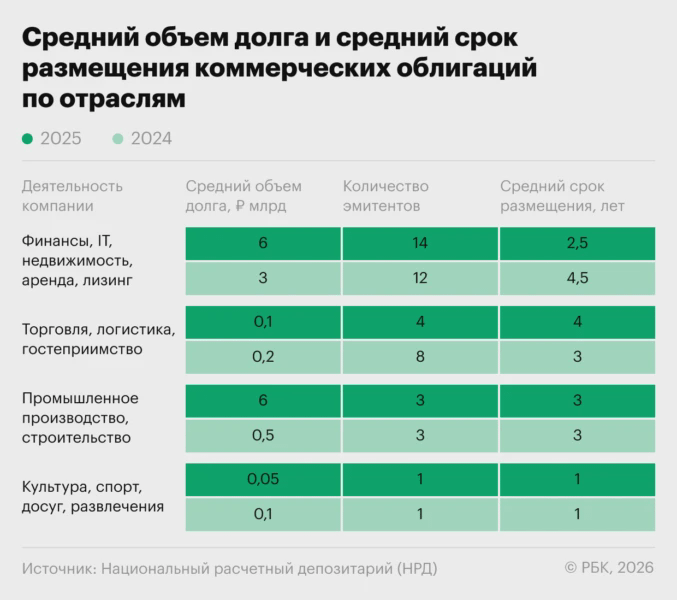
The past year and the start of 2026 are characterized by interest in the instrument from major players in the financial, IT, real estate, leasing, and rental sectors, as well as a reduction in borrowing terms. The maturity of issued bonds ranges from one year to four years. At the same time, issuing companies determine the borrowing term themselves—there are no regulatory or technological restrictions.
So, the commercial bond market in Russia is showing a steady and accelerating growth in 2025–2026, both in volume and number of participants. The key drivers are major companies from the financial, IT, real estate, and industrial sectors, which are increasingly choosing bonds as their main debt financing tool.
A high level of repeat emissions (20%) confirms the reliability and attractiveness of the market for issuers and investors, while the absence of regulatory barriers contributes to the market's flexibility and adaptability, making it promising for further development.
#TurbulentWorldOfStocks , #freedomofmoney
Enjoy your viewing. We welcome each of our subscribers or attentive readers who share interesting news with those who love to stay informed about changes in global economic and political news. Often, the economy and politics deeply influence each other, and ultimately become deeply interconnected phenomena.
Also, for those who like to stay updated on the operational coverage of changes in the global financial and economic agenda, there is always the opportunity to like an interesting article, tip the authors, or leave comments on the topic.