
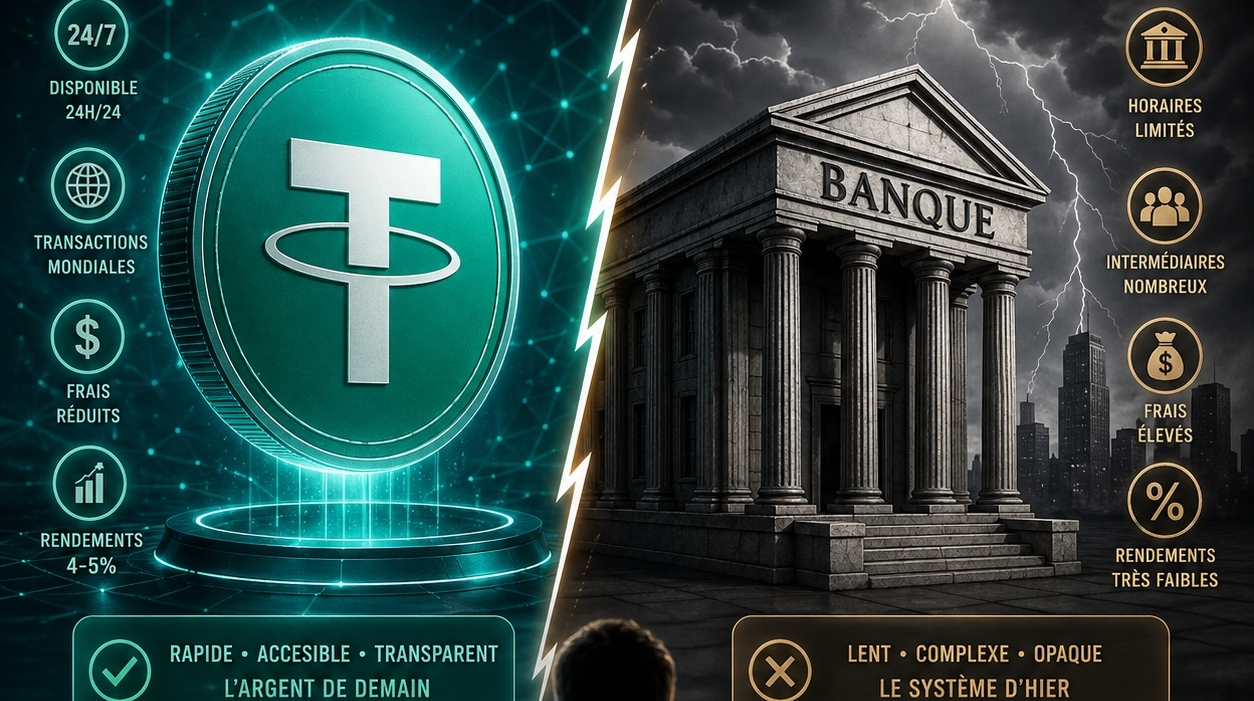
This question sends shivers down Wall Street. And for good reason: the global market cap of stablecoins has surpassed $315 billion, and this is just the beginning.
💸 The scenario that freaks out the banks
Imagine this: you pull your cash from the bank and swap it for USDT or USDC. That money is completely off the banking grid. The stablecoin issuer is gonna use those funds to scoop up U.S. Treasury bonds—totally bypassing your bank, which loses out on its raw material: your deposits.
And that's exactly what big banks fear. The CEO of Bank of America warned that up to $6 trillion in deposits could leave traditional banks for stablecoins if the latter were allowed to pay interest.
📈 Why are people moving to stablecoins?
It's simple: if crypto platforms offer 4 to 5% on stablecoin deposits, while big banks offer 0.5% on savings, it makes sense for depositors to move their funds.
24/7 accessibility, low fees, higher yields... the benefits are real.
🌍 Emerging markets: the most exposed
Standard Chartered predicts that over $1 trillion could leave emerging market banks to be invested in stablecoins by 2028.
Countries with high inflation and limited access to the dollar are on the front lines — and Algeria is part of this category.
⚖️ The banks' and regulators' counterattack
The Bank for International Settlements (BIS) refuses to consider stablecoins as real currencies and calls for strict international regulation.
Banks, on the other hand, are spending millions on lobbying to slow down their adoption.
But as the story of disruptive technologies goes: does the old system ever win these kinds of battles?
Stablecoins won't 'kill' banks overnight. But they are forcing a silent revolution. Financial institutions will have to adapt or lose their clients, generation after generation.
The real question: have you started using stablecoins yet? 👇 Let me know in the comments!
#Stablecoins #Crypto #usdt #USDC #BinanceSquare #Finance #Web3 #Bitcoin