

For years, crypto has explained finance with three tags: TradFi for banks, exchanges, and traditional rules; CeFi for centralized crypto platforms; and DeFi for smart contracts, self-custody, and open protocols.
This map is still useful, but it's no longer enough. Binance Research dropped a report on April 15, 2026, with a clear thesis: the boundaries between these three systems are blurring towards a more integrated financial ecosystem. In Binance Square, Yi He also pointed in that direction when discussing Binance as global financial infrastructure.
We can call this stage the TriFi era. Not as an official category or a promise without risks, but as a simple way to describe products where payments, trading, tokenization, liquidity, custody, and on-chain rails blend on the same screen.
The data behind the change
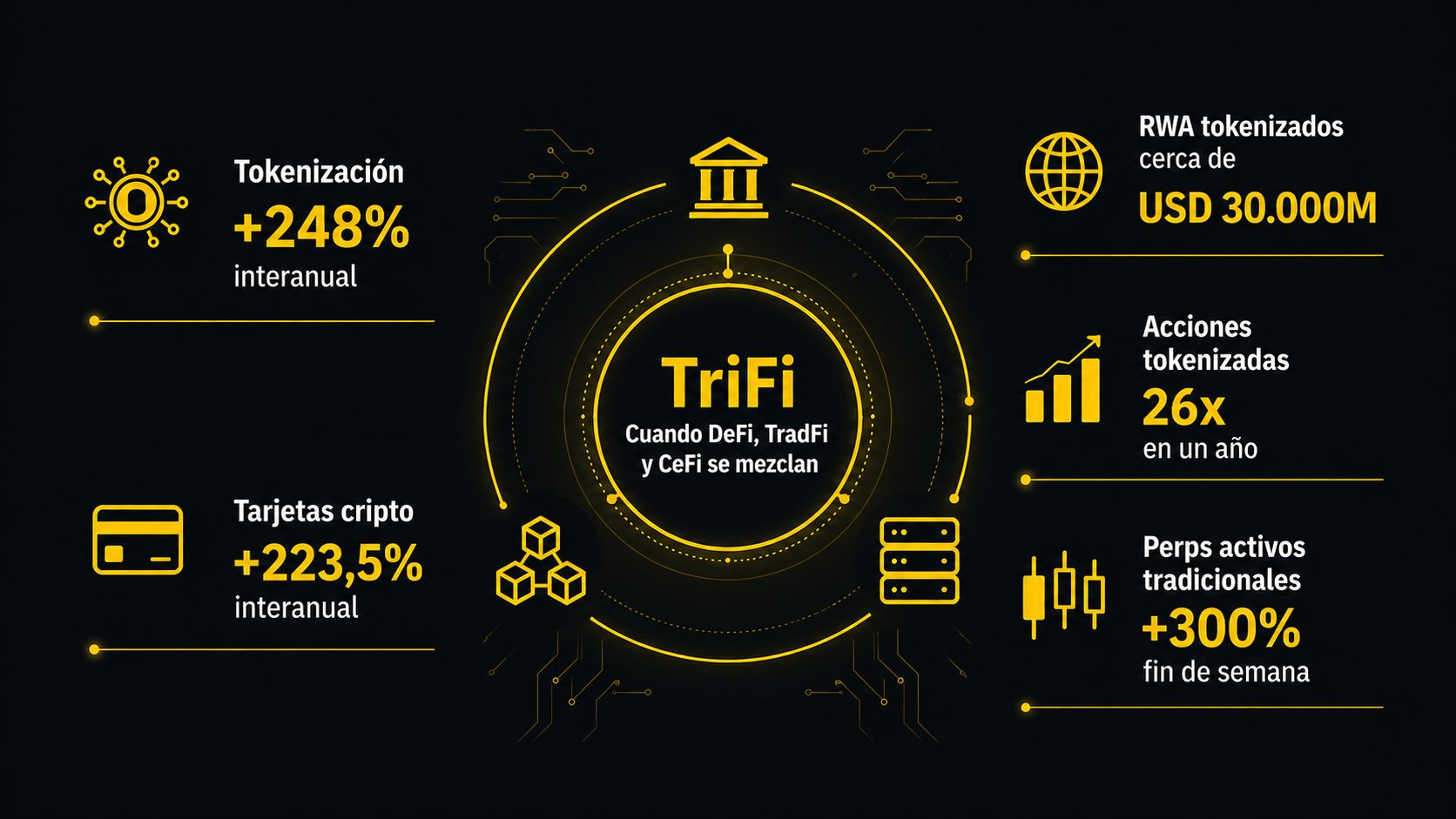
The Binance Research report shows strong signals. Tokenization grew nearly 248% year-over-year, approaching USD 30 billion in market value by April 2026. Tokenized stocks jumped from about USD 38 million to nearly USD 1 billion in a year, a 26x leap. Monthly crypto card volume surged by 223.5% year-over-year. And the average weekend trading volume in perps of traditional assets rose around 300% from January to March 2026.
The point isn't that all those products are the same or suitable for everyone. The point is that the data points in the same direction: TradFi seeks more programmable rails, DeFi seeks distribution and better experience, and CeFi acts as a bridge for users who don't want to manage every technical detail.
What changes for the everyday trader

It used to be common to ask: 'Is this DeFi or CeFi?'. In the TriFi era, that question feels outdated. A product can have a centralized interface, traditional reference asset, on-chain representation, compliance rules, KYC, transfer restrictions, and connection to DeFi protocols.
That's why traders need to focus less on the label and more on the architecture. First, custody: who controls the asset, the account, or the key. Second, liquidity: where the price forms and how easy it is to enter or exit. Third, compliance: what restrictions apply based on jurisdiction, issuer, or user. Fourth, risk: what can fail, from a smart contract to an oracle, a bridge, a counterparty, a vault, or the underlying market.
A tokenized stock, for example, shouldn't be automatically read as a traditional stock or a common crypto token. It may represent economic exposure to an underlying asset, but it depends on the issuer, custodians, redemption rules, corporate events, and access conditions. If it's later used as collateral in DeFi, another layer appears: liquidations, oracles, and protocol parameters.
The interface may feel simple. The architecture doesn't disappear; it just becomes less visible.
The correct reading of TriFi

TriFi doesn't mean that TradFi, CeFi, or DeFi will disappear. It means their functions are blending. TradFi brings assets, licenses, rules, and institutional depth. CeFi brings distribution, onboarding, support, and liquidity. DeFi brings programmability, operational transparency, composability, and settlement on open rails.
When those pieces integrate well, they can reduce real friction. When they integrate poorly, they can hide risks behind a comfortable experience. That's the tension for the next five years: we will likely see more platforms attempting to unite institutional compliance, simple UX, deep liquidity, and DeFi composability. But more integration doesn't automatically mean more security, higher returns, or less responsibility.
The trader's advantage won't just be finding the next narrative. It will be understanding which part of the product is traditional, centralized, decentralized, or reliant on external trust.
If you're new to the ecosystem and want to explore Binance with your own account, you can register here.
Conclusion
The TriFi era doesn't ask you to blindly believe in convergence. It asks you to learn to read hybrid products with more discernment. The important question is no longer just 'Is this DeFi, CeFi, or TradFi?', but: who holds custody?, where is the liquidity?, what rules apply? and what risk lies beneath the interface?
If the trader understands this, they stop trading solely by narrative and start reading structure.
What should we learn to look at?
In your opinion, will the key skill of the trader in the TriFi era be finding new opportunities, better understanding the infrastructure, or detecting hidden risks behind a simple interface?
I'm interested in reading your perspective in the comments. You can also follow my profile for future educational posts on crypto infrastructure and tokenization. If this article helped you clarify the topic, share it with someone who still sees these three worlds as if they don't touch.
⸻
This article should not be considered financial advice. Always do your own research and make informed decisions when investing in cryptocurrencies.