
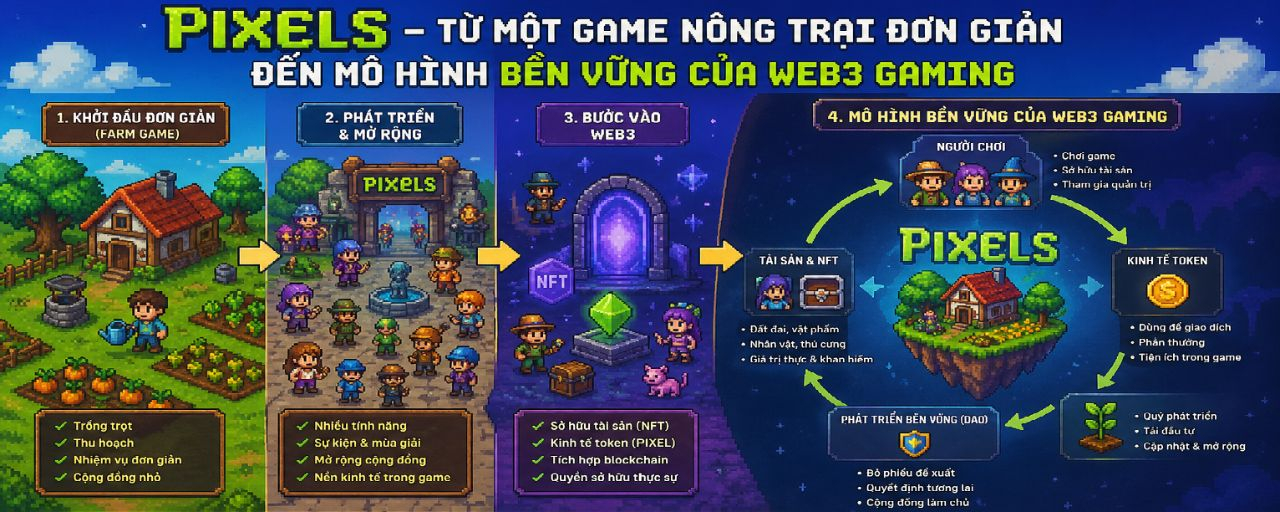

The first time I opened @Pixels , I honestly didn't expect much. Simple pixel graphics, planting crops, chopping wood, gathering resources... at first glance, it looked just like a regular farming game. I even thought, "What's so special about this game that everyone is playing it so much?"
But I didn't quit the game right away. The longer I played, the more I realized the interesting part: #pixel it doesn't try to impress quickly, but instead focuses on building an ecosystem that makes players want to stick around for the long haul.
Not Chasing Quick Profits
Many previous blockchain games focused on one thing: quick money. Players come in, farm tokens, dump, and then leave. The result is an imbalanced system, token devaluation, and a disbanded community.
But Pixels goes in the opposite direction. This game slows everything down.
Planting trees requires patience.
Upgrades require accumulation.
There's no real shortcut that is sustainable.
That slow pace creates a sense of 'realness'. You're not just playing for rewards, but gradually forming a habit.
The Value Of Small Actions
Initially, I found planting seeds, cutting wood, and mining quite repetitive. But after a while, I realized everything is interconnected:
Wood today helps upgrade tools tomorrow.
Crops planted today provide resources for future expansion.
Nothing is wasted. Everything is in a cycle.
Limited energy and time also force me to think more. You can't do everything at once. You have to calculate. This turns the game into a small strategic puzzle every day.
The Balance Between Landowners And Workers
One point I appreciate is the land mechanism.
Some own land, some don't. But both are important:
Landowners provide space.
Other players contribute effort.
This creates a mutual dependency instead of everyone playing independently. It makes the ecosystem feel more 'alive', rather than just a personal reward game.
Mistakes And How To Fix Them
The game once had an imbalance when some players exploited simple repetitive actions for advantage. But instead of letting it be, the development team adjusted the mechanics, reducing the advantage from spamming monotonous actions.
Rewards are now more focused on:
Real effort
Diversity of activities
Collaboration between players
This makes the system harder to exploit and more sustainable in the long run.
Simple On The Outside, Complex On The Inside
The graphics of Pixels are still very basic. But I think that's intentional.
The game is easily accessible from the outside, but the depth lies in the economic structure and internal mechanics. The slow pace allows players to get used to improving bit by bit: better tools, better strategies, better efficiency.
There are no surprising 'huge' rewards. Just steady accumulation.
Challenges Ahead
However, I still see some challenges:
As the number of players increases, maintaining economic balance will be more challenging.
Simple gameplay can make veteran players want to add new depth.
If we expand too quickly, the game could break the stability that is its biggest strength.
Therefore, slow but steady growth is probably the most reasonable strategy.
Personal Conclusion
For me, Pixels is not just a Web3 farming game. It's like an experiment in sustainability within blockchain gaming.
Instead of attracting players with quick profits, the game retains them with:
Reasonable pace
Tightly connected mechanism
A real sense of progress over time
And perhaps that's what matters in Web3: it's not about how quickly you can earn, but how long the system can last.
What about you? Do you prioritize short-term profits or a sustainable ecosystem that can grow for years? $PIXEL