


Hong Kong IPOs are going wild this year, but how can you participate without a Hong Kong bank card?
Let's take a look at some data: out of the 44 stocks that went public in Hong Kong in 2026, only 5 dipped below their IPO price, while there were plenty that surged over 50% on the first day. Stocks like Zhizhu and MiniMax even hit 10x gains at their peak, and just a few days ago, Xizhi's dark pool trading skyrocketed by 4x. A ~50% allocation rate is pretty common, and you can clearly see the profit potential.
However, for users from mainland China, getting into Hong Kong IPOs has always been a nightmare: can't get the HK bank card, forex limits are tight, cross-border exchange losses are a hassle, and traditional brokers take forever to approve accounts—often over half a month. By the time you get through the process, the hot new stocks have already cooled off.
So, for Web3 players holding only USDT/USDC, how do they get in?
I recently tested StableStock—a new generation of brokers that starts from the crypto side and connects with licensed broker clearing. Connect your wallet, deposit stablecoins, KYC available for mainland users, and directly participate in Hong Kong stock IPOs with zero HK cards, zero currency exchange, plus two free new listing opportunities upon registration. It's not about making stocks into synthetic tokens for you to play with, but about directly sending orders to the Hong Kong Stock Exchange for matching, with underlying stocks custodied at DTCC, and weekly broker statements for verification.
I'll explain this project in one go: what it is, why it's worth paying attention to, how to play, and what pitfalls to watch out for.
Registration portal: https://app.stablestock.finance/?join=LYS01 (40% fee rebate, plus two chances for free new listings).
1. What is StableStock? Explained in one sentence.
StableStock is a new generation broker friendly to stablecoins, allowing you to buy and sell real US stocks, Hong Kong stocks, and ETFs, and participate in real IPO new listings without needing an overseas bank card.
Pay attention to three words:
Real stocks: what you buy is not a synthetic token or a derivative. Orders are directly sent to NASDAQ, Hong Kong Stock Exchange, and other real exchanges for matching, with weekly broker statements for verification.
Stablecoin settlement: recharge, trade, and withdraw all done in USDT/USDC, no need for foreign currency bank cards.
Licensed clearing: StableStock has obtained approval from Australian regulators, operating under the regulatory framework of licensed financial institutions in Australia; underlying brokers are deeply bound to HabitTrade; stocks are ultimately custodied in the US mainstream clearing system (DTCC), cleared and custodied by CITIC Securities (USA) and Velox; USD funds are custodied in regulated banks like DBS; crypto assets are custodied by Safeheron.
Simply put, the frontend is a Web3 experience, and the backend is a complete puzzle of traditional brokers + banks + crypto custody.
2. Why is it worth paying attention to at this time?
Back to the point I've been making: big opportunities arise at the intersection of two original fields.
Traditional brokers are listing cryptocurrencies while crypto exchanges are listing stock tokens; both sides are moving towards the middle. The StockFi (crypto-stock fusion) track essentially sees who can hold both compliance licenses + stablecoin channels. StableStock is one of the few players in this track that "comes from the crypto side and directly connects with licensed brokers for clearing."
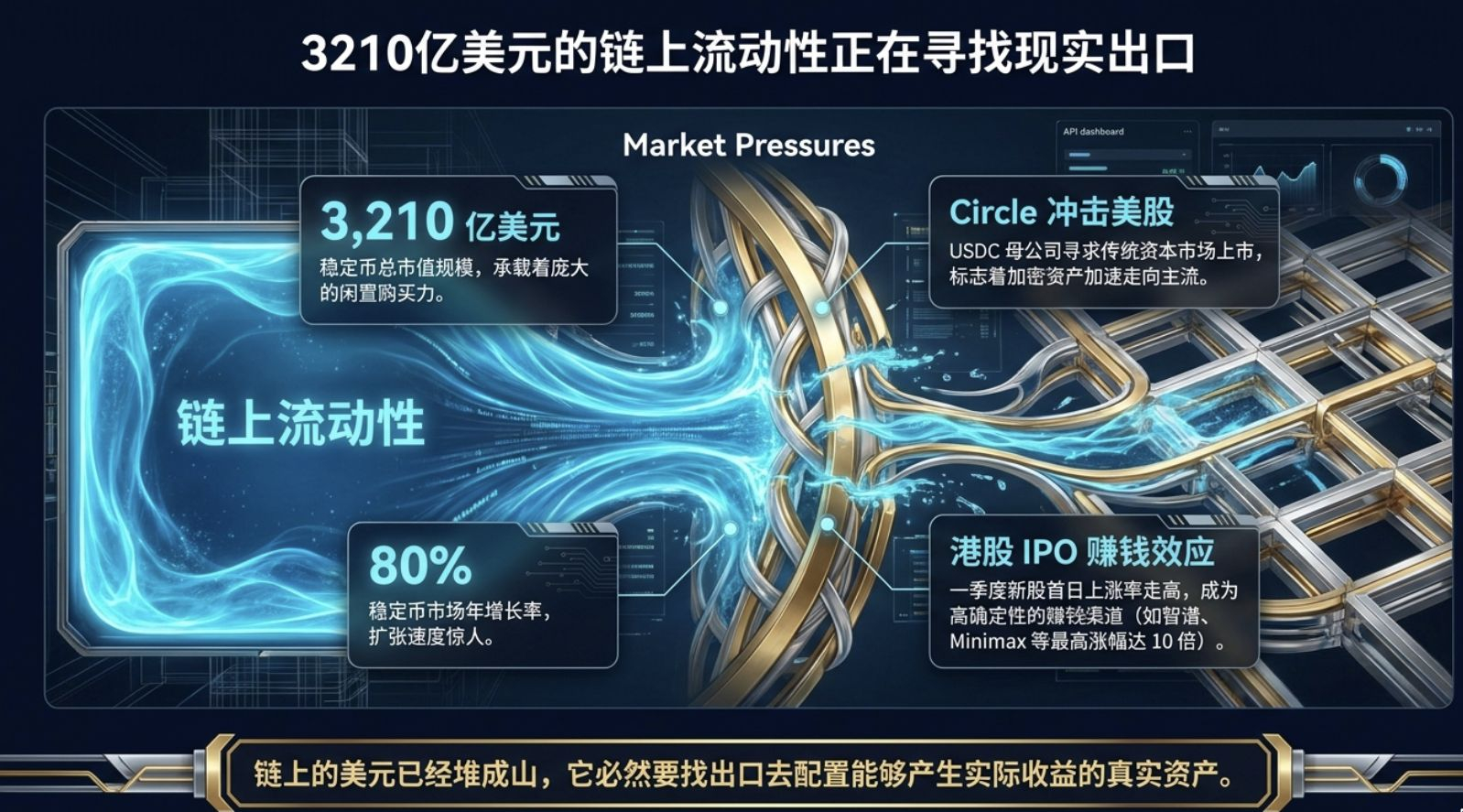
On the crypto side: the total market cap of stablecoins has reached ~321 billion USD, with an annual growth of ~80%. The parent company of USDC, Circle, has already listed on the US stock market. The on-chain dollars have piled up, and they are bound to find exits to allocate real assets.
On the traditional side: Futu, Tiger, and Robinhood are all supplementing crypto trading licenses; the first-day increase rate of new stocks in Hong Kong has risen, and the profit effect of new listings is obvious, making Hong Kong stock IPOs a profitable channel.
In the middle ground: projects moving from the crypto side to traditional brokers in the past few years have either been tradfi stock token contracts (exchanges and tradexyz) or mirrored stocks (ondo and xstock). Currently, there’s only StableStock that allows trading with stablecoins, with the underlying being real stocks and licensed brokers handling clearing.
StableStock is a candidate stuck in this gap. The funding lineup is also quite solid: YZi Labs, Matrix Partners, Vertex Ventures (Temasek-backed), Amber, 10K Ventures, etc. It covers sovereign capital, top dollar funds, international market-making institutions, and crypto industry capital. Institutional willingness to bet usually indicates that the direction of this track is right, but just because the track is right doesn't mean the project will definitely win; these two things need to be viewed separately.
StableStock's project fundamentals data:
US stocks + ETFs have been running stably, with targets ~450+.
Official launch of Hong Kong stock trading on March 17, 2026, with the first batch of 160+ targets (blue chips, technology, new energy, biomedicine, ETFs all covered).
Hong Kong stock IPO new listings opened in April, with a hot new listing month activity in April-May 2026, providing two free opportunities to participate in new listings.
Cumulative trading volume has exceeded $49.8 million.
Smart contracts have undergone double audits by Blocksec and Certik.
3. Highlights: why many people rush to it for Hong Kong stock IPOs.
Traditionally, Hong Kong IPOs have been a nightmare for mainland users: needing HK cards, dealing with foreign exchange limits, cross-border currency losses, and the hassle of traditional broker account approvals. StableStock has essentially dismantled these barriers.
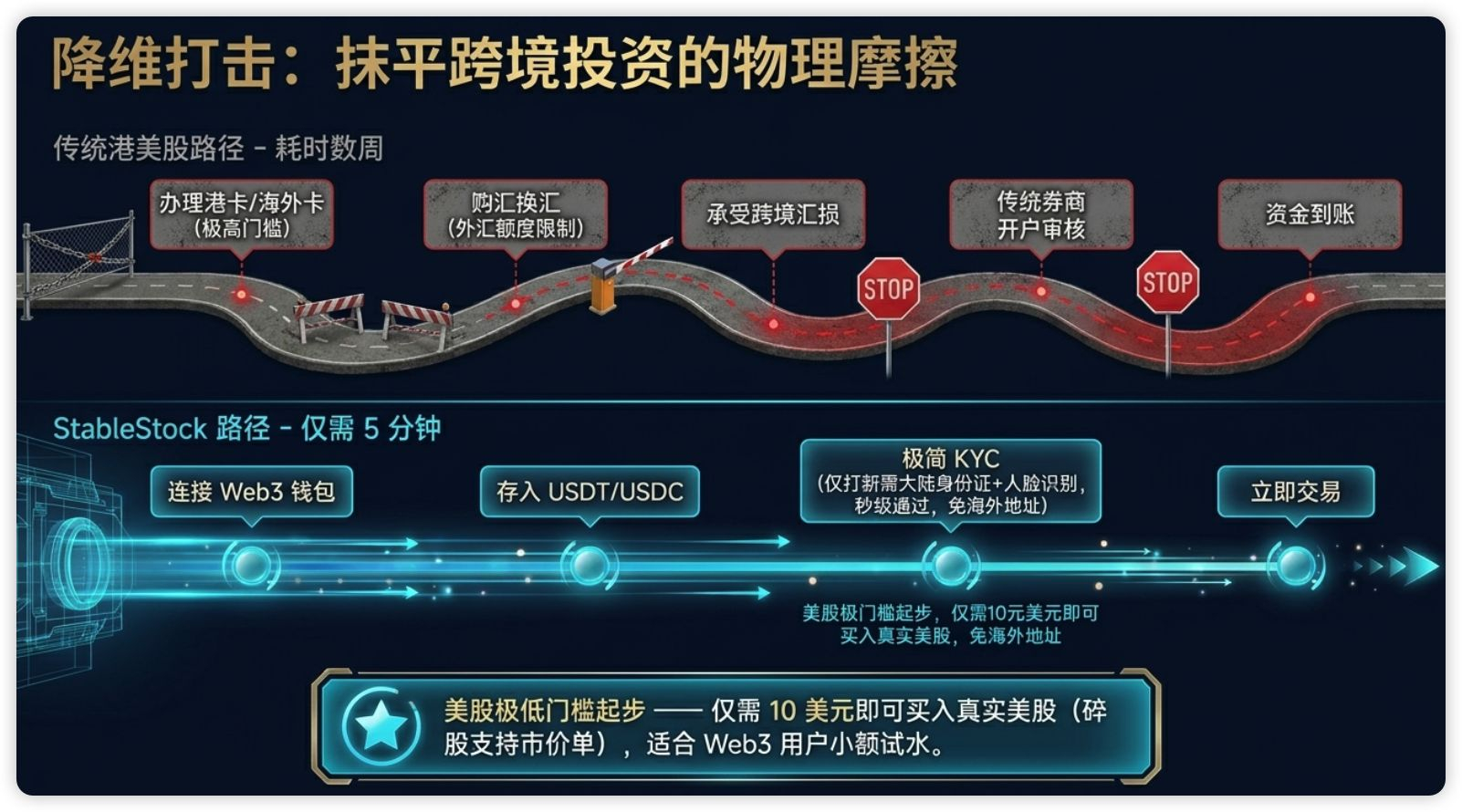
Zero HK card, zero currency exchange: connect your wallet, deposit USDT/USDC, and you're good to go. Official deposit/withdrawal rates as low as 2 bp.
KYC is super simple: regular stock trading doesn't require KYC (bypassing CRS); new listings must KYC, mainland ID + facial recognition works, tested in seconds (no overseas address needed).
Stablecoins directly leverage Hong Kong stock IPOs: stock selection, subscription, winning shares, selling out, and withdrawing USDT all done with one wallet.
Leveraged subscription: supports broker financing, but financing costs are high; it's better to directly borrow low-cost stablecoins.
Low entry threshold for deposits: you can buy US stocks starting from just $10, suitable for small trials.
Activity period subsidies: from April 20 to May 20, during the hot new listing month, new users can participate in two free new stock subscriptions.
Complete dividend rights: holders of on-chain tokens enjoy the same dividend rights as real stocks; dividends are subject to withholding tax as per regulations before disbursement.
I've boiled down its core value into one sentence: for Web3 players holding USDT but lacking HK cards / US stock accounts, it’s a game-changing practical tool. This positioning is clear.
4. Hong Kong stock new listing notes.
1. Leverage financing rates are not cheap.
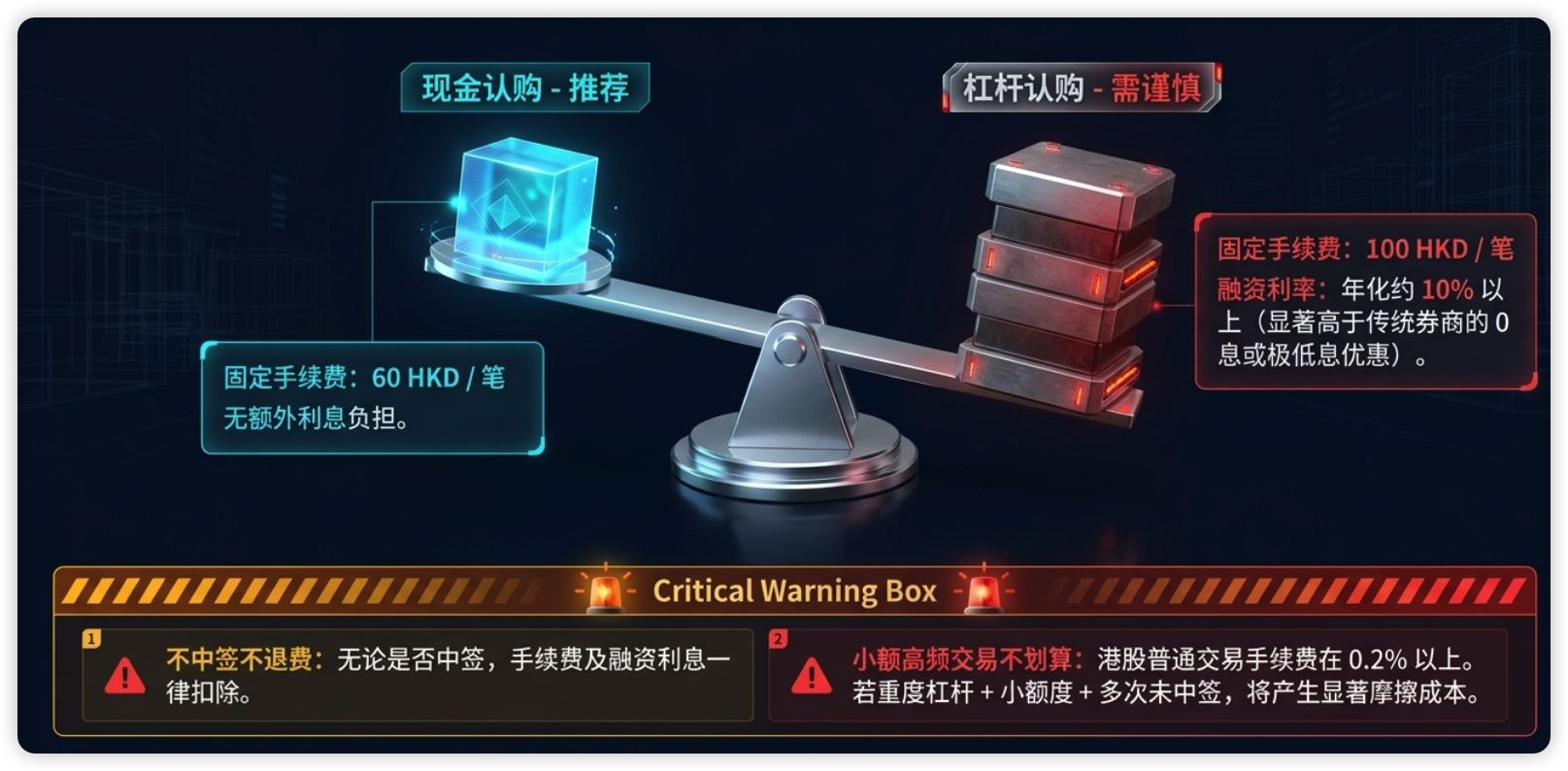
Leverage subscription financing rate is about 10% per annum or more.
For example, subscribing for 35 lots with 5x leverage requires 100 HKD in leveraged financing for new listings, plus additional financing costs. This is the cost required every time you subscribe, regardless of winning or losing shares. It may not seem like much, but compared to traditional brokers with zero interest or very low-interest IPO financing, the difference is notable.
Conclusion: Small funds + high leverage for new listings is low cost-effective; large funds for cash subscription have almost no difference.
2. Fixed fees + non-refund for failed subscriptions.
Cash subscription: a fixed fee of 60 HKD per order.
Leveraged subscription: a fixed fee of 100 HKD + financing cost per order.
Failed to win shares: handling fees/financing costs are non-refundable.
Hong Kong stock trading fees start from 0.2% and can be higher for small trades.
If you're heavily leveraged and have multiple failures with small new listings, that's not very cost-effective.
3. Winning rate and yield.
Winning announcements can be seen in the platform's public notices, including the number of applicants, subscription lots, etc. The winning rate for one lot is around 10%. The benefits of this year's Hong Kong IPOs have been decent, with many stocks increasing over 50% on their first day of listing, including Zhipu and Minimax, which have seen maximum increases of 10 times. However, there were also stocks that broke even on their first day, but the probability is quite low. Statistics show that among the 44 stocks listed this year, 5 stocks have broken even; today, Xizhi even quadrupled on the dark market.
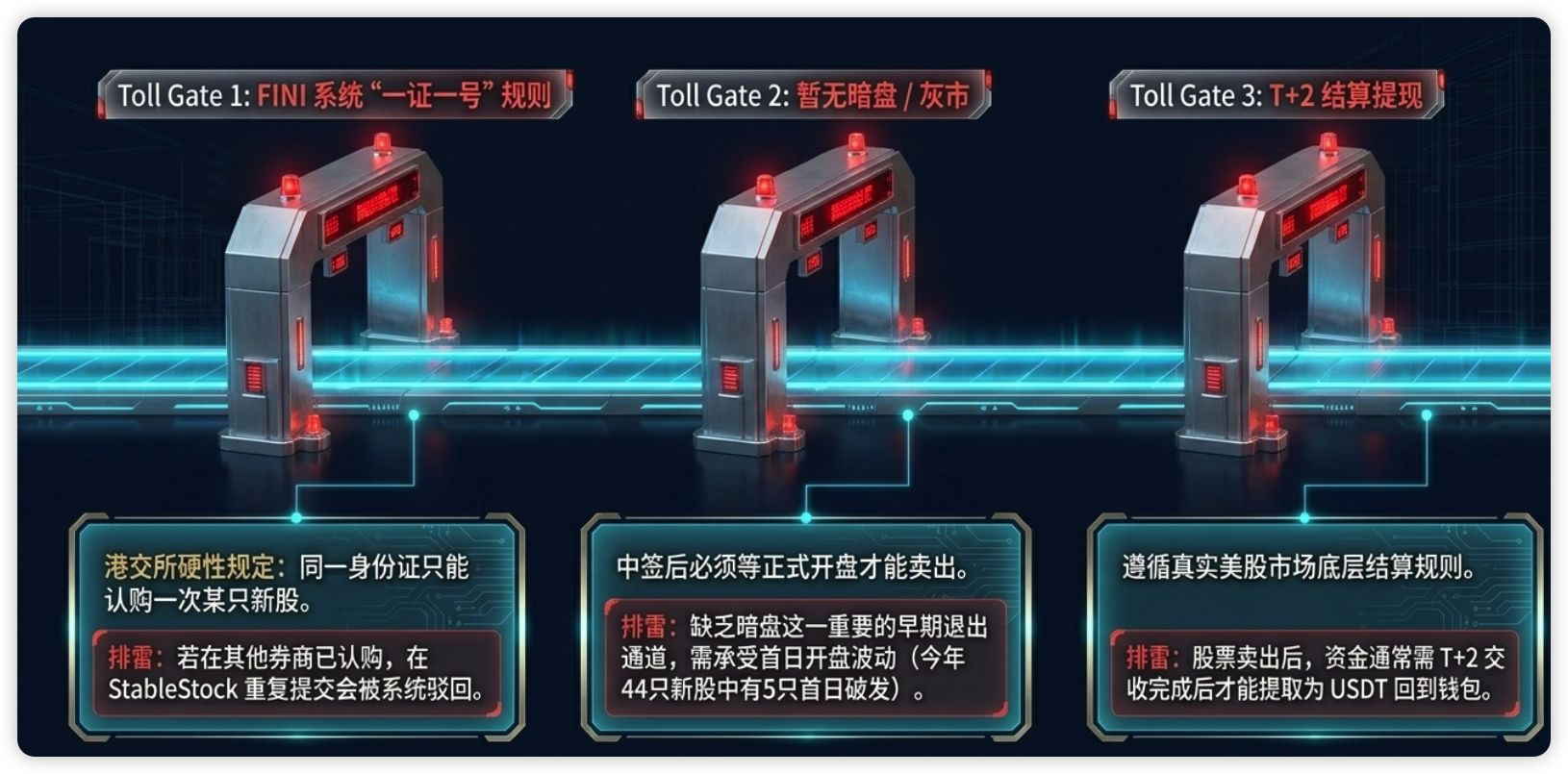
3. One identity can only subscribe once.
Hong Kong Stock Exchange FINI system hard rule: the same ID can only subscribe once for a particular new stock. If you’ve subscribed through other brokers, resubmitting at StableStock will be completely rejected; the system can check this. If you want to participate with multiple accounts, you can only ask family and friends to open individual accounts. This rule isn’t a restriction by StableStock, it's a requirement from the Hong Kong Stock Exchange, so don't blame the platform.
4. Currently does not support dark markets / grey markets.
You must wait until the official opening to sell after winning shares. For many new listing enthusiasts, dark markets are an important exit channel, but currently, StableStock doesn't have that; StableStock will wait until the listing to sell.
5. Can be used in the exchange wallet app.
Currently, the PC web experience is the best, while the mobile version is a web version; there’s no app yet, but you can directly use it in Binance and OKX wallets.
6. T+2 withdrawal rules.
Funds from stock sales need to comply with US stock market settlement rules, usually requiring T+2 completion before withdrawal to your wallet. This is a rule of the US stock market, not a delay from the platform.
7. Coverage of targets is better than stock exchanges in crypto.
US stocks 450+, Hong Kong stocks 160+, better than most crypto exchanges' stock modules, but still not as good as traditional internet brokers like Futu and Tiger.
Notes:
5. Practical operation: the full process from registration to winning in new listings.
1. Register + Deposit (5 minutes).
Official website/APP: https://app.stablestock.finance/?join=LYS01 (40% fee rebate).
Email registration or wallet login (supports Google login, Binance Wallet, OKX Wallet).
Deposit USDT / USDC.
Regular trading does not require KYC; new listings must KYC.
2. US stocks / Hong Kong stocks trading.
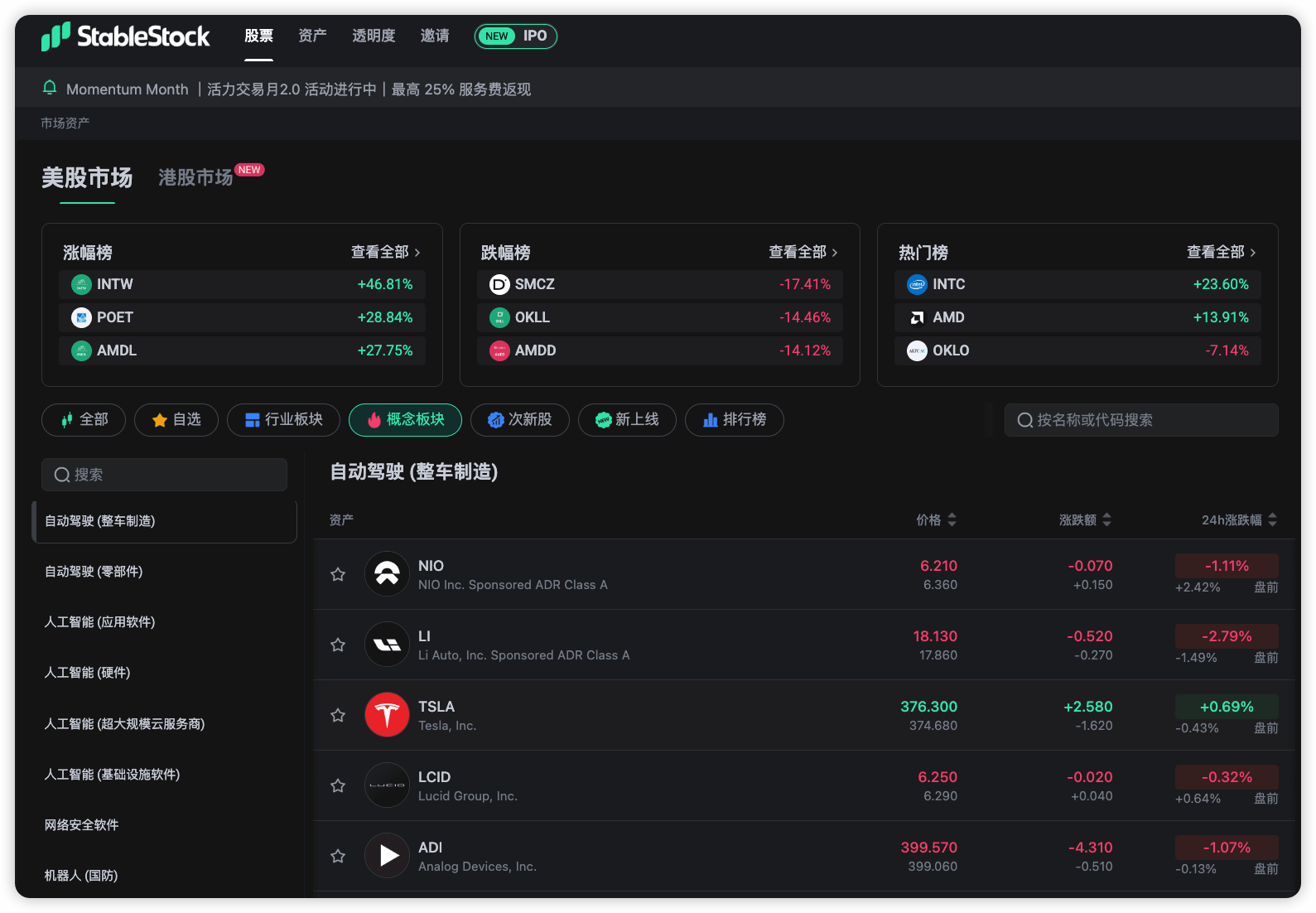
Select the target, go to the details page → limit price / market price → input quantity or amount → place order.
Supports market orders, but can only be placed during US market hours (Hong Kong stocks are currently in lots).
Stock trading without KYC is also supported, which can somewhat avoid CRS.
3. Hong Kong stock IPO new listings.
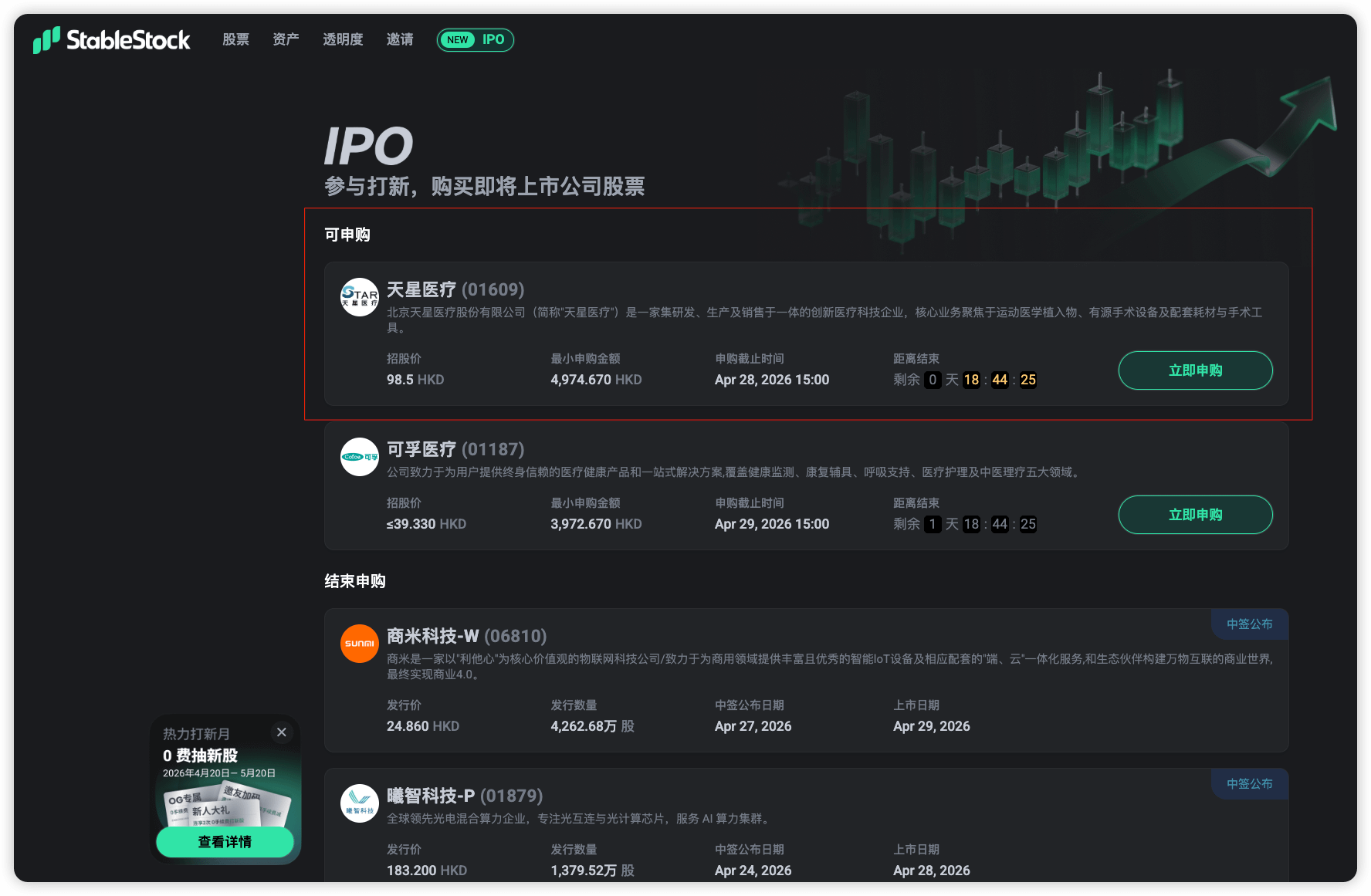
Enter the IPO section to see new stocks currently in the offering (the subscription window is usually 2-3 days before listing).
Choose cash subscription or leveraged subscription (inputting number of lots / HKD equivalent, the platform automatically converts to USDT).
Submit subscription, deduct handling fees (deducted regardless of winning shares).
Winning shares → shares transferred to account, can be sold normally on the listing day (no dark market).
After selling, funds will return to the account in USDT/USDC, and can be withdrawn after T+2.
6. Suitable crowd.
This is a product that feels comfortable for typical crypto-native users and traditional Hong Kong/US stock users don't really need to switch.
Suitable for your situation:
Holding USDT/USDC, lacking overseas bank cards or HK cards, with a real need to participate in US stocks, Hong Kong stocks, and Hong Kong stock IPOs.
Want to try small amounts of US stocks (starting from $10) without going through the trouble of opening Futu or Tiger accounts for wire transfers and currency exchange.
Already continuously participating in Hong Kong stock IPOs, looking for an additional account but only have stablecoins, seeking an alternative channel (note the FINI one-identity-per-stock hard rule).
Situations to hold off on:
Already have an HK card + traditional broker account, prefer to use traditional methods first, as financing interest is lower, dark market is available, and app experience is better.
Wanna go all-in with high leverage for new listings and small-cap players? The financing costs and base fees make it less cost-effective.
The StockFi track has a long-term trend that is correct, with traditional brokers going live with cryptocurrencies and crypto exchanges listing stock tokens; someone will definitely eat this middle ground. But which company can emerge from it will depend on compliance, the variety of trading targets, and whether the fee structure can be optimized. Currently, StableStock has advantages in compliance, trading targets, and lowering the barriers for participation in new listings, but the fee structure still has room for improvement.