
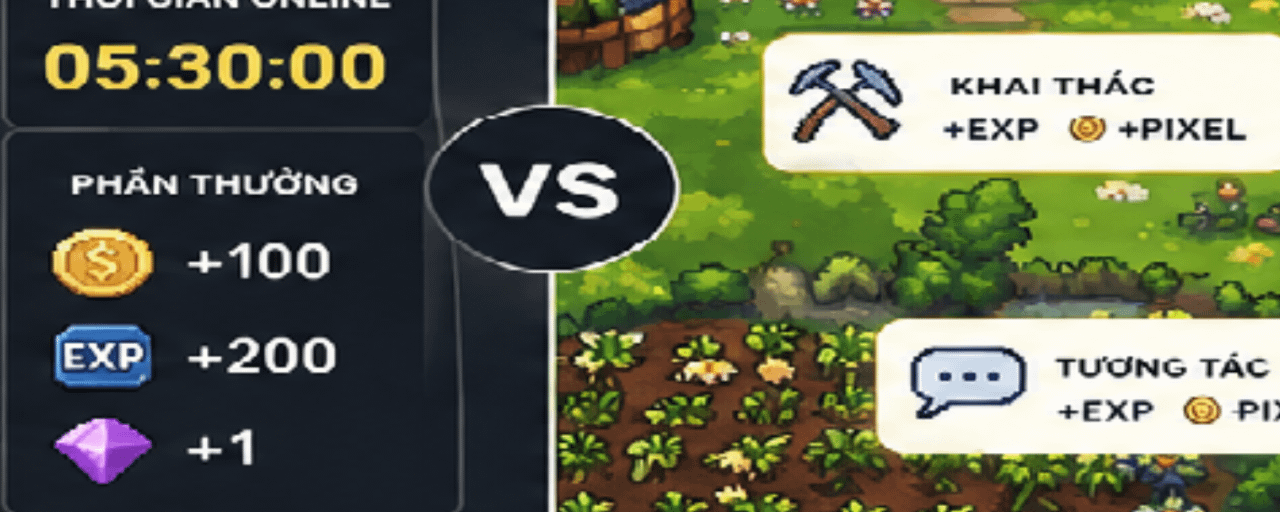

I've spent enough time in @Pixels to realize one subtle yet crucial thing: it doesn't rush to reward you just for logging in.
Many GameFi projects kick off with a familiar formula:
"How to launch a token, attract a ton of players, and keep them engaged for as long as possible?"
Initially, this strategy works. Players flood in quickly. The metrics spike. Activity is buzzing.
But then the excitement gradually fades. When rewards are tied to online time instead of value creation, the system becomes fragile. Players come for the tokens — and leave when the rewards dwindle.
Pixels poses a different question.
Instead of asking "How to reward presence?", they ask:
"What behaviors truly make this world stronger?"

That shift in perspective changes everything.
A World Observing Your Actions
In #pixel , the economy doesn't resemble a faucet continuously pouring out rewards, but rather an ecosystem quietly observing its citizens.
You don't get rewarded just for being online.
You get rewarded because you contribute.
When you farm, craft, trade, build relationships, or help the flow of resources operate more efficiently — the world responds. It recognizes the behaviors that make the economic loop more effective, connected, and sustainable.
Pixels is like a careful gardener.
It doesn't water indiscriminately.
It waters the plants that are actually growing.
Two Different GameFi Philosophies
In this space, two very different mindsets exist:
1. Buying Player Time
Some projects use tokens as bait. Simple goal: maximize playtime. The more time, the better the metrics — until the issuance runs dry.
2. Recognizing Player Value
Pixels use $PIXEL not as a "payoff", but as a ledger. A receipt confirming that value has been created.
This distinction is small but crucial for survival.
When tokens are used to buy time, they become a cost.
When tokens are used to capture value, they become leverage.
Tokens Are a Magnet, Not an Engine
I used to believe that tokens were the center of GameFi.
But after enough time in Pixels, I saw it differently.
Tokens are not the engine.
It’s a magnet.
If real value exists — productive players, an efficient economic loop, meaningful interactions — the magnet will attract and amplify that value.
But if the core is weak, the magnet cannot fix it.
It just makes the problem surface faster.
Tokens do not create value.
It finds where value is being created.
The Economy as a Living Entity
Imagine the Pixels economy as a quiet city.
Farmers wake up early. Crafters turn materials into products. Traders connect supply and demand. Network builders link people together. Each role strengthens the flow.
The economy rewards those who keep the traffic flowing.
It doesn't reward the bystanders.
That's why Pixels feels different. The system has standards. It reacts to contributions, not mere presence. And that creates a healthy "social contract" between players and the platform.
Why Most GameFi Fails
GameFi didn't collapse because of bad tokens.
It failed because it rewarded the wrong behavior.
When you reward passivity, you attract miners.
When you reward value creation, you attract builders.
Miners drain the system.
Builders cause the system to grow exponentially.
Pixels, whether intentionally or not, seems to grasp this distinction very well.
The Most Important Question
Now, every time I look at any GameFi project, I always ask myself one question:
Are they rewarding time?
Or are they rewarding value?
Because one side only creates short-term spikes.
The other side creates worlds that can exist long-term.
And in the long run, only one of those two models can survive. $PIXEL
