

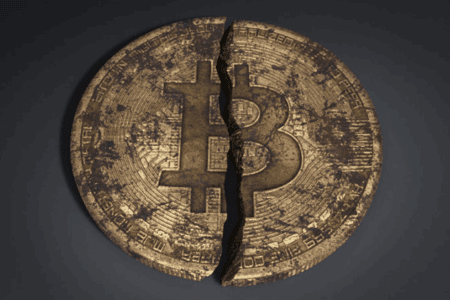
Bitcoin veteran developer Paul Sztorc has been trying to reform the Bitcoin network's architecture since 2015 but has yet to gain community consensus. Now, he’s proposing a more radical plan—a hard fork called eCash. This initiative, dubbed the 'eCash hard fork', aims to clone Bitcoin's code and launch a brand new blockchain in August 2026, allowing existing BTC holders to receive tokens on the new chain at a 1:1 ratio for free. However, the community has raised serious concerns about its fund allocation approach, particularly regarding the redistribution of assets belonging to Bitcoin's creator, Satoshi Nakamoto.
What is a hard fork?
You can think of a hard fork as a railway junction: the train departs from the same starting point, but at some point, the tracks split, ultimately heading to different destinations.
When developers cannot reach a consensus on the direction of Bitcoin upgrades, some choose to copy the existing blockchain and establish a new chain. This new chain inherits all historical data before the fork but will operate under different rules, developing its own functionalities, tokens, and ecosystem.
This situation occurred in 2017 when the controversy over block size peaked, ultimately leading to a chain split and the birth of Bitcoin Cash (BCH).
The core controversy at the time revolved around Bitcoin's 1MB block size limit, which restricted the number of transactions that could be processed every 10 minutes. Some advocated for expanding block capacity, but community opinions were divided, ultimately leading to a fork.
Sztorc's eCash fork plan
According to the proposal, the new blockchain will be named eCash and will issue a native token. Sztorc stated:
'If you hold 4.19 BTC at the time of the fork, you will receive 4.19 eCash. You can sell, hold, or completely ignore it.'
The fork is expected to occur at Bitcoin block height 964,000 (August 2026) and will launch a 'coin-splitter' tool to help users clearly separate BTC from eCash assets.
The new chain will nearly replicate the existing Bitcoin blockchain but will introduce a key technology – Drivechains. This scaling solution was proposed by Sztorc back in 2015 and submitted as BIP300 and BIP301 in 2017 and 2019, respectively.
What are Drivechains?
Drivechains can be viewed as sidechain systems attached to the Bitcoin main chain, allowing BTC to move freely between the main chain and sidechains without modifying the Bitcoin core protocol. Each sidechain can have different rules and functionalities, enabling developers to expand Bitcoin applications without compromising the security of the main chain.
You can think of it like a 'side road' next to a highway: when the main road is congested, vehicles can temporarily divert to the side road to travel at a different speed and then return to the main road. This neither alters the structure of the main route nor affects overall efficiency and flexibility.
Sztorc stated that there are currently seven Drivechains under development, including:
Referencing Zcash's privacy chain
Prediction market Truthcoin
Decentralized exchange CoinShift
Quantum-resistant chain Photon
Controversy focus: Satoshi's Bitcoin
The most controversial part of the plan is the allocation of funds. Sztorc plans to use the eCash tokens that correspond to the 'original Satoshi addresses' on the new chain to attract investors before the fork. He believes this is a necessary measure, but the community widely views it as equivalent to misappropriating or even 'stealing' assets.
Since a hard fork replicates the entire ledger, all balances on Bitcoin – including the alleged 1.1 million BTC belonging to Satoshi – will be mirrored as an equivalent amount of eCash on the new chain.
According to the plan, less than half of the 'Satoshi corresponding eCash tokens' will be forcibly allocated to investors in advance. Sztorc believes this move will provide early participants with substantial incentives, accelerate development progress, and prevent the project from becoming a slow-moving 'zombie project' or being monopolized by a few developers.
Although Sztorc's fork coin will not impact Bitcoin itself, this forced appropriation of fork coins is equivalent to seizing someone else's assets, clearly violating the broad consensus of the community regarding blockchain.
Industry reactions are negative.
However, the industry generally holds a critical stance. Bitcoin advocate Peter McCormack stated:
'Utilizing Satoshi's assets is both theft and disrespect, and the name eCash has already been used in the Lightning ecosystem (like Cashu, Fedi).'
Pixelated Ink's CTO Josh Ellithorpe pointed out that this approach could set a dangerous precedent:
'eCash represents a precedent – they can and will seize assets. Today it's Satoshi, but tomorrow it could be anyone. Additionally, issues arise regarding the misleading Bitcoin Cash fork history, the use of existing names, and the lack of replay protection, among others.'
Overall, this eCash hard fork proposal is not just a technical route dispute; it touches on the core values of the Bitcoin community – consensus, ownership, and immutability. Whether it will gain support in the future remains highly uncertain.
Reference
Source