

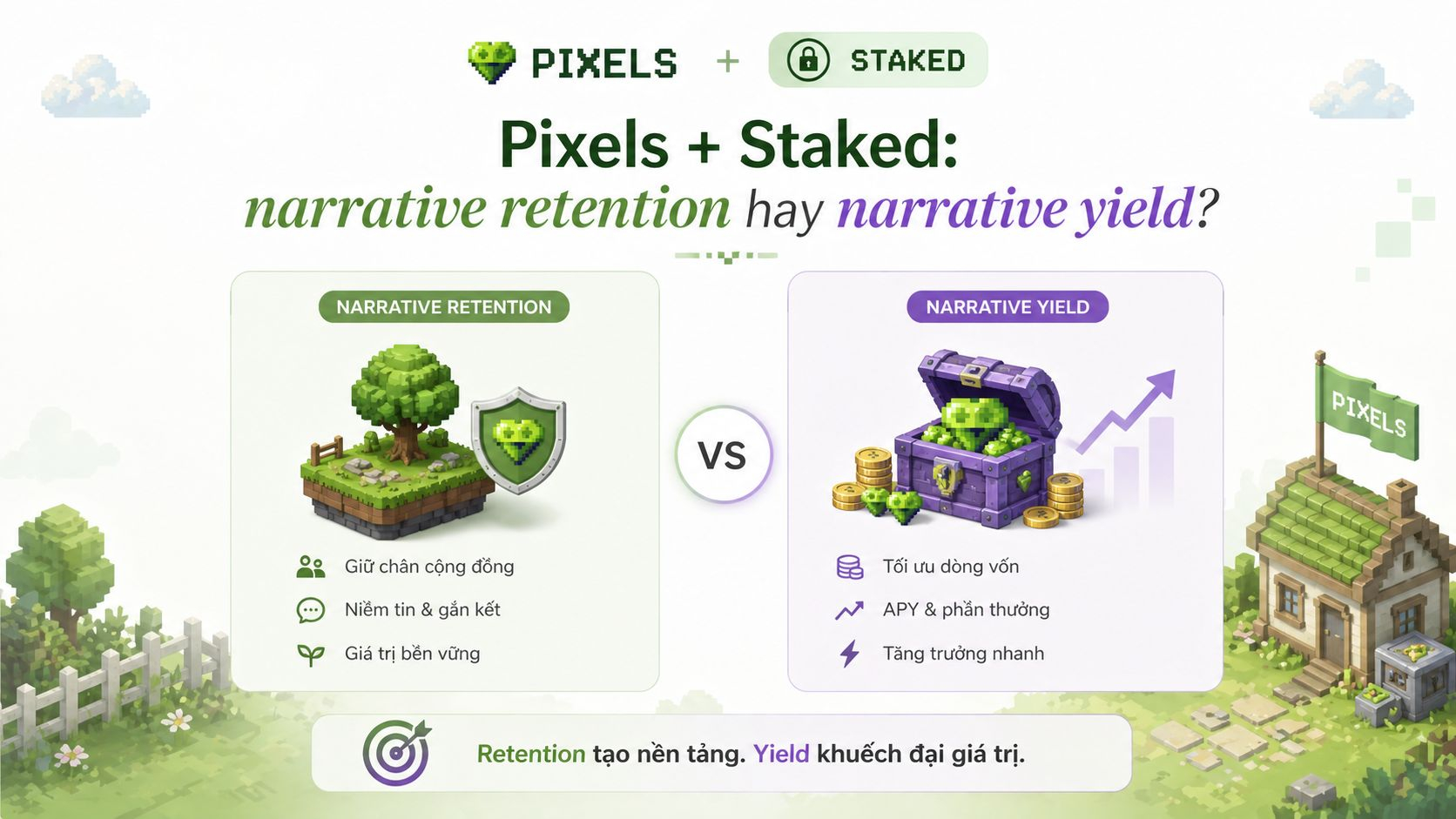
I've been following Pixels long enough to realize one thing: every Web3 gaming project has a core narrative, whether they say it outright or not.
That narrative determines which user group the system is attracting, how it keeps them engaged, and when the market shifts, where it will break.
With Pixels and Stacked, the question I keep coming back to is: what exactly are they selling to their users?
Retention or yield.
It sounds simple, but from my perspective, this question affects almost the entire direction of the system.
If it’s a yield narrative, what primarily pulls users in will be financial benefits.
People come in for rewards, for APR, for the expectation of token appreciation, because they feel their capital is being used to generate better returns than elsewhere.
This type of user comes in very quickly when the numbers look good.
But they also move very quickly when the numbers are no longer attractive.
The issue with the yield narrative is that the system doesn't need to be too deep to run well in the short term.
It just needs to pay enough.
But that's also why it often dies the fastest when the market starts to turn bad.
I think the old generation of Web3 gaming has already shown this very clearly.
On the contrary, the retention narrative is something entirely different.
Users can enter out of curiosity, for rewards, because of friends, or because of the community.
But the reason they stay is no longer entirely about the numbers.
They stay because the system has enough depth for leaving to create a feeling of missing out on something.
It's not just about missing out on today's rewards.
It's missing out on a whole loop that I've started to get attached to.
Retention doesn't live on APY.
It thrives on the system having enough reasons for users to feel that staying is still worthwhile, even when rewards aren't at their best.
And this is where I find $PIXEL + Stacked interesting.
Because from my perception, this project is running both narratives at once.
But I'm not sure the team has clearly decided what the core really is.
If you look outside, the way Stacked is told often leans more towards yield.
The community talks about staking PIXEL to receive rewards.
Talking about APR.
Talking about TVL.
Talking about the operational layer that has contributed over 25 million USD in revenue.
That’s the language of a system wanting to attract users sensitive to returns.
And to be honest, that language always has a very strong pull in Web3.
But if I look more closely at the operational logic behind it, what I see isn't entirely a yield narrative.
Stacked doesn't give the feeling of just locking tokens and receiving interest.
What it seems to be trying to do is tier rewards based on behavioral quality.
That is, not everyone locking capital or participating gets valued the same by the system.
There is a very clear effort to differentiate real players from those who are just stopping by to optimize short-term rewards.
And that's again the language of narrative retention.
A reward system, if it truly separates committed users from those who just extract, then the ultimate goal isn't just to pay yields.
The goal is to retain the type of users that make the economy last longer.
For me, this is the central contradiction of Pixels right now.
The yield narrative pulls in the exact user group that the system struggles to retain the most.
The retention narrative needs the right user group to come in slower, quieter, but more sustainably.
These two groups are not the same.
In fact, at many points, their interests can be at odds.
The yield group wants the system to pay quickly, clearly, and attractively.
The retention group needs the system to maintain a sustainable logic, not forced to optimize for short-term rewards.
If a project tries to serve both sides without clearly defining which one is core, sooner or later, they will have to choose.
And each time they choose, one side will be disappointed.
From my perspective, this is the real test of Pixels + Stacked.
Not when everything is still beautiful.
It's when the market starts to create pressure.
If the APY drops, if the cash flow slows down, if the system can no longer easily onboard new users with the yield narrative, then what will the team protect first?
They will pump more incentives to keep the user flow sensitive to the numbers.
Or they will accept slower growth to protect a higher quality user loop.
That answer, for me, reveals their true narrative.
Not just a whitepaper.
It's not a pitch either.
I still lean towards the idea that Pixels has enough foundation to focus more on retention than most other Web3 games.
Their gameplay is light enough to create habits.
The community is large enough not to rely entirely on incentives.
Stacked also seems to be built to keep value in the system longer, not just to pay attractive yields.
But I'm still not sure if that gameplay is strong enough to stand alone without significant yield backing.
This is the part where I still hold some reservations.
Because if the gameplay isn't deep enough, then every time the system faces pressure, the team will easily revert to the quickest way of using yield narrative to rescue momentum.
And if that repeats, eventually users will understand who this project is really serving.
If I have to be honest about my thoughts right now, I would say this:
Pixels + Stacked is not just a case of selling yield.
But they also haven't fully proven that they are confident enough to prioritize retention over yield during tough phases.
For me, that's why this project is still very much worth following.
Not because everything is clear.
But because that unclear part is precisely where they will decide whether they will become a more sustainable game economy, or just a system telling a better financial narrative than most competitors.
@Pixels #pixel $PIXEL