

Global capital markets in late 2025 are showing renewed appetite for technology-led issuers that combine clear earnings visibility with disciplined financial management. After a year of valuation resets and tightened capital conditions, investor focus has shifted toward companies demonstrating both tangible revenue growth and the capacity to self-fund operations ahead of their IPOs.
Amid this renewed focus on fundamentals, Finanx AI Inc., a digital-asset and artificial-intelligence financial technology company preparing for its planned NASDAQ listing under the ticker FNXI, stands out as one of the few upcoming entrants combining growth potential with positive cash generation. According to the company’s recently released Q3 2025 Interim Financial Report, Finanx AI reported sustained trading profitability, strong liquidity, and no outstanding debt — an uncommon profile among early-stage fintechs advancing toward an initial public offering.
Financial Position and Liquidity Runway
Liquidity strength and financial self-sufficiency remain key tests of IPO readiness. While positive operating cash flow is encouraging, investors will look deeper—asking whether such results can be sustained through varying market conditions or if they stemmed from a single strong quarter.
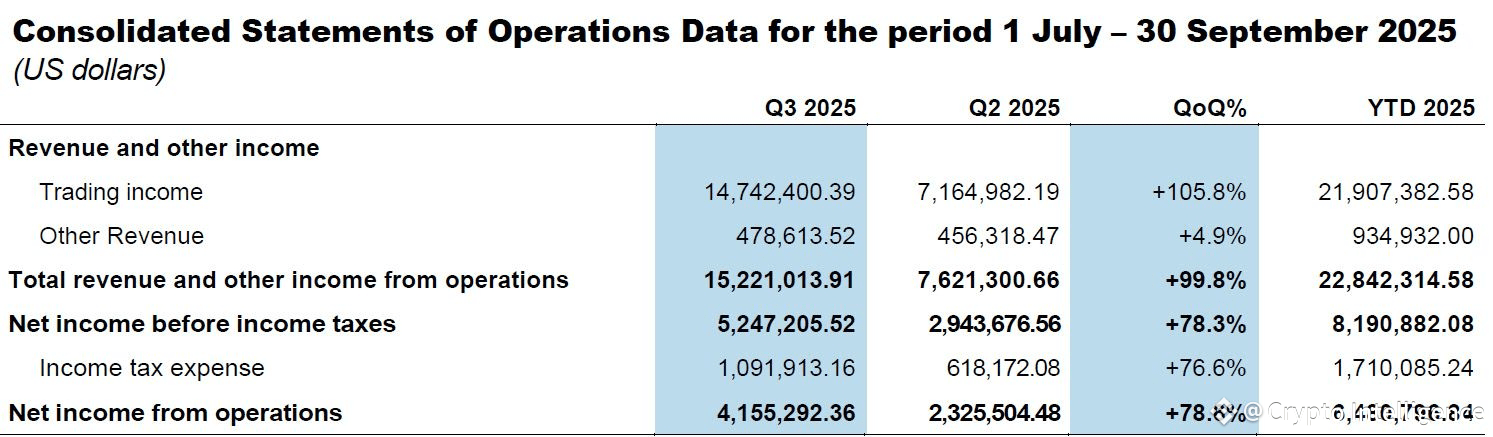
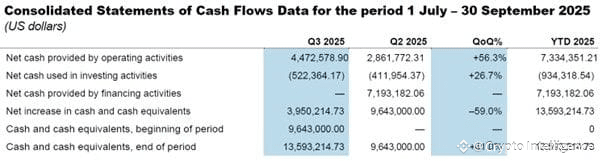
Finanx AI’s Q3 2025 financials point to genuine strength. The company reported trading income of US $14.74 million for the three months ended 30 September 2025, up 106 percent quarter-on-quarter, and net cash provided by operating activities of US $4,472,578.90. It carried no debt or external borrowings, reflecting a clean balance sheet. Year-to-date net income totalled US $6.48 million, showing profitability across multiple quarters rather than an isolated result.
Still, the company’s rapid growth invites questions about repeatability. Trading income, by nature, can fluctuate with market volatility and liquidity conditions. While Finanx AI’s systems appear to have performed well during favorable market cycles, investors will want to see whether the company can maintain similar cash-generation levels if market activity moderates.
The Q3 2025 Interim Financial Report shows cash and cash equivalents of US $13,593,214.73 and no outstanding liabilities. Based on reported figures, this represents a solid liquidity base. Assuming expense levels remain consistent and without new capital inflows, the company’s existing reserves would support operations for three to six years, even under conservative cash-flow assumptions. This suggests a long operational runway, though the durability of that strength will depend on how consistently Finanx AI can sustain its trading performance and cost discipline.
In essence, Finanx AI’s liquidity position appears robust, but the coming quarters will show whether its operational cash generation is structural or cyclical. The absence of debt provides a meaningful buffer, yet sustaining free cash flow through a full market cycle will ultimately determine the depth of its financial resilience.
Growth Momentum and AI Trading Performance
For prospective investors, assessing whether a company’s technology can translate into sustainable revenue is often the most difficult question. Finanx AI’s growth trajectory appears closely linked to its proprietary AI-driven trading infrastructure and the rollout of its Quantum AI Trading Engine, which the company publicly announced in October 2025.
This system is described as incorporating quantum-optimization algorithms to enhance predictive accuracy and execution speed in digital-asset markets. While third-party validation has not yet been disclosed, the timing of the system’s release and the sharp rise in Q3 trading income may suggest a correlation between technological upgrades and commercial performance. Whether this relationship proves consistent over multiple quarters will be an important factor to watch.
Beyond trading performance, Finanx AI’s capital allocation model also warrants attention. The company’s Treasury Reserve Fund (TRF) channels realized trading gains into digital-asset holdings, primarily Bitcoin.
The concept shares similarities with strategies used by MicroStrategy (NASDAQ: MSTR) and Semler Scientific (NASDAQ: SMLR), though Finanx AI’s approach introduces a more active, algorithmic layer. If effectively managed, this could provide both income and balance-sheet appreciation potential—but it also exposes the company to digital-asset price cycles.
Even so, the ability to convert active trading profits into appreciating reserve assets positions Finanx AI’s model as potentially more resilient than conventional trading or holding strategies. Future disclosures on reserve composition and realized performance will determine how well this framework sustains value through different market cycles.
The underlying principle—linking short-term trading efficiency with long-term asset accumulation—remains structurally sound and strategically forward-looking.
Capital Structure and IPO Readiness
As companies prepare for listing, investors often look beyond headline profitability to evaluate how well an organization balances growth ambition with governance maturity. Finanx AI plans to raise US $200–250 million through the issuance of approximately 50 million Class A shares on NASDAQ under the ticker FNXI. With no outstanding debt and audited statements confirming profitability, the company enters the market from a stronger base than many loss-making fintech peers. Still, valuation outcomes will depend on investor sentiment and perceptions of its exposure to digital-asset volatility.
Finanx AI’s management has stated that the IPO proceeds will fund infrastructure expansion and reserve growth rather than liquidity needs. If that allocation proves accurate post-listing, it would signal a more strategic use of capital than is typical for early-stage issuers. However, without a published prospectus detailing deployment plans and post-offering structure, the extent to which the IPO serves as a pure growth catalyst remains to be fully assessed.
Risk Factors and Market Context
Every digital-asset company entering public markets faces the same scrutiny: can its model withstand volatility, regulatory uncertainty, and shifts in investor sentiment? For Finanx AI, these questions are particularly relevant given its reliance on algorithmic trading and the integration of digital assets within its balance sheet. Market downturns, liquidity constraints, or abrupt regulatory changes could all affect short-term performance.
A related question concerns whether a strategy that blends active trading with asset accumulation can remain resilient when market conditions reverse. The Treasury Reserve Fund (TRF) sits at the center of this discussion. While some observers may see any digital-asset reserve as speculative, Finanx AI’s model appears structured differently: the TRF reinvests realized trading gains into reserve assets rather than depending solely on appreciation. If this mechanism performs as designed, it could provide a partial buffer against volatility—but that remains to be proven across multiple market cycles.
Regulatory dynamics add further complexity. Oversight of digital-asset trading and custody continues to evolve globally, and how Finanx AI navigates these shifts will be a critical factor post-listing. The company’s preparation for a U.S. IPO and its adoption of audited financial reporting suggest a degree of governance discipline uncommon among early-stage peers, though compliance expectations are likely to tighten as the sector matures.
Ultimately, the key question is not whether Finanx AI can avoid market and regulatory risks, but whether it can manage them more effectively than others in its category. Current disclosures show a framework that acknowledges these challenges and incorporates some adaptive mechanisms, yet the durability of that approach can only be validated through sustained performance over time.
Final Assessment
Drawing on published data from Finanx AI’s Q3 2025 Interim Financial Report and public disclosures surrounding its planned NASDAQ listing, Finanx AI appears to approach the public markets with a solid financial foundation relative to its peers in the digital-asset sector.
Key highlights include:
Zero debt and positive operating cash flow, reflecting disciplined capital management.
Quarterly trading income of US $14.74 million, up 106 percent from the previous quarter, confirming strong revenue growth.
Ending cash and cash equivalents of US $13,593,214.73, underlining liquidity strength ahead of its planned offering.
A liquidity position exceeding US $13.5 million provides Finanx AI with an estimated three-to-six-year operational runway, substantially lowering near-term financing risk and giving management flexibility to scale growth initiatives without immediate reliance on external capital.
Collectively, these figures suggest Finanx AI is entering its IPO phase from a position of measurable strength rather than speculative projection. Yet as it transitions to the public sphere, sustained transparency and performance through different market cycles will determine whether this early momentum translates into long-term shareholder confidence.
All figures and operational information are derived from Finanx AI Inc.’s published Q3 2025 Interim Financial Report and publicly available sources.