

The honest question about any competitive feature in a Web3 game is whether it adds a genuinely new dimension to the experience or whether it is a token distribution mechanism dressed up with game language. Spore Sports, Pixels' guild-based competitive event running across twelve weeks with a total prize pool of fifteen million $PIXEL, is the most useful answer to that question the project has produced. Not because of the prize pool size, but because of the design decisions underneath it.
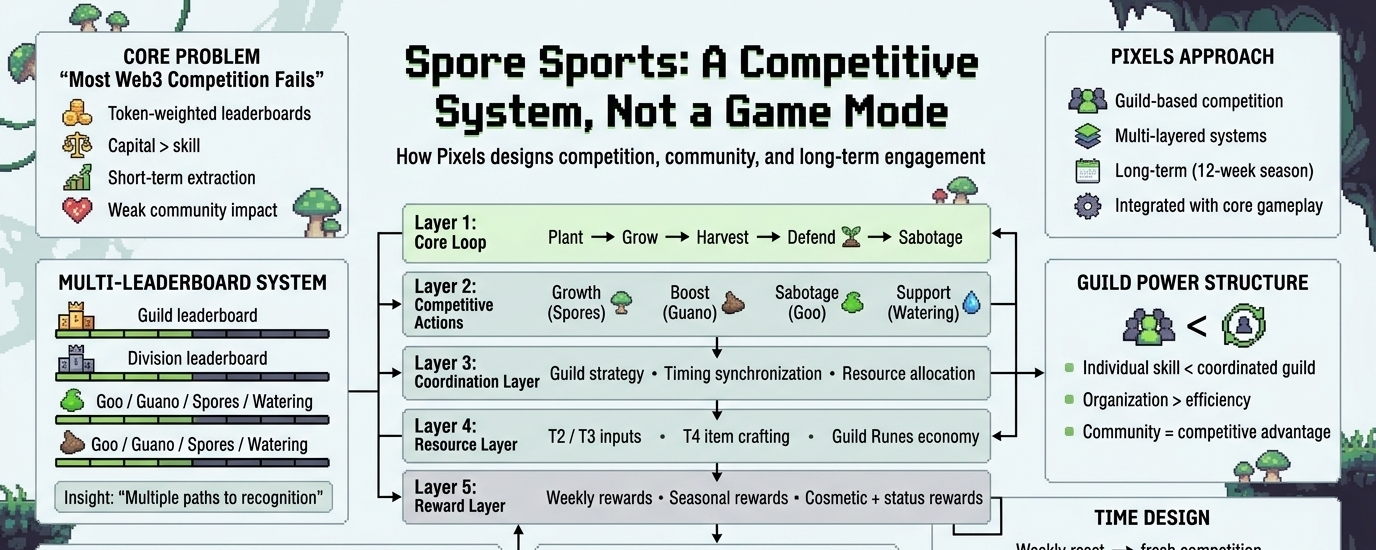
Most Web3 games that add competitive features make the same structural mistake. They create a leaderboard, attach token rewards to the top positions, and call it a competitive mode. The problem with that approach is that it optimizes for the wrong thing. Players at the top of a token-weighted leaderboard are not necessarily the most skilled, the most strategic, or the most genuinely competitive. They are often the most capital-efficient extractors who found the fastest path to accumulating points and ran that path repeatedly. The competition is real in a narrow sense but it does not produce the kind of community engagement, strategic depth, or genuine rivalry that makes competitive features worth building for their own sake.
Spore Sports is structured differently and the differences are worth examining in detail because they tell you something specific about how the Pixels design team thinks about what competition is supposed to accomplish inside a game world.
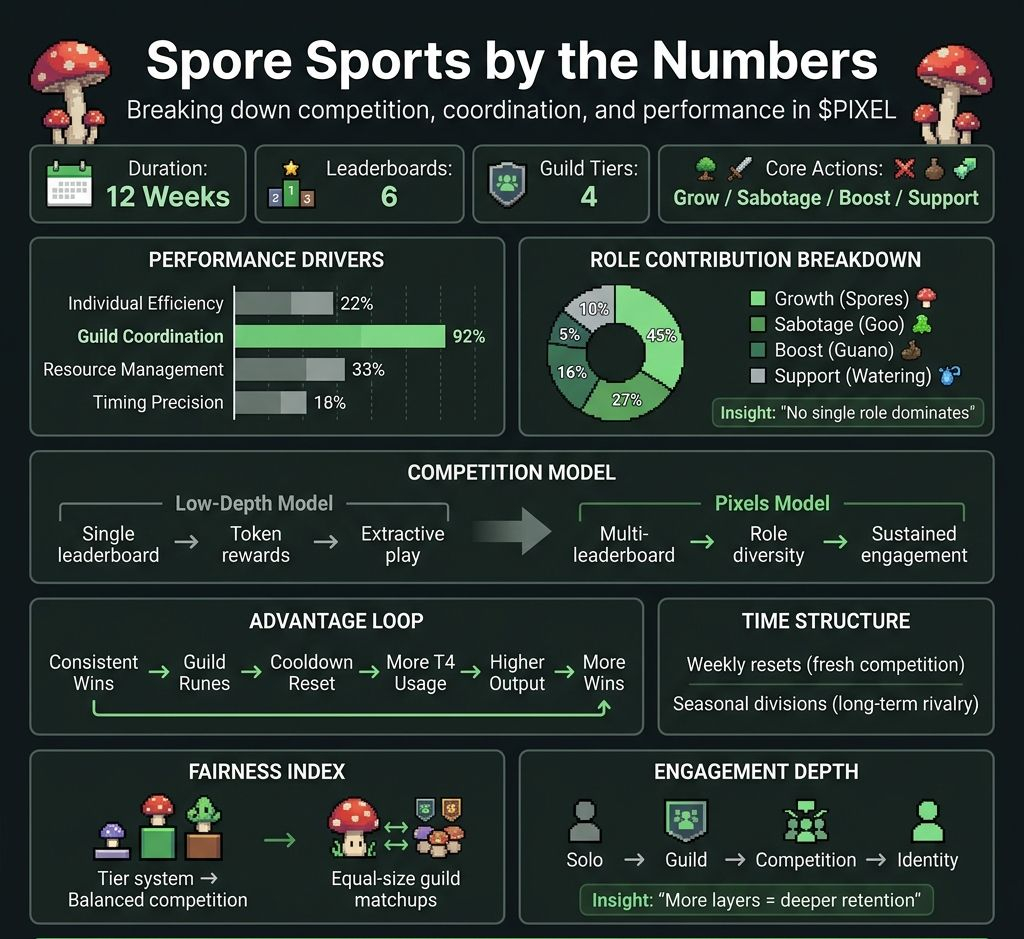
The first structural difference is the guild requirement. To participate in Spore Sports, a player must be pledged to a guild. That single requirement does more design work than it initially appears to. It means Spore Sports is not an individual competition that happens to have a team leaderboard. It is a team competition where individual performance only matters in the context of collective effort. A player who grows mushrooms efficiently but whose guild is disorganized will perform worse than a slightly less efficient player whose guild coordinates planting schedules, sabotage timing, and resource allocation. That makes Spore Sports a test of community organization as much as individual skill, which creates a fundamentally different kind of competitive dynamic than a solo leaderboard.
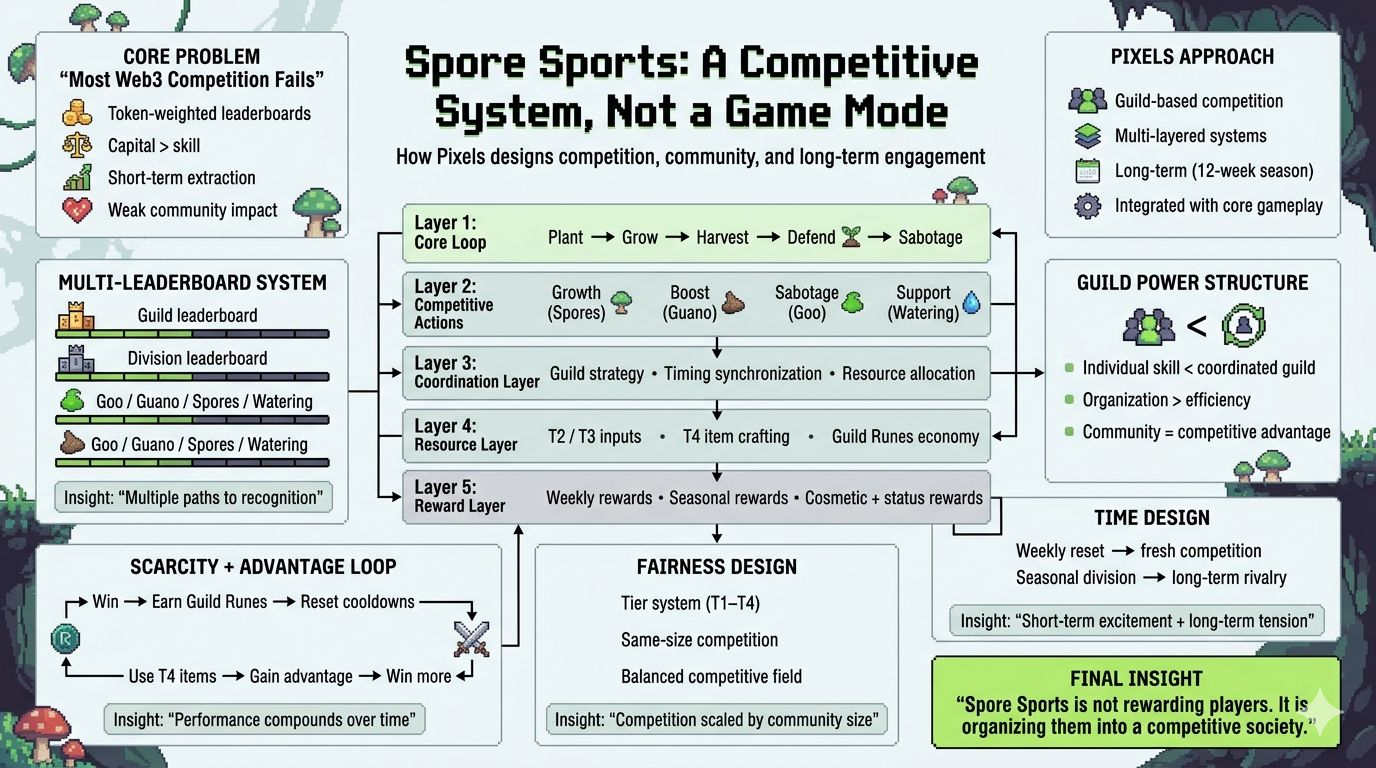
The tier system reinforces this. Guilds compete against other guilds of the same tier, with tiers defined by membership size. T1 guilds have fewer than eleven members. T2 runs from eleven to thirty-one. T3 covers thirty-two to sixty-five. T4 is sixty-five and above. Guilds only battle against others in their own tier, which means small guilds are never crushed by large ones and large guilds cannot coast on size advantages against smaller competitors. That tiering creates meaningful competition at every scale of community organization. A guild of eight people can be genuinely competitive in T1 without needing to recruit aggressively just to participate. A large guild of seventy or more people faces competition from other large, well-organized communities. The competition is designed to be fair at every size, which is a more thoughtful design decision than most competitive game modes bother to make.
The core gameplay loop of Spore Sports is specific enough to be worth describing precisely because the specificity reveals how much thought went into making it feel like an actual sport rather than a point accumulation exercise. Players enter a cave environment through the Guild Castle, interact with NPCs, purchase spores, plant them, and then manage a timed growth cycle where harvested mushrooms must be collected within one minute of ripening or they die. That one minute window is a meaningful mechanical constraint because it requires players to coordinate their presence in the cave at specific times rather than farming passively whenever convenient. It introduces real-time pressure into a game that is otherwise largely asynchronous.
The sabotage dimension adds the competitive depth that transforms mushroom farming from a cooperative accumulation exercise into genuine strategic competition. Players can use goo to reduce soil moisture in enemy crops by ninety-five percent, effectively destroying the farming progress of opposing guilds. Guano accelerates growth for your own crops. Stones block navigation and can be knocked down. The interplay between growing your own crops, sabotaging enemies, and defending against sabotage creates a multi-dimensional competitive environment where pure farming efficiency is not sufficient. A guild that focuses entirely on growth without attending to defense will see its crops destroyed. A guild that focuses entirely on sabotage will fall behind on points. The optimal strategy requires balancing all three dimensions simultaneously, which is exactly the kind of strategic depth that makes competition feel meaningful over a twelve-week season.
The T4 Ultimate Items add another layer of strategic complexity that rewards the most engaged and best-organized guilds. T4 Ultimate Goo, Guano, and Spores are obtainable through specific entities in the Cave Hub Map — the Guano Mixer, Spore Chamber, and Goo Pot — each of which can only be used once per twenty-four hours. The cooldown can be reset using Rune Charms purchasable with Guild Runes, which are awarded to top-performing players and guilds weekly and seasonally. That chain of mechanics creates a resource scarcity layer on top of the base competition. Access to the most powerful items requires consistent top performance and active engagement with the weekly reward cycle. Guilds that fall behind in Guild Rune accumulation lose access to the cooldown resets that would let them use T4 items more frequently, which creates a compounding advantage for well-performing guilds and a compounding disadvantage for struggling ones. That kind of compounding is not unique to Spore Sports but the specific implementation through a multi-step resource chain is more sophisticated than most competitive game modes attempt.
The mechanics of the T4 item crafting are also worth examining because they reward resource diversity rather than simple quantity. To craft T4 items, players prime the Guano Mixer, Spore Chamber, or Goo Pot with four to twelve T2 or T3 items, then throw in additional resources during a one-minute activation window. The more value, quantity, and variety of resources added during that window, the more T4 items received. That reward structure incentivizes players to bring diverse resource stockpiles rather than simply dumping as many of one item as possible. It rewards preparation, coordination between guild members who may specialize in different resource types, and knowledge of the crafting system's value hierarchy. A guild that organizes a diverse resource contribution run will outperform a guild of the same size that approaches T4 crafting as a solo activity.
The leaderboard structure is where the competitive design becomes most revealing. Spore Sports does not have a single leaderboard. It has six distinct competitive tracks running simultaneously. There is the overall Guild leaderboard where guilds compete for seasonal and weekly rewards. There is the individual Division leaderboard where players compete within a randomly assigned group of fifty for weekly prizes, with a separate seasonal Division that remains fixed across the twelve-week event. And then there are four specialized individual leaderboards tracking specific activities: Goo, Guano, Spores, and Watering. Each of these four activity leaderboards awards its own seasonal and weekly rewards in both $PIXEL and Guild Runes.
That multi-track structure is a genuinely sophisticated competitive design because it creates meaningful paths to recognition and reward for players with different skills and playstyles. A player who excels at sabotage will perform well on the Goo leaderboard even if their overall point contribution does not put them near the top of the Division leaderboard. A player who focuses on accelerating guild crop growth will see that reflected on the Guano leaderboard. A player who specializes in planting volume will appear on the Spores leaderboard. A player who focuses on the agricultural support role of watering will have their contribution recognized on the Watering leaderboard. The result is that Spore Sports creates recognition pathways for specialists rather than only rewarding generalists who optimize for total points.
This matters for community dynamics in ways that extend beyond the competitive event itself. In a competition with a single leaderboard, the players who dominate that leaderboard become the recognized contributors while everyone else is effectively anonymous. In a competition with six leaderboards, the recognized contributors are distributed across different specializations and different competitive contexts. The player who tops the Goo leaderboard in their tier has a visible achievement that their guild and the broader Pixels community can recognize, even if they never appear near the top of the overall Division ranking. That distributed recognition structure creates more investment in the competitive ecosystem across a larger share of the player population, which is good for both the event's engagement metrics and for the guild communities that form around Spore Sports participation.
The seasonal versus weekly distinction adds a temporal dimension that keeps the competition interesting across the full twelve weeks rather than front-loading all meaningful competition into the first few weeks. Weekly individual Divisions are randomly reassigned each week, meaning players face different competition every seven days and have a fresh opportunity to perform well in their weekly Division regardless of how the previous week went. The seasonal Division is fixed from the start, creating a long-term competitive relationship between the same fifty players that evolves across the full twelve weeks. That combination of short-term freshness and long-term continuity is a design choice that keeps different types of competitive players engaged. Players who prefer consistent rivals have the seasonal Division. Players who prefer fresh competition have the weekly reassignment.
The reputation requirement to enter Spore Sports, which requires at least four hundred fifty reputation points, connects the competitive event to the broader Pixels identity and progression systems. Reputation in Pixels is not a currency or a resource. It is a measure of a player's history of meaningful engagement with the game. It accumulates through consistent participation in core game activities and declines through behaviors that harm the ecosystem. The reputation gate for Spore Sports means that players who have not demonstrated consistent engagement with the game world cannot participate in the competitive layer. That design decision serves two purposes. It filters out the most purely extractive actors who might otherwise enter Spore Sports purely for prize farming without any genuine investment in the guild or the competitive experience. And it makes Spore Sports participation a visible marker of established status within the Pixels community, which gives the event additional social significance beyond its competitive value.
The prize structure warrants examination because its distribution reflects specific design values about who competition is supposed to benefit. The total prize pool of fifteen million $PIXEL is split between guild rewards and individual rewards, each receiving seven point five million $PIXEL approximately. Within guild rewards, the top three guilds of each tier at season's end receive prizes, and the top ten guilds of each tier each week receive prizes. Within individual rewards, the Division leaderboards and the four specialized activity leaderboards each distribute prizes weekly and seasonally. That distribution means rewards flow to a much broader pool of participants than a winner-takes-all structure would produce. A guild that consistently finishes in the top ten of its tier each week across a twelve-week season will accumulate meaningful rewards even if it never wins a season championship. An individual player who consistently performs well on a specialized leaderboard without ever topping the Division ranking will still receive meaningful seasonal recognition.
The Guild Runes currency that flows through the prize structure deserves specific attention because it creates an economy within the competitive event that extends the strategic depth beyond the mushroom growing and sabotage mechanics. Guild Runes can be spent in a rotating store that offers Spore Sports Charms for cooldown resets, Energy Drinks, decorative items, and utility items. The rotating nature of the store means that the optimal use of Guild Runes is not immediately obvious and changes over time, which rewards players who pay attention to the store rotation and plan their Rune spending accordingly. The Spore Sports Charms that reset the twenty-four hour cooldown on T4 item crafting create a direct competitive utility for Guild Runes, making Rune accumulation itself a strategic goal that requires consistent performance rather than one-time good results.
The cosmetic rewards embedded in Spore Sports are worth noting because they represent a form of recognition that persists after the competitive event ends. Matching Guild Wardrobe Outfits, the Goo, Guano, Spores, and Watering Wardrobe Outfits, the Spore Sports Decoration, and the Trophy and Badges for guilds all remain visible in the game world after the season concludes. A guild that wins a Spore Sports championship has a badge that its members can display. A player who won their Division or topped a specialized leaderboard has a wardrobe item that signals their achievement. Those persistent markers create a social history inside the game world that gives Spore Sports competitive success meaning beyond its duration. Players who were not part of the game during a particular Spore Sports season will see the badges and wardrobe items of players who competed and they will know something real about those players' histories inside the world.
The connection between Spore Sports and the broader Pixels ecosystem is most visible in how the event uses and reinforces the guild system. Spore Sports is not a standalone event that could exist in any game. It is specifically designed around the guild infrastructure that Pixels built as a core social layer. The tier system uses guild membership counts. The prize structure rewards guild performance. The T4 item crafting rewards guild coordination. The Guild Rune economy flows through guild participation. Every meaningful mechanic in Spore Sports is connected to the guild system, which means participating in Spore Sports strengthens players' attachment to their guilds and gives guilds a concrete shared purpose that extends beyond casual social interaction.
That purposeful connection between the competitive event and the core social structure is what makes Spore Sports more than a seasonal distraction. It is a mechanism for deepening the community bonds that make the Pixels world feel like a place worth returning to. A player who spent twelve weeks coordinating mushroom harvests, organizing sabotage raids, and competing on specialized leaderboards alongside their guildmates has a shared history with those guildmates that persists after the season ends. The competitive experience creates relationships that the social infrastructure then sustains. Those relationships are the thing that keeps players logging in when no active event is running.
The data point nobody talks about when evaluating competitive features in Web3 games is not how much the prize pool is worth in dollar terms. It is how many distinct player types the competition engages and how deeply it integrates with the rest of the game's social and progression systems. Spore Sports engages farmers through spore growing, strategists through sabotage timing, coordinators through guild organization, specialists through the four activity leaderboards, and community builders through the seasonal Division relationships. It integrates with the guild system, the reputation system, the crafting system, the energy system, and the broader game economy through its resource inputs. That breadth of engagement and integration is the genuine measure of whether a competitive feature was worth building.
Spore Sports was worth building.
#JointEscapeHatchforAaveETHLenders #MarketRebound
@Pixels #pixel #PİXEL #Web3Gaming #GameFi #Ronin #BinanceSquare