

Recently, I've been spending quite a bit of time digging into how the backend operates, and honestly, the deeper I go, the more interesting it gets. Many people assume this is a 'pure blockchain' game, where every action is recorded on-chain. But the reality is completely the opposite — and that's exactly what makes it so successful.
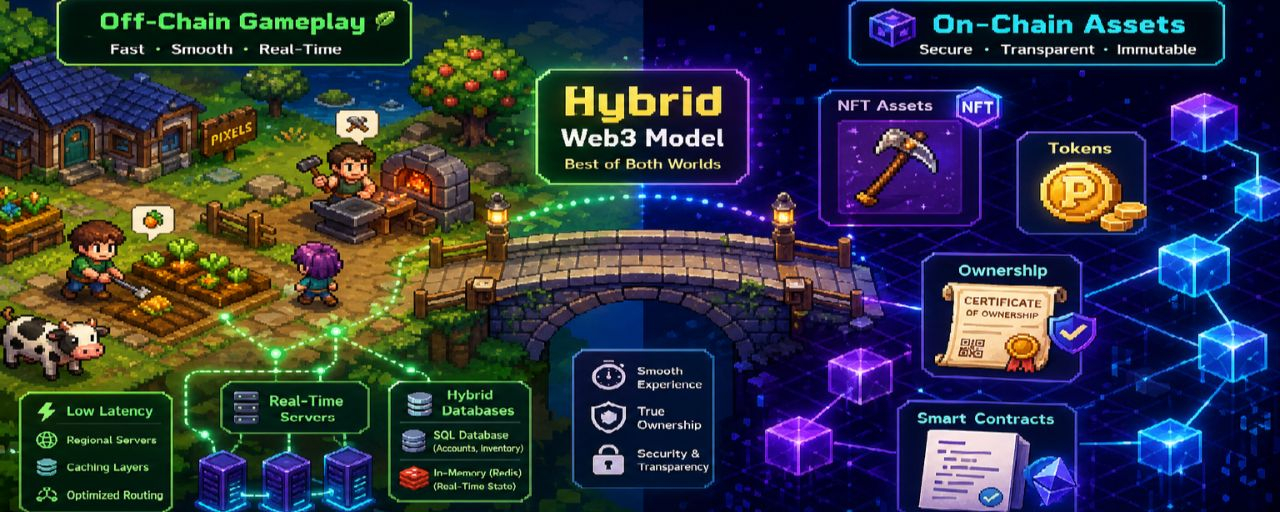
Instead of putting the entire gameplay on the blockchain (which would almost certainly cause lag and high gas fees), Pixels has split the system into two very clear parts:
Gameplay runs off-chain: moving, farming, crafting, interacting... all handled in real-time on traditional servers.
Assets and ownership run on-chain: NFTs, tokens, high-value trades are recorded on the blockchain.
At first glance, it may seem 'less decentralized', but from a system design perspective, this is an extremely practical choice.
If every action is on-chain, every time I till the land or pick up an item, I’d have to wait for block confirmation, the experience would be... no different than gaming over a 3G modem in 2005. Games need instant feedback. Players need a smooth feel.
Pixels solves this issue by using a familiar architecture from Web2:
Server processes events in real-time
Caching to reduce latency
Network system partitioned by region
Can combine relational databases for account data and in-memory systems for real-time state
Things that might sound 'not very Web3' are actually what make the game playable.
The issue lies in the trade-offs. Want speed? We have to accept less decentralization at the gameplay layer. Want everything on-chain? We have to sacrifice experience. Pixels clearly chose experience.
And I think this is the point worth pondering.
The future of blockchain gaming might not be '100% on-chain', but a hybrid model:
On-chain for ownership and value
Off-chain for performance and player experience
The question I keep asking myself is: if most of the experience takes place off-chain, are we building a decentralized game... or just tacking blockchain onto a traditional game?
But maybe, instead of being extreme between Web2 and Web3, what's more important is:
Is the game fun? Do players truly own assets? And is the system transparent where it needs to be?
For me, #pixel is showing a more practical path than idealization. Not perfect. Not purely on-chain. But balanced enough to survive and grow. And perhaps, in the current phase of Web3 gaming, that balance is the most valuable thing. $PIXEL
