

Main Takeaways
The next wave of crypto adoption will be driven by not only and not primarily by trading crypto in spot and derivatives markets – multi-asset expansion, payments, tokenization, event markets, AI and social integrations are widening crypto's addressable value space.
Binance is building toward a vision that combines AI, community, yield, payments, and on-chain services into a more integrated user experience.
This approach can help bring institutional-grade financial capabilities to billions of people around the world.
For years, crypto platforms competed on a familiar set of criteria: liquidity, market depth, product range, execution speed. Working to optimize for those strengths helped define the exchange era and brought hundreds of millions of users into digital assets. As we enter the next phase of growth, the industry is facing a fundamental question: what kind of financial platform do the next billion users need?
At Binance, we believe the answer goes far beyond trading. Simply making markets more efficient won’t be enough to attract and serve billions of global users. They will only come when finance becomes easier to understand and access, and more useful in everyday life, and when intelligence, community, yield, payments, and on-chain services work together in one connected experience. That is the direction powering Binance forward.
The Exchange Era: Opening the Door
The first generation of crypto platforms solved foundational problems, giving users a way to access and trade digital assets, and move capital across borders with greater speed and flexibility than many traditional systems allowed. That was a historic step forward that created the rails for a brand-new kind of financial participation.
But as the industry matures and technology evolves, users want more from the platforms they trust. They want help understanding markets, discovering opportunities, managing assets, moving funds, interacting with communities, and putting capital to work over time. In other words, they want finance to feel continuous and connected – and this is where the next chapter begins.
For platforms, what is different in 2026 is that the surrounding product space is now large enough for aggregation to pay off. In earlier cycles, trading was mature but the adjacent crypto rails were relatively thin: stablecoins were still small, tokenized assets largely conceptual, payment rails not quite institutional-grade yet, and the regulatory perimeter did not support a broad product set under one roof.
Today, each of those constraints has at least somewhat loosened. Just to mention a few: stablecoin circulating supply has climbed above $320B, with monthly on-chain volume reaching $7.2T, even surpassing the U.S. ACH network (the national automated clearing house network for electronic funds transfers) earlier this year; tokenized RWAs have scaled above $25B, leaping from concept to a meaningful and increasingly investable asset class.
Taken together, these shifts mean that crypto-native platforms can now become the central interface through which users access the full digital financial experience.
A New Kind of Platform
The next billion users, and then three billion and more, will arrive through payments, yield products, on-chain services, tokenized traditional assets, or community-led discovery in addition to crypto trading. Many will first engage with crypto through a mobile-first experience and expect the platform in front of them to feel intelligent and integrated from day one.
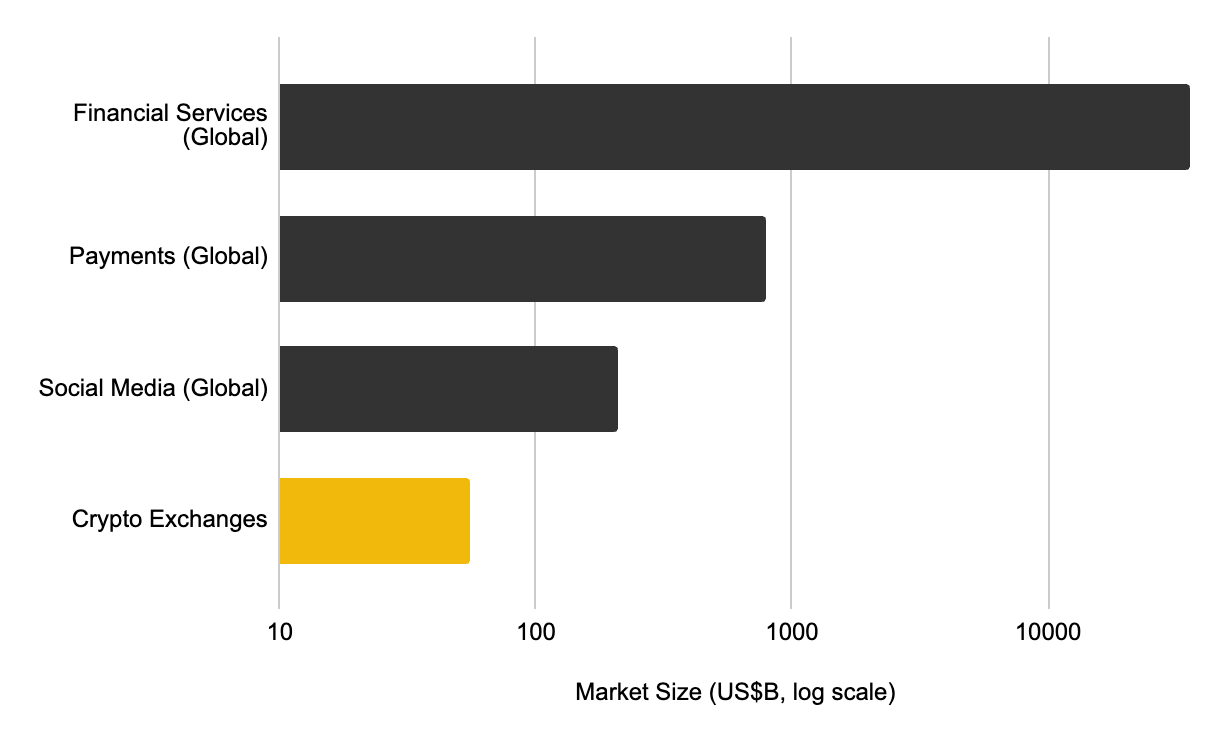
On the industry level, the size and structure of the pool makes a strong case for a financial super app to be the most advantageous model for the next stage of the digital finance evolution. Today, the global financial services market size is roughly $36T, payments $788B, and social platforms $208B. At the same time, crypto exchanges sit at around $55B. Capturing even a modest share of these adjacent markets would represent a pool that is orders of magnitude larger than the current base.
Furthermore, crypto rails have demonstrated an excellent ability to verticalize: for example, the same wallet and stablecoin balance can interact with multiple products without moving across different settlement systems (as would be traditional finance’s default approach). A financial super app like one Binance is building can provide continuity and help users move from first interaction to long-term participation without forcing them to rebuild their journey across separate apps, tools, and fragmented identities.
For users, finance works better when its core functions are connected. Insight and social discovery become more valuable when they come in close to execution, leading directly into action. Payments, yield, and on-chain tools become more powerful when they are part of the same ecosystem. The future belongs to platforms that can bring these layers together in a coherent way.
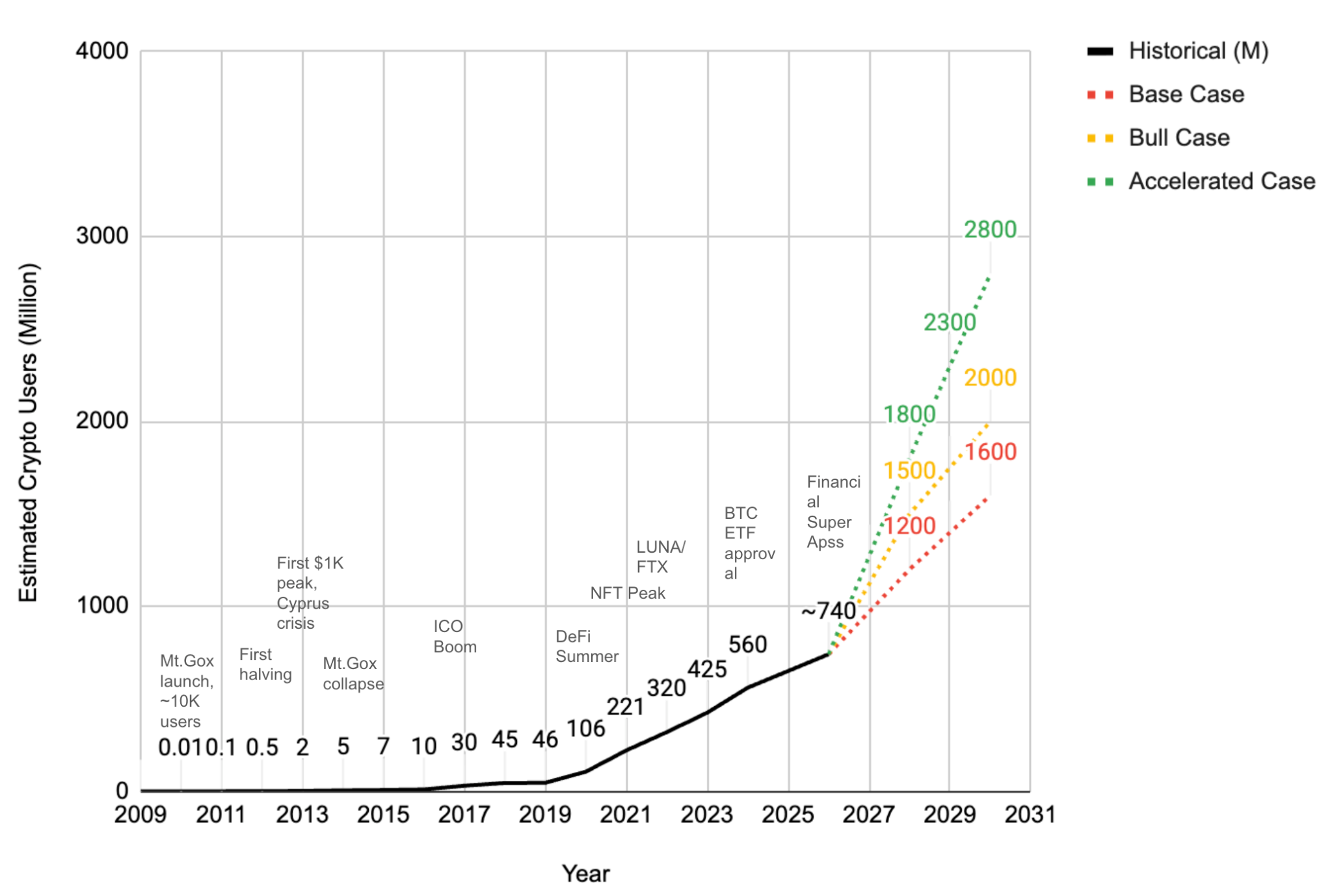
We expect that as multi-function integration becomes mainstream across the industry, total crypto users could grow rapidly from ~700 million today to around 2 billion by 2030.
Binance’s Four Layers of Integration
Binance is the place where capital enters the digital-asset space and gets parked and deployed. We are in a pole position given that we already hold the user and funding relationship, and act as one of the few platforms supporting multiple core layers required for a global financial super app, from trading to multi-asset support, wallets, stablecoins, payments, yield, agentic rails, social, discovery, and more.
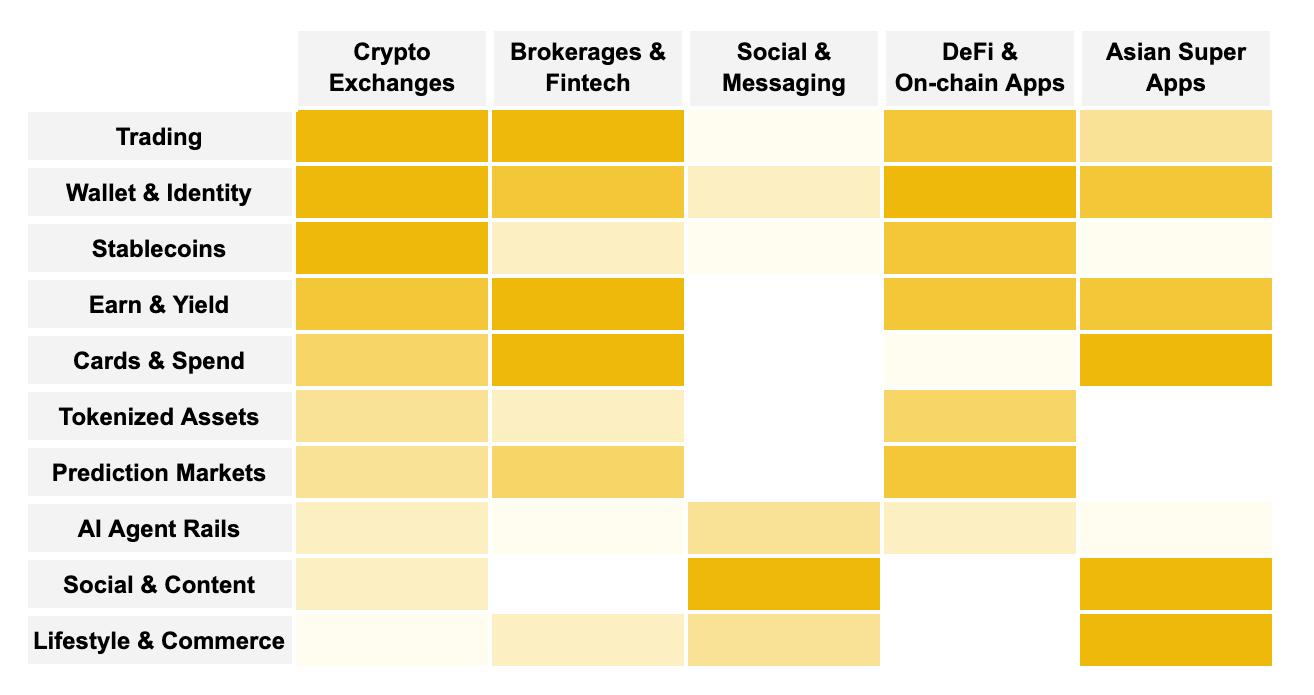
Figure 3. Financial Super App stack coverage matrix. Source: Binance Research, as of April 2026.
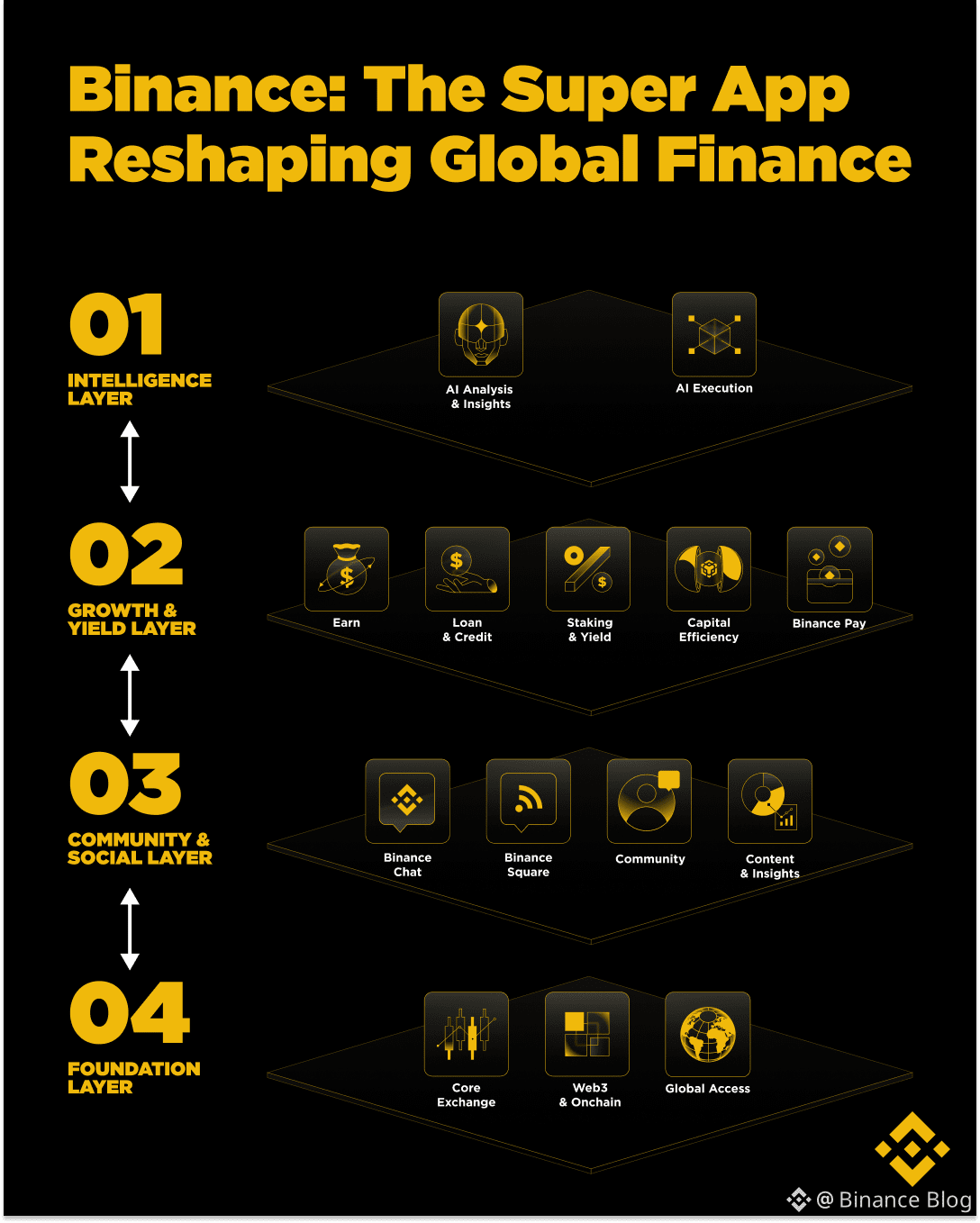
At Binance, we increasingly see the future in terms of a four-layer structure:
Intelligence Layer: AI-driven analysis, insights, and smart execution tools that help users interpret markets and act with greater speed and structure.
Community and Social Layer: Spaces where users can discover ideas, learn from others, and participate in the wider crypto conversation through products like Binance Chat and Binance Square.
Growth and Yield Layer: Tools that help users manage capital over time, including products related to earning, borrowing, payments, and broader financial utility, like Binance Earn and Binance Pay.
The Foundation Layer: The infrastructure that makes the rest possible, including the core exchange, pay, and on-chain services.
While each layer matters on its own, their greater significance comes from how they reinforce one another. This kind of integration is what can move digital finance from a collection of products to a more complete operating environment.
How AI Changes the Equation
AI is becoming one of the most important forces shaping the next generation of financial products.
For years, advanced financial tools – automation, research, and execution systems – were concentrated in the hands of institutions and professional or highly technical users. But when intelligence is embedded directly into a widely accessible platform, more users can leverage capabilities that were once out of reach. Market analysis, strategy design, ongoing monitoring and overall financial decision-making become more structured and efficient.
This is one of the biggest reasons we believe the next billion users will come through integrated platforms rather than isolated products. Much more than jut another feature category, AI can become the secret sauce that makes the rest of the financial experience easier to use. We believe users should be able to access increasingly sophisticated financial tools through interfaces that feel intuitive and mobile-native. That is a major part of how digital finance can become a substantially larger and more inclusive system.
The Road to 3 Billion
Binance’s vision of 3 billion users is ambitious, as it should be. Reaching that scale will require financial products that meet people where they are and help them do more once they arrive. We believe the path forward lies in integration. When AI, community, trading, payments, and on-chain infrastructure work together, finance becomes easier to access and more useful to a much broader set of users.
We are building toward that vision by bringing together the key layers: intelligence, community, growth, and foundational infrastructure. Each layer expands what users can do; together, they drive a bigger shift in how people participate in digital finance.
Further Reading
The Rise of Binance as the 24/7 Global Market – From Crypto to TradFi Perpetuals
From Zero to a Global Pricing Hub: Binance TradFi’s First 90 Days
Binance Powers Toward 3 Billion Users With an Everyday Financial App Vision