

If you’ve been in the crypto market long enough, you’ll notice something strange. Every 4 years or so, the same story plays out. Bitcoin surges hard, media coverage explodes, new money floods in, a peak gets established, then the market collapses. People declare Bitcoin is dead. And then the next cycle begins.
What fascinates me isn’t that this cycle exists. It’s that every single time it happens, so many people are still completely caught off guard.
The answer lies in a technical event that anyone who wants to understand Bitcoin seriously needs to know inside out. That event is the halving.
What is the halving and why does it matter so much?
Bitcoin was programmed to have a maximum total supply of 21 million BTC. Nobody can change this number. Not Satoshi Nakamoto, not the world’s largest miners, not the government of any country.
To control the rate at which Bitcoin enters circulation, Satoshi designed a mechanism called the halving. Every 210,000 blocks mined, the reward miners receive for each block is cut exactly in half. At an average mining speed of 10 minutes per block, this happens roughly every 4 years.
Here’s how the halving history has unfolded:
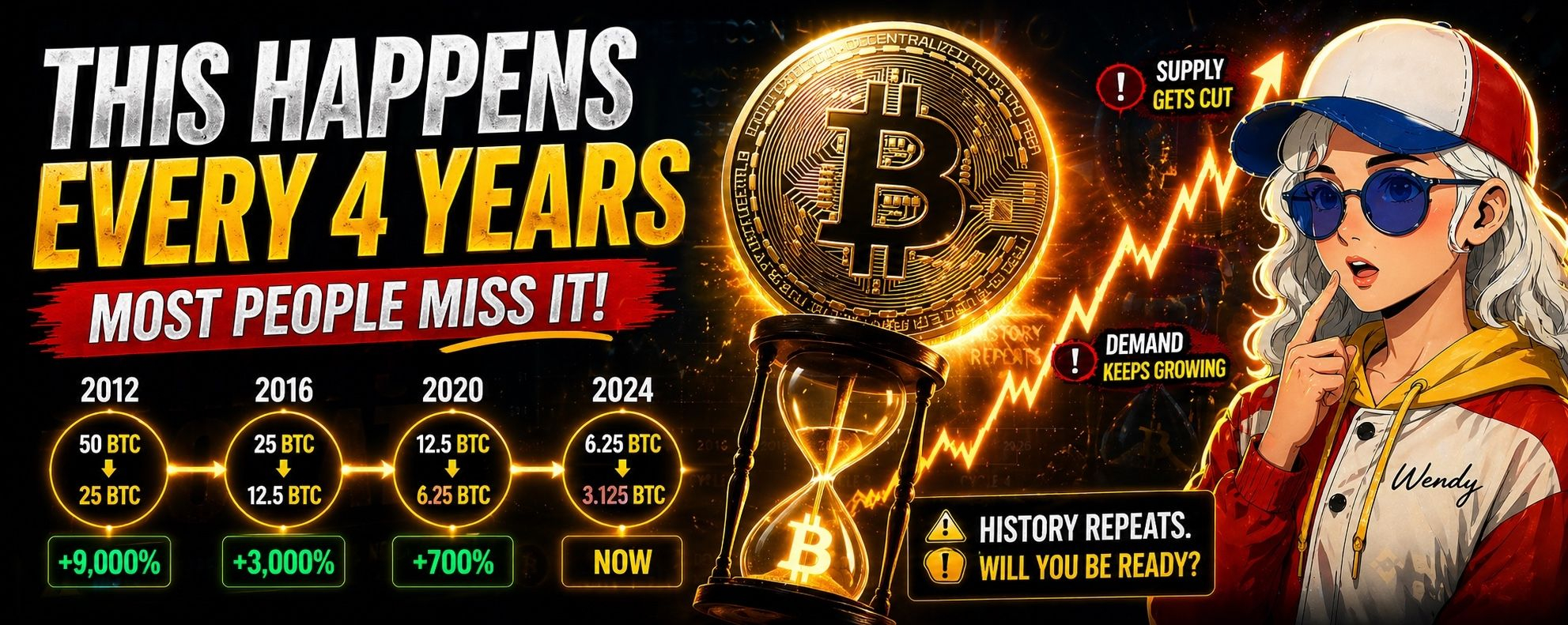
The first halving in November 2012 reduced the reward from 50 BTC to 25 BTC per block. The second halving in July 2016 dropped it from 25 BTC to 12.5 BTC. The third halving in May 2020 brought it from 12.5 BTC down to 6.25 BTC. And the fourth halving in April 2024 reduced it from 6.25 BTC to 3.125 BTC — the reward level we are currently at right now.
Why does the halving affect price?
This is the part most people get wrong.
The halving doesn’t directly create buying pressure. It creates supply pressure. Every day after a halving, the amount of new Bitcoin being created and entering the market drops by half. If demand stays the same or increases while new supply decreases, basic economics says price must rise.
But the reality is more nuanced than that. The halving doesn’t produce an immediate price pump. History shows the market typically needs 6 to 18 months after a halving to react fully. This is why many people buy Bitcoin on the exact day of the halving, get disappointed when price doesn’t move immediately, and sell before the cycle actually begins.
What does the historical data from each halving cycle actually show?
Let’s look at the real numbers.
After the first halving in 2012, Bitcoin climbed from around $12 to nearly $1,150 within 13 months. A gain of roughly 9,000%.
After the second halving in 2016, Bitcoin rose from around $650 to nearly $20,000 by the end of 2017. A gain of roughly 3,000%.
After the third halving in 2020, Bitcoin climbed from around $8,700 to nearly $69,000 in November 2021. A gain of roughly 700%.
Do you notice the pattern? The absolute gains are still enormous, but the percentage returns are declining with each cycle. This makes complete sense because Bitcoin’s market cap keeps growing larger, requiring far more capital to generate the same percentage move.
What makes the 2024 cycle different?
The April 2024 halving was the first one to occur after spot Bitcoin ETFs were approved in the United States. This is the biggest structural change in Bitcoin’s history because it opened the door to capital from traditional financial institutions — institutions that previously had no legal and convenient way to access Bitcoin.
This means the supply and demand equation this cycle has an entirely new variable. New Bitcoin supply drops to 3.125 BTC per block, while demand from ETFs and major institutions continues growing steadily. Supply pressure is being tightened from two directions simultaneously.
History is repeating. But this time with a scale and speed we haven’t seen in previous cycles.
So what should you actually do with this information?
I don’t give financial advice. But I’ll share how I’m thinking about this.
Understanding the halving cycle doesn’t mean you know where the top will be. Nobody knows that. But understanding the cycle means you won’t be blindsided by movements that actually have clear historical precedent.
The people who lose the most in every cycle are usually not the ones who bought at the wrong time. They’re the ones who had no plan at all and let emotions drive their decisions when the market swings hard in either direction.
The halving cycle doesn’t tell you when to buy or sell. But it gives you a reference frame — so you don’t panic when the market corrects 30% or 40% mid-cycle, and so you don’t get swept into FOMO at the very end when everyone around you is at peak euphoria.
That’s the real value of understanding the halving.
Follow my channel to stay ahead of the next analysis
I’ll keep going deep on topics like on-chain data, tokenomics, macro signals and their impact on crypto, and everything I genuinely believe is worth understanding to read this market correctly.
No hype. No price predictions. Just data and analysis with real depth.
👉 Follow Wendy 🇻🇳 on Binance Square right now and turn on notifications so you never miss a post.
The market doesn’t wait for anyone. But the right knowledge means you’ll never be left behind. 🔍
This is not financial advice. All investment decisions carry risk. Always do your own research before making any decision.