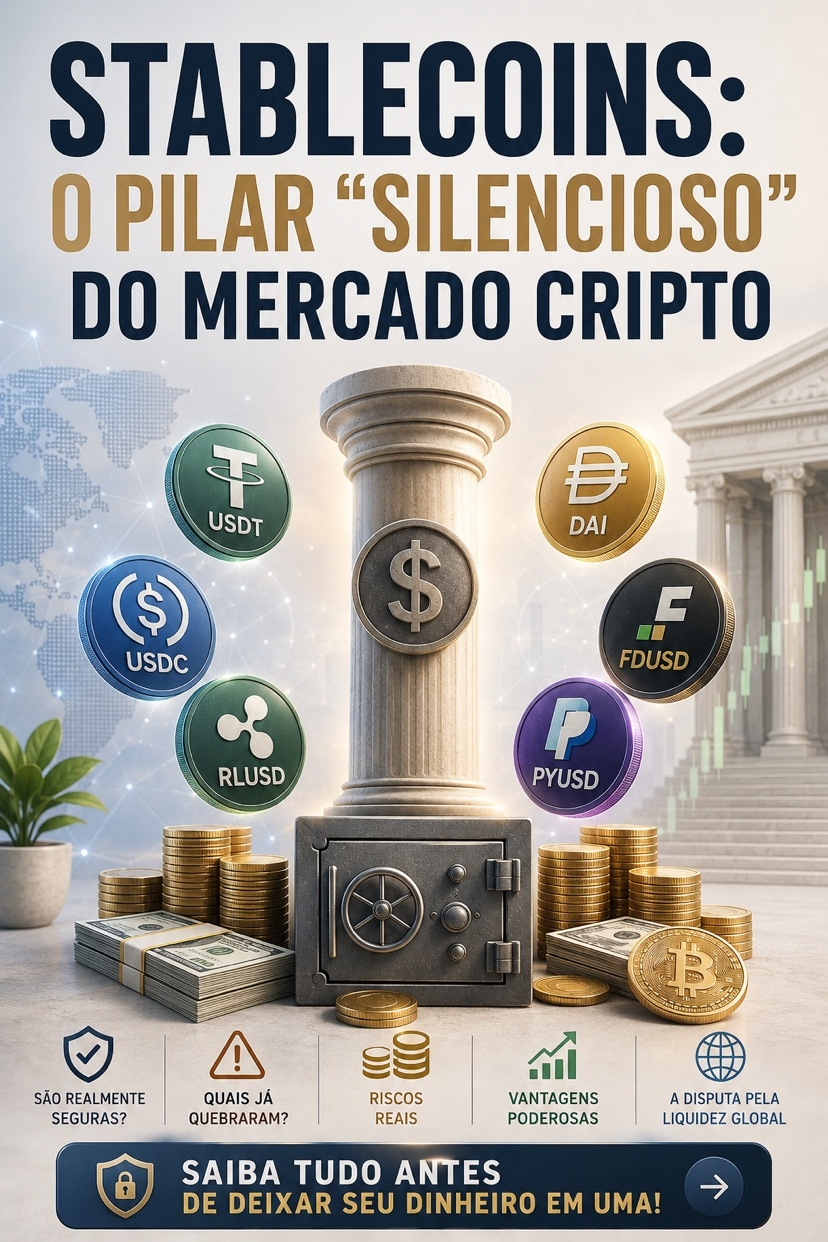
Stablecoins have become the operational backbone of the ENTIRE crypto market.
I believe this is one of the most important segments, and perhaps the most misunderstood.
📌 WHAT ARE STABLECOINS?
Stablecoins are cryptocurrencies designed to maintain a stable value, usually pegged to the dollar.
But… they are NOT all the same:
• different structures
• different reserves
• different levels of transparency
• different risks
• different issuers
• different objectives
🌎 HOW MANY STABLECOINS EXIST TODAY?
HUNDREDS of different stablecoins circulating on the blockchains.
📊 Industry estimates suggest:
• more than 200 active stablecoins globally
• around 150 to 170 still have some relevant liquidity
• but few really concentrate the market
And despite the huge number of projects, the market is EXTREMELY concentrated.
💵 $USDT + $USDC practically dominate global liquidity.
Creating a stablecoin is relatively 'easy'; the hard part is generating TRUST, liquidity, and global adoption.
🌍 THERE ARE STABLECOINS PEGGED TO VARIOUS CURRENCIES:
💵 US dollar (USD)
💶 euro (EUR)
💷 British pound (GBP)
💴 Japanese yen (JPY)
🇨🇳 Chinese yuan (CNH/CNY)
🇧🇷 Brazilian real (BRL)
🇭🇰 Hong Kong dollar (HKD)
🪙 gold and other tokenized assets
But... approximately 99% of the world's relevant stablecoins are dollar-based.
Blockchains have further strengthened the dollar's global presence in the digital financial system.
🏦 MAIN STABLECOINS IN THE MARKET
💚 USDT (Tether)
The LARGEST stablecoin in the world by volume and liquidity.
• Dominance of 58% to 60% of the entire global stablecoin market
Strengths:
• greater global adoption
• enormous liquidity
• dominant on exchanges
• widely used in emerging countries
Point of attention:
• less transparency compared to USDC
• high centralization
Even after years of attacks, doubts, lawsuits, and crises... $USDT remains dominant in the market.
🔵 USDC (Circle)
Stablecoin with a more institutional profile.
Strengths:
• greater regulatory transparency
• clearer audits
• strong proximity to banks and institutions
Risks:
• greater regulatory dependence in the US
• potential for freezes
• strong centralization
Even during the Silicon Valley Bank crisis... Circle managed to stabilize USDC, reinforcing many investors' view that it is currently the 'safest institutional' stablecoin.
🟢 RLUSD (Ripple USD)
Ripple's stablecoin.
Ripple has officially entered the stablecoin market aiming to unify:
• blockchain
• global payments
• institutional liquidity
• banking integration
Strengths:
• institutional focus
• integration with international payments
• potential use within the Ripple/XRP ecosystem
Point of attention:
• still new
• has not faced major crises yet
• still needs to prove global adoption
The market is watching closely because Ripple already has relationships with financial institutions worldwide.
🟡 DAI
Decentralized stablecoin from the DeFi ecosystem.
Differential:
• issued via collateralization of digital assets
• decentralized governance
• not directly dependent on a single company
Risks:
• greater complexity
• dependence on DeFi
• indirect exposure to centralized assets
DAI is seen by many as one of the stablecoins most aligned with the original concept of decentralization.
⚫ FDUSD
Stablecoin that gained recent strength mainly due to #BİNANCE.
Positive points:
• rapid growth
• strong integration on Binance
• high liquidity in some pairs
Point of attention:
• still a small track record compared to the leaders
🟣 PYUSD (PayPal)
Stablecoin created by PayPal.
The market is paying close attention because:
• brings traditional giants closer to the sector
• reinforces integration between payments and blockchain
But still has small adoption compared to the leaders.
📊 AND WHAT IS THE MARKET WATCHING NOW?
• advancement of global regulation
• interest from traditional banks
• growth of CBDCs
• competition between Tether x Circle x Ripple
• stablecoins generating yield
• integration with global payments
• increasing institutional use
I believe the next big battle in the financial market WON'T be over Bitcoin...
It will be about who will control global digital liquidity.
And stablecoins will be at the center of this discussion.