
Analysis of an anomalous transaction with a fee exceeding the average level by 226,000.
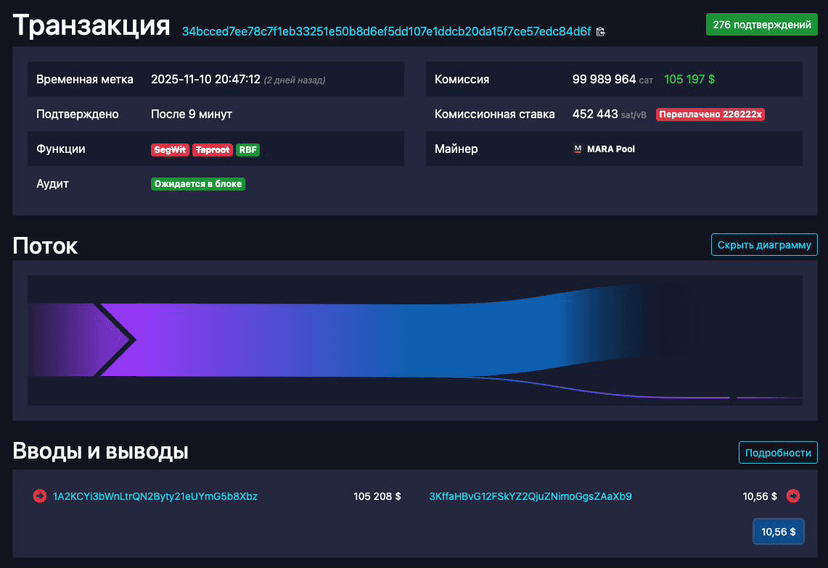
👋 Hello! An unprecedented transaction has been recorded on the Bitcoin blockchain: a user transferred $10 in BTC but paid a fee of $105,000 for it. Let's analyze how this is possible and what lies behind this case.
Details of the anomalous operation
Transfer amount: 0.00010036 BTC (about $10 at the current rate).
Fee: 1 BTC (approximately $105,000).
Block: No. 923023.
Exceeding the average level: more than 226,000 times (according to mempoolspace).
Fact: This is one of the most expensive fees in the history of the Bitcoin network relative to the transfer amount.
Who received the reward?
The block was mined by the MARA Holdings mining pool:
Total reward: 4.154 BTC (≈ $435,000).
Of these:
3.125 BTC — new coins (issuance);
1.029 BTC — fees, including a record overpayment.
Why was the fee so huge?
User error
The sender likely indicated the fee amount incorrectly in the wallet.
Such cases are rare, but occur due to human factors.
Technical nuances
In some wallets, the fee is set manually, and an error in the parameters can lead to overpayment.
Malicious act
Theoretically, this could have been a demonstrative gesture (for example, a 'gift' to miners).
However, such a scenario is unlikely due to the scale of the overpayment.
Experiment or test
Perhaps the transaction was part of a study on network performance, but this is unconfirmed.
Important: The Bitcoin network does not check the 'reasonableness' of the fee — it only processes the transaction when the fee is sufficient.
Context: average fees in the BTC network
Current level: about 0.6% of the total block reward.
Typical fees for priority transactions: less than $1.
Factors driving up fees:
high network congestion;
the need to expedite transaction processing.
For comparison: during peak periods, fees rarely exceed $10–20 even for urgent transfers.
Consequences for the network and users
For miners:
The MARA Holdings pool made excessive profits, but this is an isolated case.
Such anomalies do not affect the long-term profitability of mining.
For users:
A reminder of the importance of checking transaction parameters.
The risk of errors remains, especially with manual fee entry.
For the reputation of Bitcoin:
The case highlights the transparency of the blockchain: any transaction is publicly visible.
However, it may intensify criticism of the network's 'inefficiency.'
What do experts say?
“This is a classic example of human error. Such cases are a reminder that blockchain does not forgive negligence,” notes a CoinDesk analyst.
“A fee of $105,000 is absurd. But the network operates as intended: the rules do not prohibit such payments,” adds a representative from K33.
“Users should use wallets with automatic fee estimation to avoid such situations,” warns a trader from Pantera Capital.
Checklist for safely sending BTC
✅ Check the fee: use wallets with automatic calculation or verify the fee amount against current average values (for example, via mempool.space).
✅ Test with small amounts: if unsure about the settings, first send a small transaction.
✅ Learn the wallet interface: ensure you understand how to set fee parameters.
✅ Monitor network congestion: during peak periods, fees increase — plan transfers in advance.
✅ Use RBF (Replace-by-Fee): if you made a mistake, you can increase the fee later (but not decrease it).
Tip: Use mempool.space, Blockchair, or Bitcoin Fees to monitor fees.
Conclusion: a lesson for all market participants
What is important to remember:
Blockchain is not a 'magic box': errors in transaction parameters are irreversible.
Fees are not abstract numbers: they directly affect your capital.
Automation reduces risks: trust proven wallets with smart fee calculation algorithms.
The transparency of the network is its strength: anyone can check transaction details, but they remain visible themselves.
Be careful: even a $10 transfer requires thorough checking.
Main point: This case is not a reason to doubt Bitcoin, but a reminder: technology requires mindfulness. Your task is to use it wisely.
P.S. In the next article, we will discuss how to choose the optimal fee size for different BTC transfer scenarios. Stay tuned!
📊 Chart: Dynamics of fees in the Bitcoin network (October–November 2025). Source: mempool.space.


