
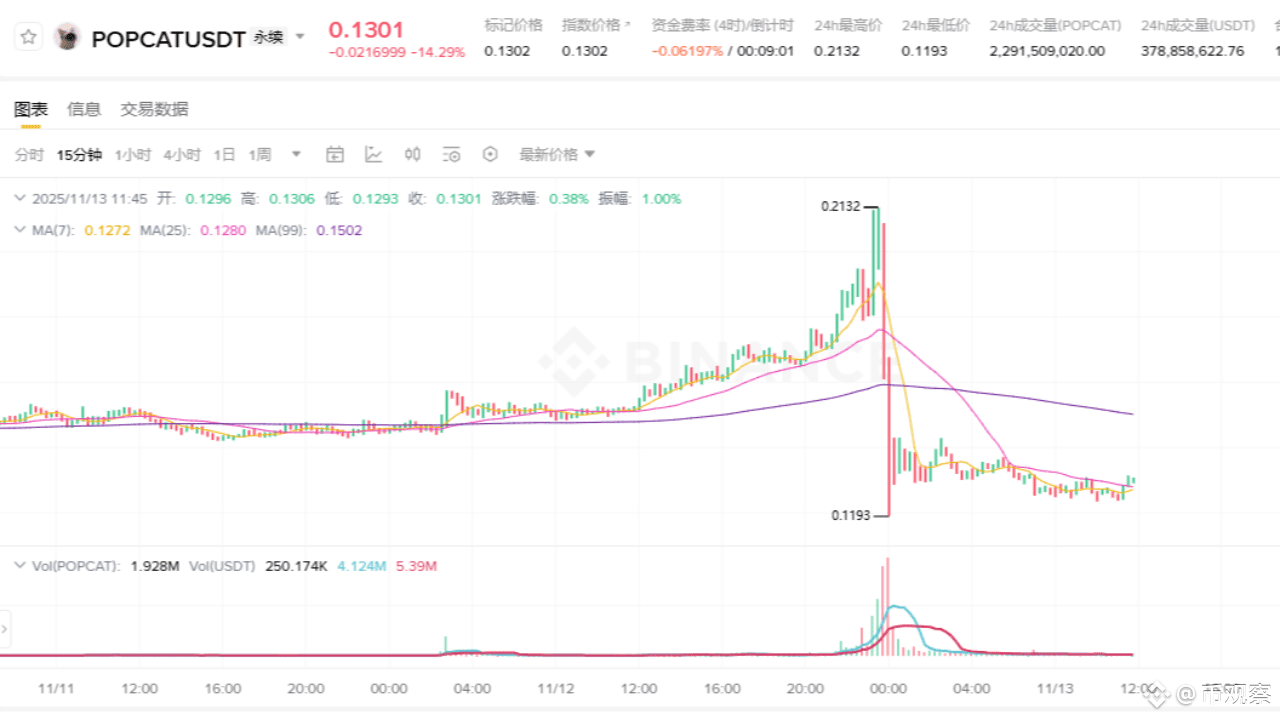
Last night, the price of $POPCAT suddenly plummeted.
Many people thought it was another long squeeze, but from the trading trajectory, market signs to the final liquidation results—
This is not normal market fluctuation, it is a precise simulation and a liquidity attack that was prepared in advance.
The most terrifying thing is:
Such things have happened before and will happen again in the future.
It's not that you did something wrong, but the system itself gave the attacker an opportunity.
The transparency and programmability of perpetual DEX is an advantage, but also a risk.
This time is a live demonstration lesson.
1. Event process: it started to unfold 13 hours ago.
This is not a sudden event, but a calculated operation from 'capital - market - liquidation path'.
① Capital preparation → 3 million USDC, split into 19 small accounts.
The attacker withdrew 3 million USDC from OKX in advance, then immediately divided it into 19 wallets.
Why break it down?
Avoid triggering the platform's single-address risk control.
Can break down long positions, thus increasing position limits.
This is a layout that only professional players would do.
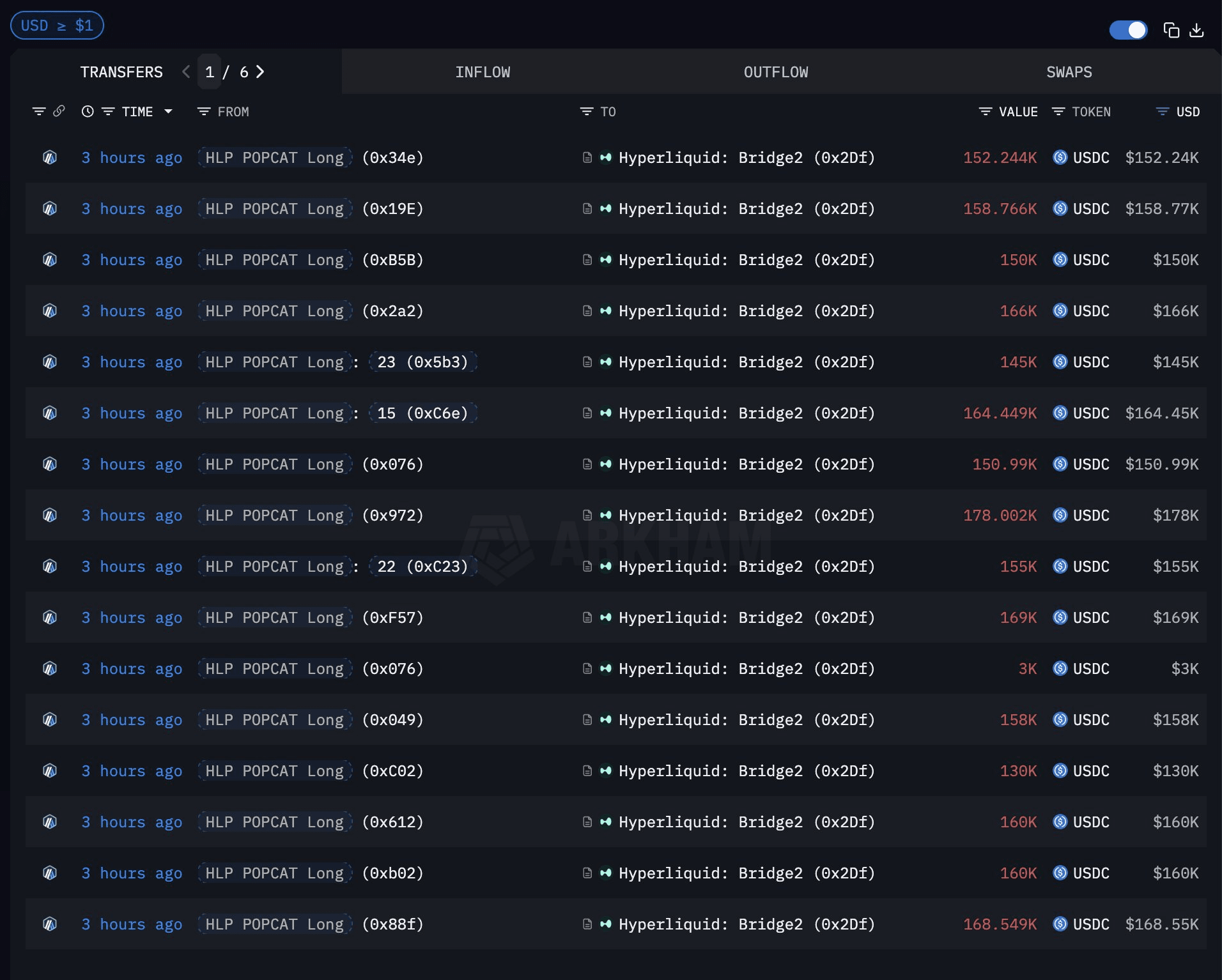
② Continuing to accumulate large long positions on Hyperliquid.
Constantly going long, pushing the total long exposure of POPCAT to 20-30 million dollars.
For a token with limited depth, this is basically the level that can influence the price.
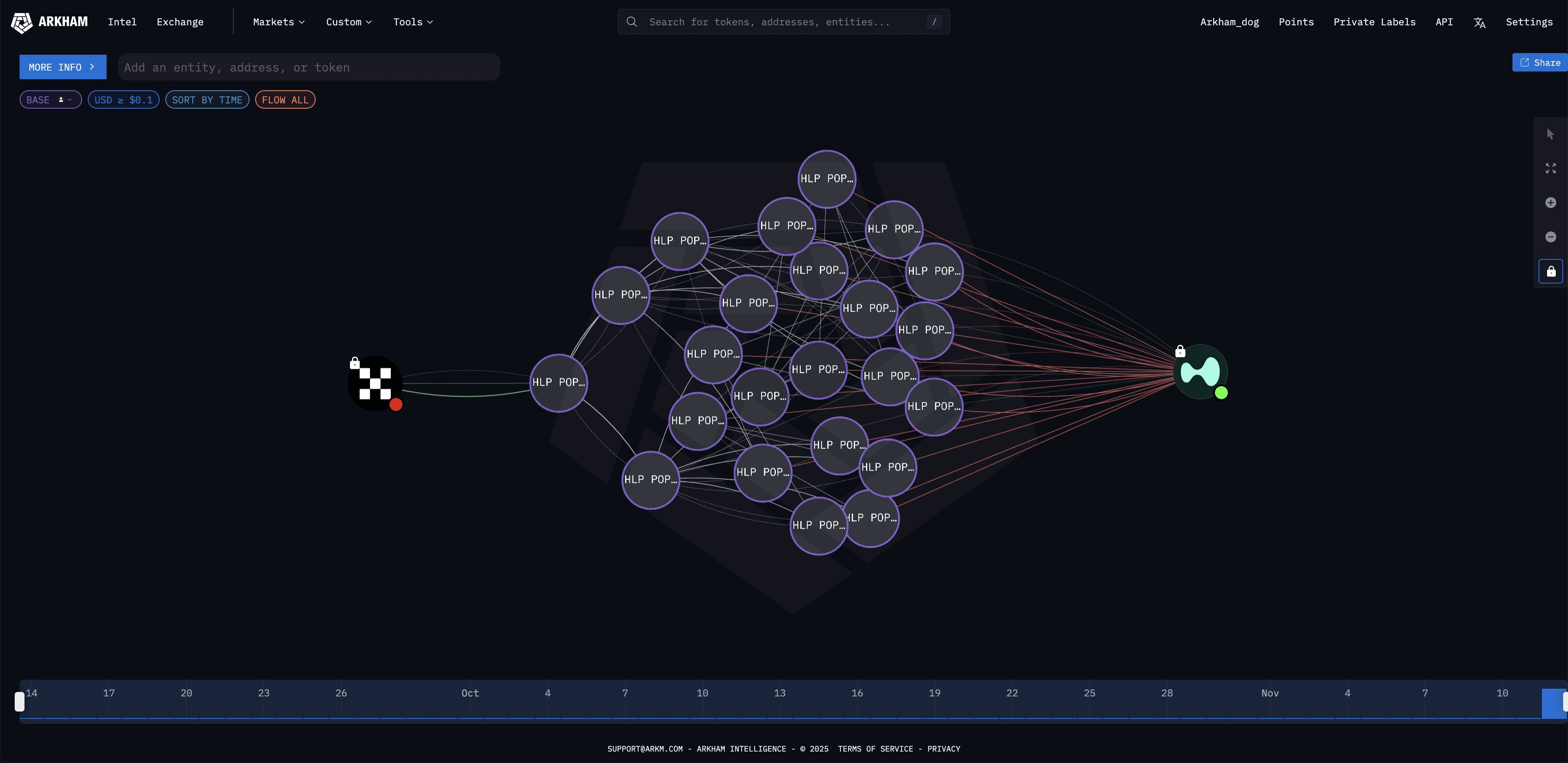
③ Place a giant buy wall of nearly 30 million at the 0.21 position.
Note, this step is critical.
This massive wall is set up to create the illusion of 'large funds entering', attracting retail and quantitative strategies to follow.
Visually it's strong support, but in reality, it's a trap.
④ The market is induced → Long positions start to pile up.
Seeing a large buy wall, retail and quantitative traders start to go long.
The attacker's objective is halfway achieved.
⑤ The buy wall is instantly removed → The price directly explodes and drops.
Because POPCAT originally has low depth, this step is like pulling the floor out, causing the market to plummet instantly.
⑥ The attacker's own long positions are all liquidated → Capital loss to zero is part of the design.
Many people cannot understand this point:
The attacker is not 'flipping',
but deliberately causing their own liquidation.
Because the next step will transfer massive bad debts to LP.
⑦ HLP bears the remaining liquidation → Ultimately loses 4.9 million dollars.
After a massive position is liquidated, slippage is too high, and the system cannot digest it in the market, leaving the remaining exposure to LP pools.
Result:
HLP lost about 4.9 million dollars.
The attacker's objectives have been achieved.
⑧ The platform is forced to intervene, closing risk exposure + suspending the Arbitrum bridge.
Once losses of this scale occur, the platform must intervene manually to stabilize the system.
This is the complete link.
In summary:
Using real money to create fake depth → Exploiting vulnerabilities in the liquidation mechanism → Shifting losses to LP.
Two, why this is definitely not an 'ordinary liquidation'?
Because it has typical attack characteristics:
Mult-address splitting → Professional preparation.
Fake buy wall → Market manipulation
Removing walls instantly → Triggering a price break.
Active liquidation → Change LP to place orders
This is the third time the platform has encountered a similar incident → Not a coincidence.
Ordinary people will be liquidated, but won't drag LP down with them.
This is the essential difference of the attack.
Three, the structural risks of perpetual DEX have once again been highlighted.
The serious point of this incident is not POPCAT itself, but:
The basic structure of perpetual protocols has been proven to be artificially tearable again.
The three major weaknesses of perpetual DEX:
① Long-tail asset liquidity is thin → Easy to manipulate.
POPCAT, which itself has limited depth, is most suitable for manipulation.
② High leverage amplifies attack leverage.
Borrowing 20-30 times leverage can trigger large-scale liquidations with very little cost.
③ The liquidation mechanism relies on market depth → Can be manipulated.
As long as one can control the market, one can decide the direction of liquidation prices.
These three points combined create a direct path to the LP wallet.
Similar issues have occurred in the early versions of GMX, MUX, Drift, Vela, and even dydx, and it's not the first time.
The biggest risk of perpetual DEX is not the market, but the 'mechanism'.
Four, several realities worth pondering:
1️⃣ Give traders
Long-tail assets are the playground for manipulators.
Buy walls and sell walls are both illusions.
The biggest hidden danger of perpetual protocols lies in the system itself.
The more volatile a place is, the easier it is to attack.
2️⃣ Give LP
Profits are never free.
GLP/HLP/vLP are all 'liquidation counterparties'.
In extreme market conditions, losses are borne by oneself.
In high-leverage scenarios, bad debts are inevitable events.
3️⃣ For the industry
This incident will not make perpetual DEX disappear, but it will force protocols to change:
Target selection is stricter.
Liquidation rules need to be redone.
Fake depth should be restricted.
Price sources need to be more robust.
LP must have supplementary insurance mechanisms.
All these will become directions for future reconstruction.
Five, finally I want to say: The market is terrifying, but the mechanism being precisely exploited is even more terrifying.
The collapse of POPCAT is just a surface phenomenon,
the real risk is another matter:
You think you are fighting against the market, but in reality, you are fighting against a mechanism that can be calculated through.
In the perpetual market, you may not have made any wrong decisions, but will still be affected by system vulnerabilities.
You don't need to predict where the risk comes from,
You just need to know about yourself:
Don't touch areas you don't understand.
Don't try directions you are not good at.
Don't bet on uncertain markets.
Capital is always much more important than profits.
True maturity is knowing what you don't know.
I hope those who read this article are not just shocked by the event, but have gained a bit of insight.
—— Coin observation