
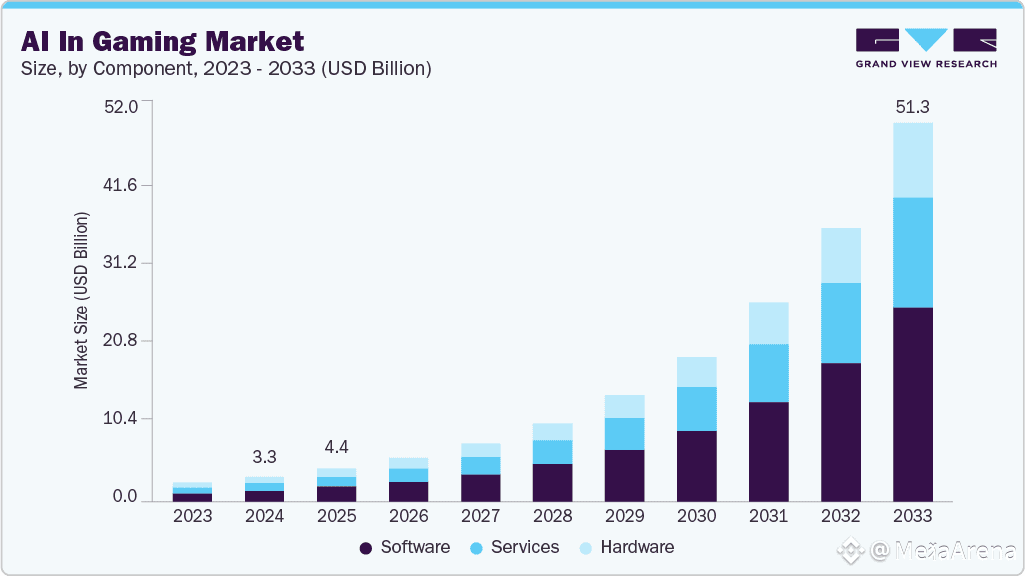
In recent years, artificial intelligence has been penetrating the gaming industry at an unprecedented pace. From a market perspective, the global AI in Games market was estimated at around USD 3.3 billion in 2024 and is expected to grow to approximately USD 51.26 billion by 2033, with a compound annual growth rate (CAGR) of 36.1%. This rapid growth reflects that game developers and platforms are heavily investing in AI technology to achieve higher player engagement, more personalized experiences, and smarter gameplay mechanics.
Meanwhile, AI Agents—software entities in games with autonomous perception, decision-making, and action capabilities—are becoming a hot topic in the industry. Industry analysis suggests that AI Agents in games will "fundamentally enhance NPC behavior, making each game world unique compared to the previous session." Additionally, a developer survey published by Reuters in 2025 showed that as many as 87% of game developers have already integrated AI Agents into their workflows for automating tasks, assisting content creation, and improving interactive experiences. These trends indicate that AI Agents are rapidly evolving into core components of game design and operation.
Trust Concerns with AI
In practice, most current AI Agents are semi-autonomous systems—they possess some decision-making and execution capabilities but still require human instructions, feedback, or supervision. When tasks exceed their pre-defined scope, human intervention is often needed to ensure safety and accuracy. This means that most AI Agents heavily rely on prompts for human-machine communication. A prompt is an instruction or description provided by a user to guide the AI in generating output, for example, having ChatGPT write a press release or instructing an autonomous vehicle to plan a route.
However, this is precisely where the problem lies: most existing AI Agent systems rely on centralized servers, making their operational logic and reasoning processes a "black box." Users cannot verify whether prompts are tampered with, whether the reasoning process is secure, or whether the generated outputs are trustworthy. They also cannot ensure that sensitive information contained in prompts—such as private keys, identities, or medical data—is adequately protected.
More critically, centralized AI Agents are often controlled by the server operators who hold the highest privileges, capable of influencing Agent behavior or accessing user assets. The current AI ecosystem is concentrating toward a few companies monopolizing models and computing power, continuously expanding potential risks. Even Web3 projects like AI16z’s Eliza or the Virtuals Protocol place only identity and economic layers on-chain, while core reasoning and interactions still depend on centralized infrastructure.
As a result, when using most AI Agent services, users are effectively "blindly trusting" the system without verification. This structural opacity perpetuates public doubts about the safety and reliability of AI Agents. Against this backdrop, MetaArena leverages zero-knowledge proofs to build a trusted execution and verification framework for AI Agents, providing a cryptographically verifiable solution to the trust challenges of the AI era.
MetaArena’s zkTrace Solution
MetaArena is a trusted execution infrastructure built around zero-knowledge proof (ZKP) technology, designed to provide high-performance, low-cost ZK services for applications requiring verifiable computation and privacy protection.The system consists of a distributed off-chain computation network and an on-chain verification engine: the former is responsible for receiving and executing computational tasks and generating zero-knowledge proofs, while the latter verifies the proofs on-chain, ensuring the authenticity and consistency of data, transactions, and behaviors. Through a distributed network architecture, MetaArena significantly enhances system scalability and task throughput while reducing computational costs.
On this basis, MetaArena has launched the zkTrace solution specifically for large models and AI Agent services, further extending it as a key infrastructure in the field of AI trusted execution and privacy computing. zkTrace embeds ZK proof mechanisms into AI execution paths, allowing models to provide verifiable execution proofs externally without exposing underlying prompts, input data, or inference logic. This mechanism compensates for the shortcomings of traditional encrypted communication protocols (such as TLS) in “verifiability,” enabling data to have proof of computational authenticity while remaining secure in transmission, thereby establishing stronger trust in AI model reasoning and interactions.
Unlike solutions that rely on hardware trusted environments (TEE), MetaArena is fully built on cryptographic security, without dependence on any centralized entity or hardware trust roots. The system supports multiple proof generation modes, including lightweight off-chain proxy verification, distributed MPC (multi-party computation) collaborative generation, and modular pluggable verification modules, allowing developers to flexibly choose optimal execution paths based on performance and privacy requirements.
MetaArena’s on-chain verification engine adopts a modular structure and optimizes performance via an efficient P2P communication network and sharded verification logic. Node communication and task routing are based on a Kademlia algorithm structure, allowing nodes to complete task assignment and proof propagation via the shortest paths, ensuring stable performance and low-latency responses under high load conditions.
Thanks to this architecture, MetaArena employs lightweight proxy verification in zkTrace and zkAction solutions, avoiding the high cost and complexity of multi-party computation while circumventing the closedness and vulnerability risks associated with TEE hardware. This provides AI Agents with a truly decentralized, verifiable, and privacy-protecting execution environment.
zkAction
In addition to zkTrace, MetaArena has pioneered the zkAction framework based on ZKP solutions. This framework uses zero-knowledge proof algorithms to ensure that AI Agents strictly follow predefined rules and model logic during execution, guaranteeing that their decision-making processes are fair, accurate, and secure.
zkAction makes AI Agent behavior verifiable without exposing underlying models, prompts, or execution data, effectively preventing collusion or malicious behavior among multiple intelligent agents and ensuring fairness and security across scenarios such as Web3 games and intelligent interaction systems.
The zkAction framework is particularly suitable for lightweight models executing deterministic tasks, such as AI combat agents in on-chain games or automated adjudication systems. By encapsulating AI behavior as verifiable actions, zkAction cryptographically fixes AI decision paths and outcomes in verifiable circuits, achieving a “what executes is what can be verified” trust logic.
Overall, the zkAction framework features:
Verifiability: Uses zero-knowledge proofs to verify AI Agent behavior logic without exposing underlying models or execution details.
Anti-collusion: Prevents cooperative cheating or manipulation among different agents, ensuring fairness in games and interactive processes.
Scalable computing power: Provides flexible computing resources via a decentralized computing network for verifiable AI, balancing performance and security.
AI Agent Game Engine Trusted Framework
MetaArena has achieved early deployment in on-chain gaming, launching the AI Game Engine and game integration tools via the MetaArena SDK. Developers can create on-chain games with verifiable execution, intelligent interaction, and player co-creation features. AI Agents execute game operations through smart contracts and ensure fairness, trustworthiness, and auditability between players via zkTrace / zkAction verification mechanisms.
Within the engine framework, developers can continue using mainstream game engines like Cocos Creator, Unity, Unreal, and Godot, integrating on-chain functionality without altering existing workflows. With the MetaArena SDK, game teams can capture key actions (skill activation, shuffling, turn switching, etc.) with one click and automatically convert them into verifiable tasks, significantly lowering the barriers for on-chain integration and behavior verification.
Through interfaces with a decentralized data management layer, core game state management can be updated and verified on-chain in real time, including player input, content generation, and test feedback. All state data is collaboratively processed by multiple AI Agents such as content generation agents, game testing agents, and data insight agents to optimize the game experience and ensure data accuracy and consistency.
AI Agents can be flexibly injected into game roles like NPCs, bosses, or player proxies, implementing personalized strategies and verifiable execution via built-in prompt management and security tools to ensure compliant and safe behavior.
All inputs, states, and feedback generated during gameplay are transmitted to the decentralized data management and storage layer. This data is verified via zero-knowledge proofs integrated through the ZK Game SDK and zkTrace / zkAction modules, ensuring immutability and authenticity of logic and states. Based on a distributed verification network, the system can jointly audit player and AI behavior, prevent cheating, and implement a secure “action-as-proof” closed loop.
MetaArena’s tech stack further integrates an optimized resource layer for efficient scheduling of computing and storage resources, allowing multiple AI Agent types such as content generation, testing, and insight agents to run in parallel with low latency. The system also supports UGC / AIGC player creations: players can generate characters, storylines, or cards via text, with the system automatically generating ZK proofs and minting them as NFTs, directly integrating into the game ecosystem and forming a verifiable creative loop.
Additionally, MetaArena proxy players can participate in staking under an LP structure, sharing game revenues with other stakers to implement a “play-to-earn” economic incentive model. This model supports cross-platform operation (mobile and desktop) and enhances player engagement and retention through revenue sharing mechanisms.
Currently, MetaArena’s zkTrace / zkAction solutions are continuously expanding to more domains, promoting large-scale safe adoption of LLMs and AI Agents through privacy and trusted mechanisms, providing a verifiable, auditable, and sustainable trust foundation for the next-generation AI gaming ecosystem.
Ecosystem Value-Driven Asset $TIMI
$TIMI is the native token of the MetaArena network, serving multiple functions across the ecosystem, including computation incentives, task execution, governance participation, and system staking. It is not only a settlement medium for verification and task execution but also a core value carrier connecting AI behavior verification, node collaboration, and ecosystem incentive cycles. Developers, validator nodes, and players can all participate in network operations through $TIMI: computation nodes receive rewards for completing zero-knowledge tasks, users use $TIMI to trigger task execution or behavior verification, and nodes and users staking $TIMI gain higher task priority and reward rights. Meanwhile, as a key governance credential, $TIMI grants holders the rights to vote on parameter adjustments, module upgrades, and incentive strategies, organically integrating incentives with decision-making.
At the economic model level, $TIMI’s value growth is built upon a continuous cycle of real interactions and verifiable computation. Each trusted AI Agent behavior verification, task execution, or cross-chain invocation is settled in $TIMI, with a portion burned, creating an endogenous deflationary and scarcity mechanism. As core modules like zkTrace and zkAction scale, demand for AI computation, intelligent services, and on-chain reasoning will continue to expand, further increasing $TIMI’s usage frequency and circulation value within the system.
At the same time, governance participants can obtain long-term network incentives and revenue distribution through token holdings, making $TIMI both the “fuel” for network operation and the “stake anchor” for ecosystem growth. As the underlying support connecting AI trusted execution and the gaming economy, $TIMI is driving MetaArena toward a self-circulating, verifiable, and sustainably incentivized intelligent economy.
Conclusion
Overall, the AI field is still in an early stage of rapid evolution. Although LLMs and AI Agents have demonstrated significant potential across multiple domains, the lack of verifiability and traceability caused by their “black-box” nature remains a key barrier to large-scale deployment. The absence of transparent execution and trusted verification makes it difficult for AI systems to gain the trust of users and developers in critical scenarios.
MetaArena, by building a trusted computing and verification framework based on zero-knowledge proofs, establishes verifiable paths for AI Agent execution, ensuring that every decision, interaction, and reasoning can obtain independent proof and traceable verification on-chain.
Especially in complex, highly interactive on-chain gaming scenarios, MetaArena’s zkTrace and zkAction modules ensure fair, trustworthy, and auditable behavior for players and AI agents (NPCs, bosses, automated opponents), eliminating cheating and hack risks. More importantly, this system transforms “AI trusted execution” into a “verifiable entertainment experience,” making AI no longer the product of a closed algorithm but an agent that is verified, trusted, and genuinely accepted by players. With the improvement of the trusted framework and ecosystem expansion, MetaArena is poised to become a key hub for scaling AI Agents in the gaming industry.