
One of the essences of the market is non-linearity or randomness, which is an absolute attribute, global, eternal, and at all levels, while linearity or regularity is local, temporary, and limited;
The second essence of the market is time. Without the passage of time, there is no price fluctuation, and without price fluctuation, there is no market. Time is the carrier of price movement;
Based on the above essence of the market, trading is essentially a losing game.
What is the essence of human nature?
1. The inherent weaknesses of human nature are greed, fear, the pursuit of control, the pursuit of perfection, loss aversion, shortsightedness, laziness, impulsiveness, lack of restraint, and so on. Traders are naturally born losers.
2. The inherent weaknesses of human nature can be trained to weaken or hide to a certain extent over a period, making them less important and not affecting trading. Successful traders are well-trained individuals who have developed good thinking and behavioral habits. However, they still cannot fundamentally overcome the weaknesses of human nature. If they completely overcame them, they would no longer be human.
3. A bad habit is often a comfortable habit that forms naturally; a good habit is often an uncomfortable habit that requires deliberate practice to develop. Good things are easily destroyed; good habits may present a dissipative structure over time, background, and circumstances; for example, elementary school students do morning exercises very seriously, but during middle school, they start to become lazy. By the time they reach college, they become even more perfunctory.

A stock selected from a technical perspective that has neither a high risk of falling nor a high probability of rising.
Three key points for 'Tianyan with low volume' operation
1. When you see 'Tianyan with low volume', you can immediately buy in as the safety factor is relatively high. As long as no unexpected events occur, there will at least be a period of intermediate market rising. You should feel confident to intervene and operate decisively.
2. 'Tianyan with low volume' sometimes also shows a failed trend, that is, after appearing, the stock price only rises for a short time and then stops rising. The 5-day moving average also falls with the stock price and returns below the 20-day moving average, causing a lock-up. However, this lock-up is temporary, and after a short lock-up, it will be released. Experience tells us that it is often needed to construct the bottom pattern. When the stock price falls back to the vicinity of the previous two low points, it will stop falling and stabilize, then turn upwards. After another golden cross, the stock price will rise steadily.
3. When the 10-day moving average and the 20-day moving average show 'Tianyan with low volume', but the buy signal is more reliable and stronger, the stock price should be higher, and conservative investors should try to adopt this buying method.
4. The position of the 'Tianyan with low volume' generally indicates that it appears at the bottom, but it can sometimes also appear in the rising phase or at the top. If it appears in the second adjustment wave, the buy signal is generally more reliable, and the success rate is higher after buying, allowing for confident purchases. If it appears in the fourth adjustment wave, it should be approached with caution. If it appears in a top range, it is mostly a false breakout, and care should be taken to avoid getting trapped.
5. When 'Tianyan with low volume' appears, after all, the stock price has already risen to a certain extent, only short-term operations can be performed. Once there is a profit, one should exit quickly and not hold the stock for too long to avoid being trapped.
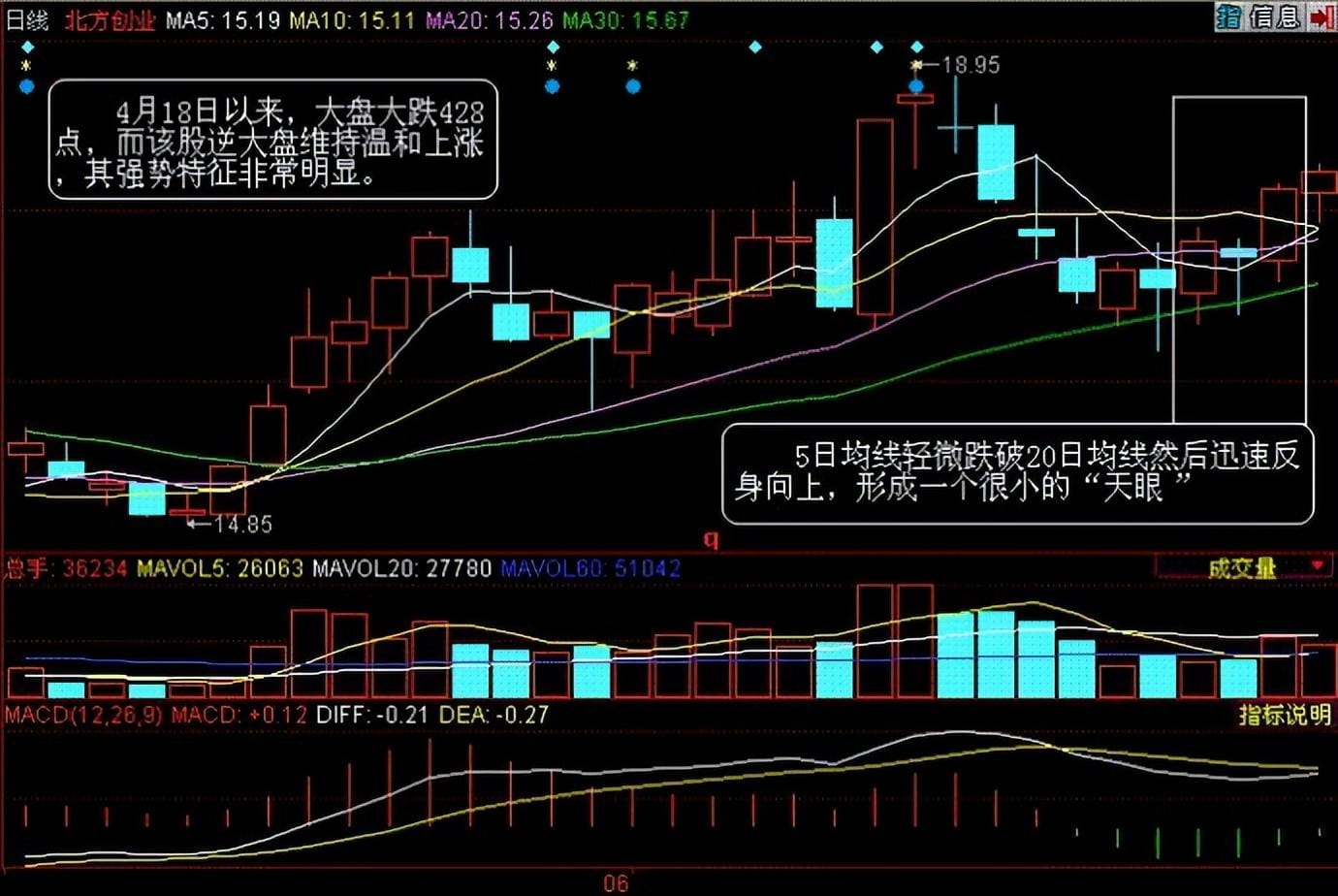
Four 'Tianyan with low volume' best conditions:
The stock price is above the moving average; the stock price just crosses above the 30-week moving average on this day; short-term moving averages are in a bullish arrangement.
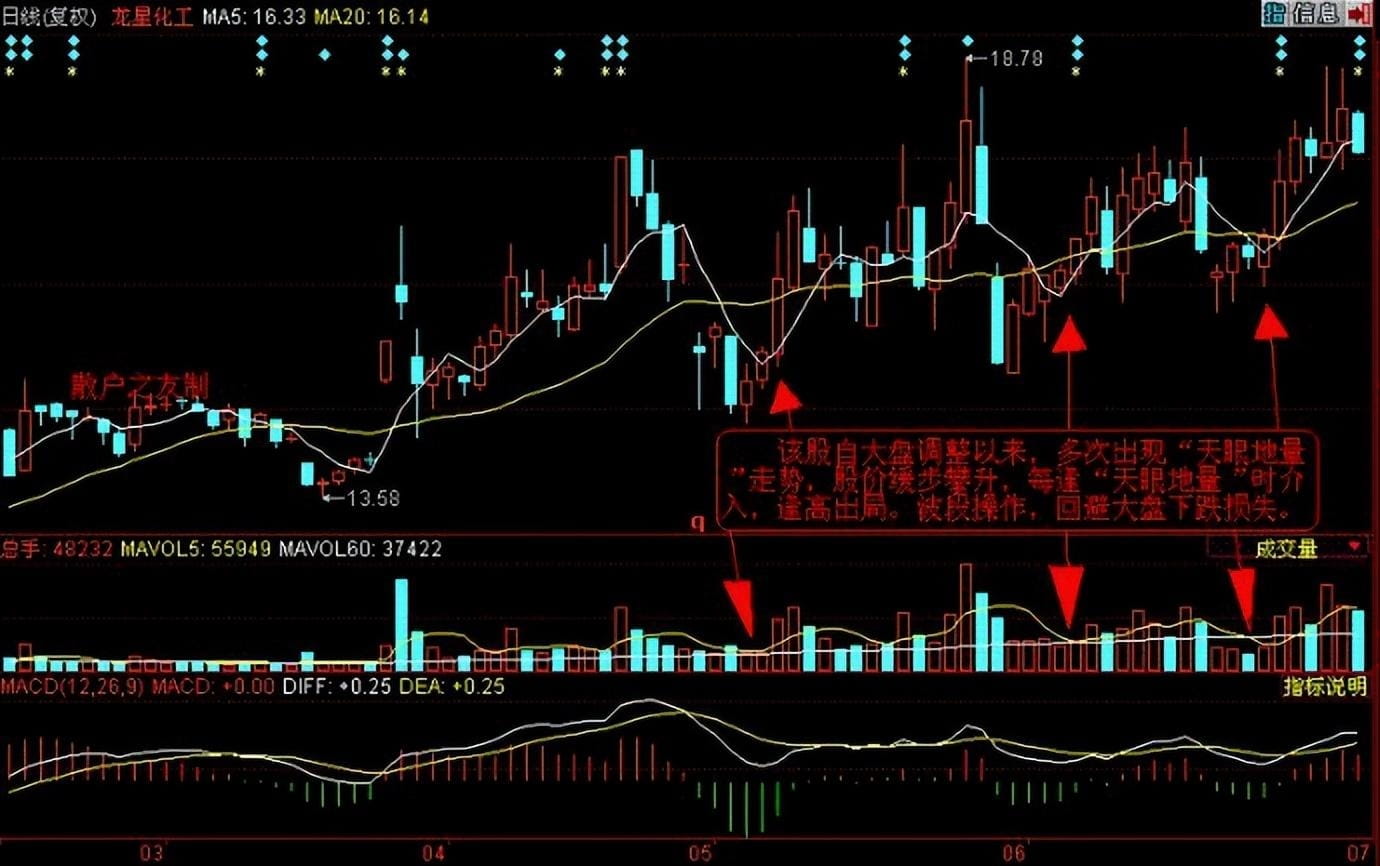
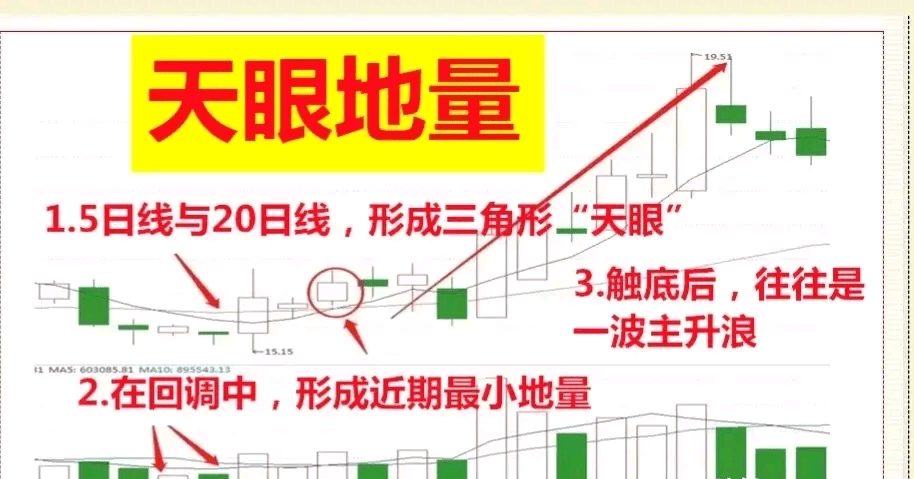
Tianyan with low volume K-line pattern
Consists of the 5, 10, and 20-day moving averages and volume bars.
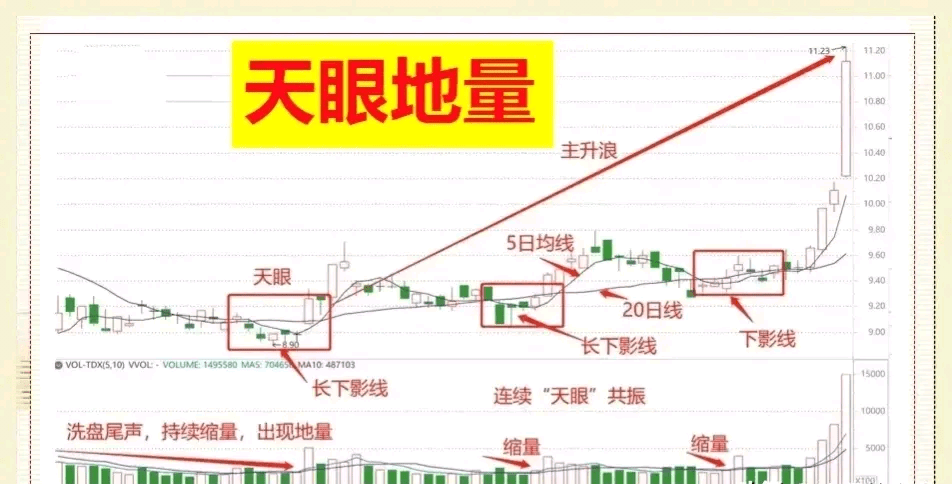
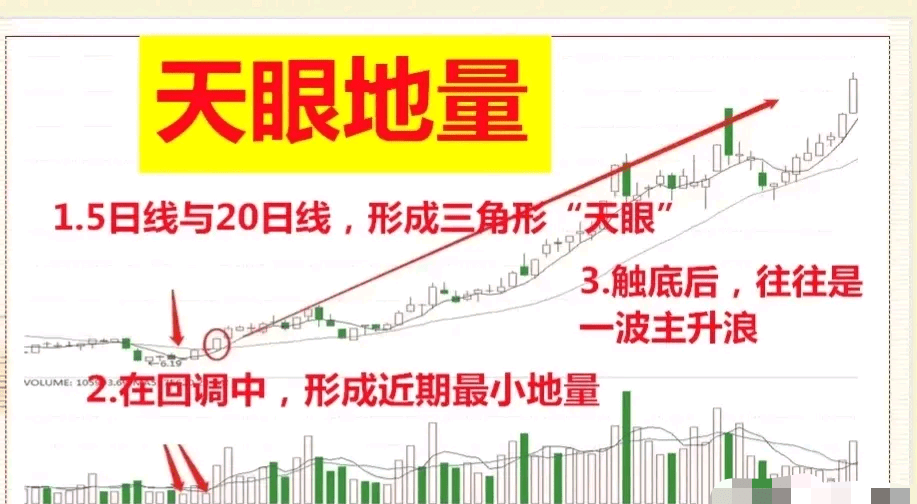
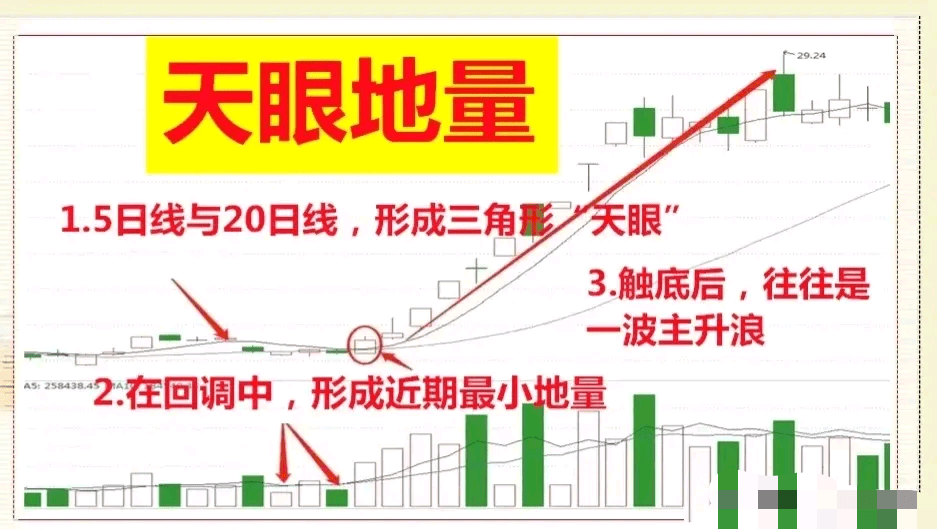
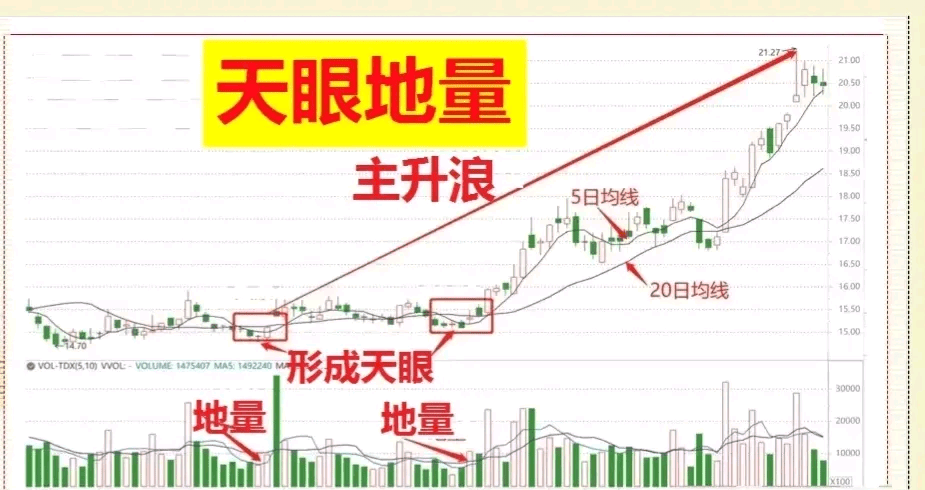
The 5-day moving average crossing below and above the 20-day moving average twice looks like an eye, called 'Tianyan'.
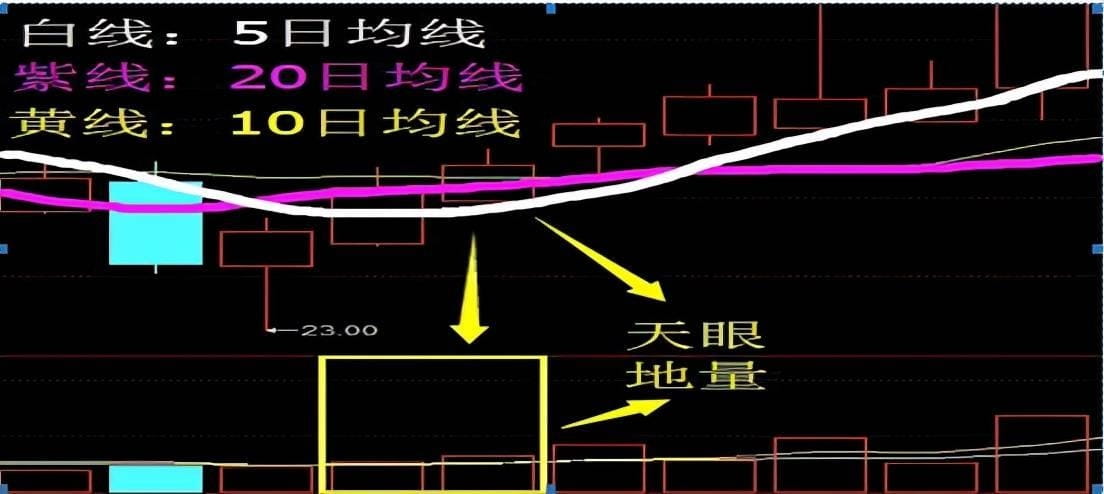
The volume below the Tianyan shows low volume (shrinkage), not high volume (increase).
Tianyan
①Position, the 5-day moving average crosses above the 20-day moving average for the first time;
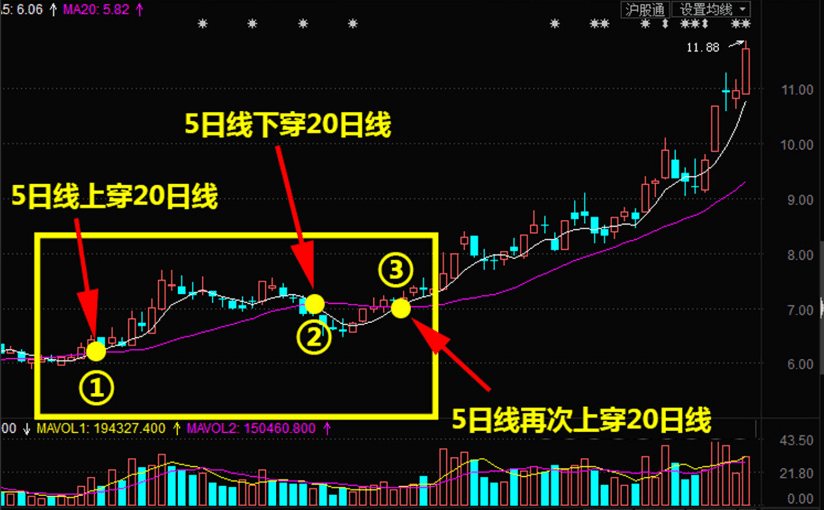
②Position, the 5-day moving average crosses below the 20-day moving average for the first time;
③Position, the 5-day moving average crosses above the 20-day moving average again.
Low volume
①Position, the 5-day moving average crosses above the 20-day moving average for the first time;
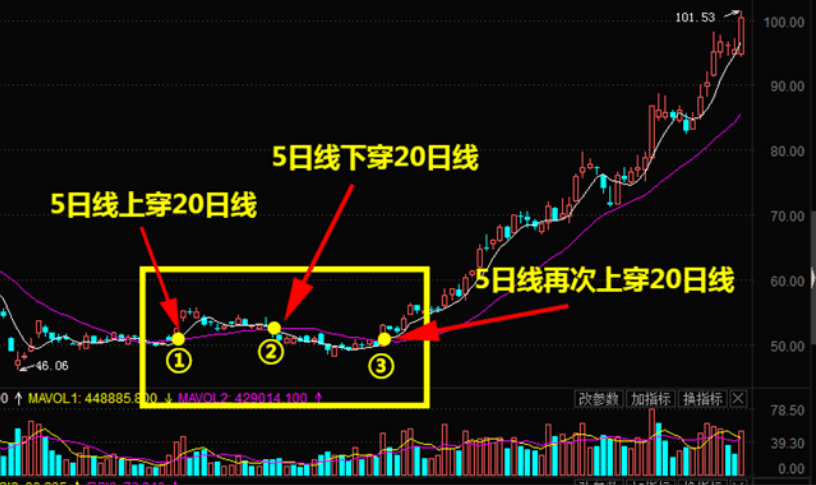
②Position, the 5-day moving average crosses below the 20-day moving average for the first time;
③Position, the 5-day moving average crosses above the 20-day moving average again.
Moving average
The moving average is a curve representing the average closing price of a stock over a certain period.
For example, the 5-day moving average indicates the average price over the last 5 days.
The 20-day moving average indicates the average closing price over the last 20 days.
The so-called 'Tianyan' means the 5-day moving average crosses above the 20-day moving average first.
Then crosses below the 20-day moving average, and finally crosses above the 20-day moving average again.
And simultaneously running upwards, leaving a shape similar to an 'eye'.
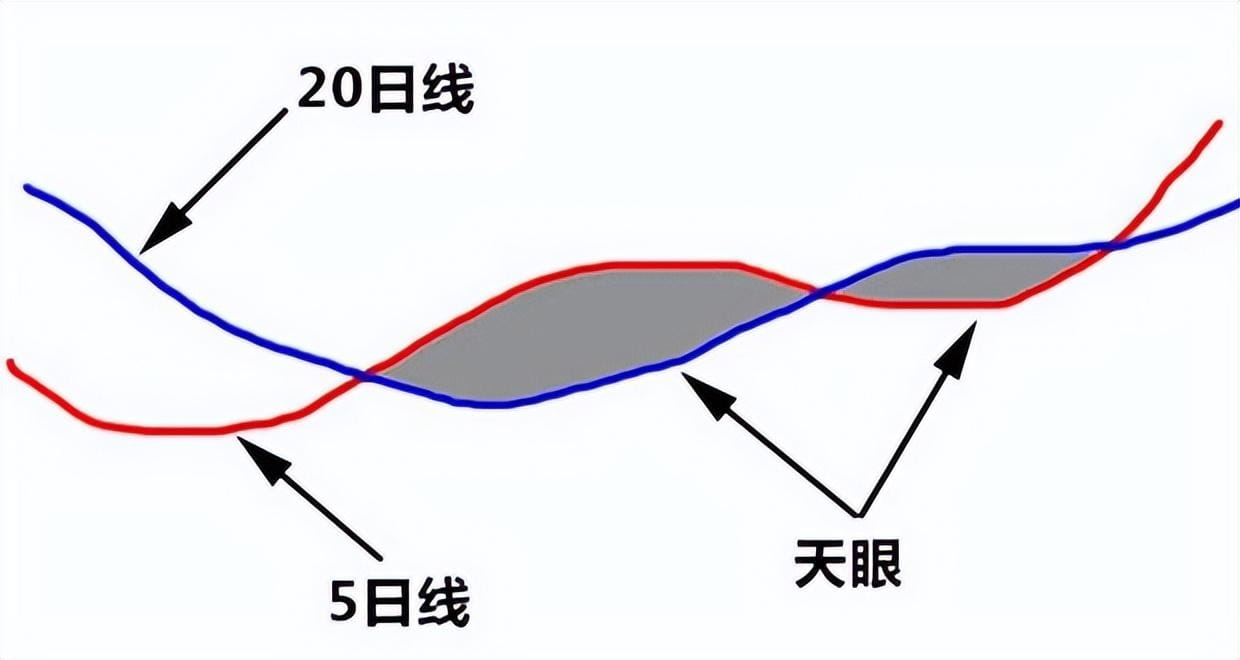
The 5-day moving average indicates short-term bullish momentum, and the 20-day moving average indicates medium-term bullish momentum.
When the 5-day moving average is up and the 20-day moving average is down,
Indicates that short-term bullish funds are strengthening, but medium-term bullish funds are weakening;
When the 5-day moving average is down and the 20-day moving average is up,
Indicates that short-term bullish funds are weakening, but medium-term bullish funds are entering;
When the 5-day moving average is up and the 20-day moving average is also up, the 'Tianyan' technical pattern appears.
Indicates that short-term bullish funds and medium-term bullish funds are both strengthening at the same time, significantly increasing the likelihood of a stock price rise.
Key points for 'Tianyan with low volume' operation
When encountering 'Tianyan with low volume', one can immediately buy in, as the safety factor is relatively high.
As long as no unexpected events occur, there will at least be a period of intermediate market rising.
One should feel confident to intervene and operate decisively.
'Tianyan with low volume' sometimes also shows a failed trend, that is, after appearing, the stock price only rises for a few days and then stops rising.
The 5-day moving average also falls with the stock price and returns below the 20-day moving average, causing a lock-up.
But this lock-up is temporary, and after a short lock-up, it will be released.
Experience tells us that it is often needed to construct the bottom pattern.
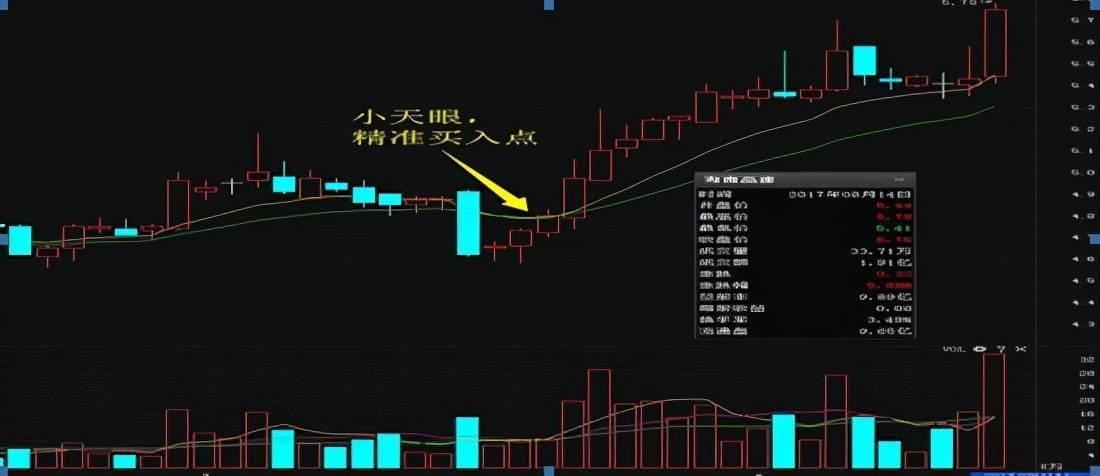
When the stock price falls back to the vicinity of the previous two low points, it will stop falling and stabilize, then turn upwards.
After another golden cross, the stock price will rise steadily.
When the 10-day moving average and the 20-day moving average show 'Tianyan with low volume', but the buy signal is more reliable and stronger.
But the stock price should be higher, and conservative investors should try to adopt this buying method.
Case
During the process of stock price fluctuations, a Tianyan with very low volume appears, and the 'Tianyan' is very small.
However, it still reveals the intention of the main force to collect chips, and the trading volume significantly shrinks.
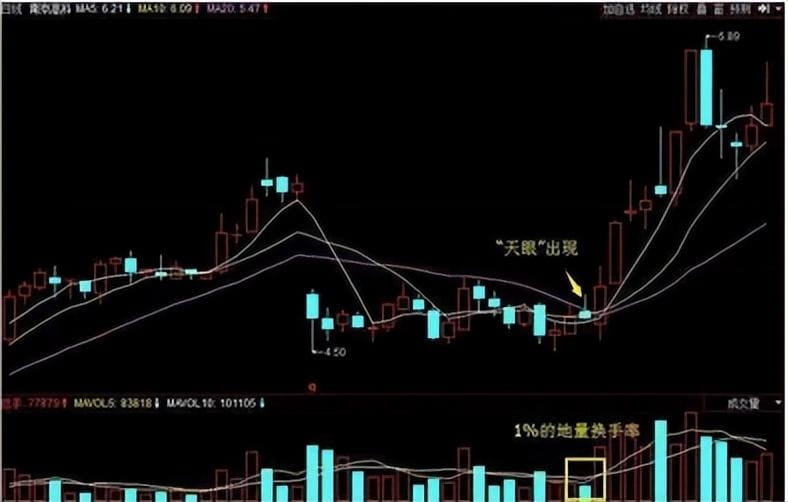
At this point, one can buy near the 10-day moving average based on the 'Tianyan with low volume' method.
After this pattern appeared, the stock price rose from 4 yuan to 41 yuan.
'Tianyan with low volume' pattern requires the following conditions and details for usage:
1. The stock price is at a low level, and the short-term moving average is above the medium-term moving average;
2. With the stock price falling back, the 5-day moving average crosses below the 20-day moving average, and then crosses above the 20-day moving average to form the 'Tianyan';
3. The stock price pullback cycle is generally around 15 days, and during the pullback period, forming low volume must be the smallest trading volume recently;
4. In most cases, when the 'Tianyan with low volume' appears, the K-line often accompanies a long lower shadow, indicating a bottoming signal, and the subsequent market often sees a main upward wave.
Summary: 'Tianyan with low volume' generally appears at the bottom of the market. If it appears at the top, it is mostly a false breakout, and at this time, do not blindly intervene.
Case sharing:
How to survive longer in the stock market?
First, pay attention to research and judgment of the overall market. Many retail investors have not systematically studied stock trading behavior, and their trading is too casual and frequent. They overlook long-term tracking and research of the overall market and sectors. They like to rely on others' recommendations and hope that the stocks recommended by others will rise, which is actually not comprehensive. They need to understand the reasons behind others' recommendations, how they researched, and why they chose to buy. The impact of the overall market's rise and fall on sectors and individual stocks is critical. Therefore, retail investors must ask several 'whys' when buying stocks.
Second, pay attention to what the buy price is, what the stop-loss price is, what the position is, and what the profit-taking price is. This way, you can buy a stock calmly, keeping both rises and falls within your control.
Third, many people including myself will make a fatal mistake, which is the frequent trading mentioned earlier. The result of frequent trading is that the losses from stop-losses keep expanding. Calculating over a week, a month, or a quarter, the losses keep increasing. Retail investors, due to their disadvantages such as discipline and self-control, must operate cautiously, and since they do not have time to track many stocks over the long term, it is best for beginners not to operate too many stocks and trade frequently, or else the consequences can be dire.
Fourth, it is necessary to establish your own trading system and principles. You must first learn some simple technical things, learn to observe the market's intraday movements, understand K-line structures, familiarize yourself with intraday average price lines, and understand volume indicators, oscillators, and price indicators. Only after having a basic understanding and being familiar with these indicators can you have a preliminary guarantee for operation and establishing your own trading system.
Fifth, after having your own trading system and principles, focus your main energy on in-depth study of the overall market, sectors, and individual stocks. Researching individual stocks requires in-depth examination of various indicators, financial status, thematic types, chip distribution, various K-line combinations, market changes, capital flow, etc. After long-term observation and having a deep impression of the stock's 'characteristics', the success rate of operations will increase, while the failure probability will increase otherwise.
Sixth, execution must be firm. Every investor who can profit in the market shares a common point: setting goals and executing them decisively. Stick to being yourself! Never rely on others because you are different from them; your ability, experience, background, capital, and mindset are all different, so your operations will naturally differ. Stick to your plan and principles, and you will naturally have a greater chance of winning in the game.
Seventh, mindset determines your success. The so-called mindset is not the attitude of a trapped person who is oblivious to danger, but rather a calm and objective view of rises and falls, an objective view of one's own operations, being unhurried, adhering to one's previously validated judgments, accepting obvious mistakes, correcting operational errors, giving up in bad market conditions, being bold in good market conditions, not being discouraged by operational errors, not being proud of making money, and not being pessimistic about losing money.
Eighth, control emotions. In life, we often have some inexplicable actions. The stock market is also a part of economic life, and controlling emotions well in trading allows you to have stocks in hand while being untroubled, or to have no stocks in hand while still being confident.
One tree cannot form a boat, and a lone sail cannot travel far! In the crypto circle, if you do not have a good circle or first-hand news from the coin circle, then I suggest you pay attention to Huahua's crypto diary to help you make a profit. Welcome to join the team!!!

