My article in the Lebanese Media Center
Trump's visit to Beijing: Temporary détente or a reshaping of the relationship between the world's two largest powers?
Writer Youssef Iskandar
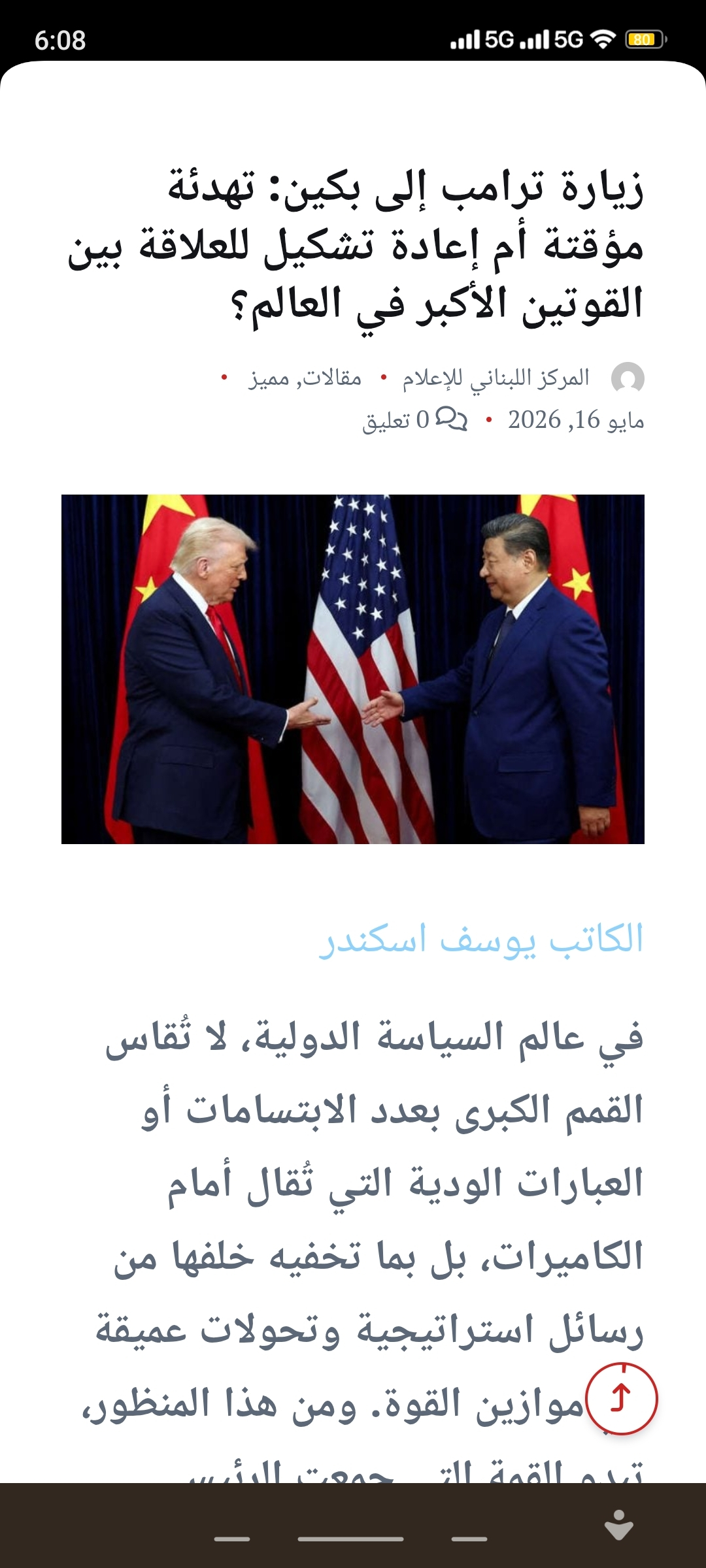
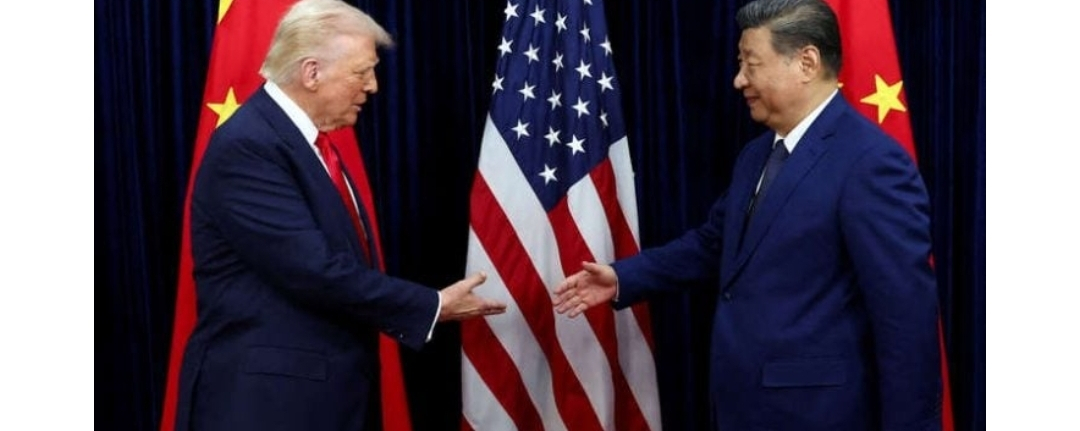
In the realm of international politics, major summits aren't measured by the number of smiles or friendly phrases exchanged in front of the cameras, but by the strategic messages and deep shifts in power dynamics that lie beneath. From this perspective, the summit that brought together U.S. President Donald Trump and Chinese President Xi Jinping in Beijing seems more significant than the terse official data released after the visit would suggest.
Despite the celebratory atmosphere surrounding the meeting and the warm Chinese reception of the U.S. president, what happened in the Chinese capital cannot be reduced to mere 'trade deals' or fleeting economic understandings; rather, it reflects a mutual attempt to recalibrate the relationship between the world's two largest economies after years of trade, technological, and geopolitical escalation.
From the moment Trump arrived in Beijing, it was clear that China wanted to give the visit a special character. The official guard, the lavish banquet, and the invitation to the closed political complex where the Communist Party leaders reside were all carefully crafted messages aimed at showing political respect for the U.S. president and conveying the impression that Beijing still sees its relationship with Washington as a cornerstone of international system stability.
Interestingly, this political warmth hasn't come with major and clear economic agreements, despite Trump's talk of 'great deals' and China buying hundreds of American planes and massive amounts of agricultural products.
The Chinese side handled these statements with extreme caution, avoiding direct confirmation, which reveals that Beijing likely wanted to give Trump an internal media win without making final commitments that could be interpreted as political or economic concessions to the U.S.
Here emerges one of the traditional characteristics of Chinese diplomacy; Beijing tends to create positive atmospheres and exhibit calculated flexibility, while deferring critical details to later stages of negotiation.
Yet behind the pleasantries, the core issues that form the basis of the conflict between the two countries remain unresolved. The most sensitive issue, tariffs and the trade war, saw no clear breakthroughs, and Trump himself acknowledged that the tariff file was not discussed directly during the summit.
This in itself is a significant indicator; it means that both parties have reached a shared conviction that resolving major economic disputes is still a distant goal, and that the current priority is to prevent deterioration and slipping into an open economic confrontation that could harm the entire global financial system.
In this context, discussing the establishment of a 'Trade Council' between the two countries can be seen as an attempt to manage and regulate differences, not to resolve them radically. The U.S. and China are not moving towards complete reconciliation, but rather towards a new form of 'managed competition', where the conflict persists but within boundaries that prevent it from exploding.
Perhaps the most significant aspect of the summit was not traditional trade, but advanced technology, artificial intelligence, and semiconductors. The notable presence of top American businessmen, led by Elon Musk and Jensen Huang, was not a mere protocol detail but reflected the true nature of the conflict between the two powers.
Today, technology has become the central arena for global competition. The U.S. aims to slow down China's rise in artificial intelligence and semiconductor fields through increasing export restrictions and technical sanctions, while Beijing works to break this technological blockade and accelerate the building of its own capabilities.
So, just the fact that the CEO of Nvidia joined the visit sparked a ton of speculation about some behind-the-scenes talks regarding possibly easing some restrictions on exporting advanced chips to China, or at least opening new channels for dialogue about the future of tech cooperation between the two countries.
However, economic and technological competition was not the only file on the table. Taiwan was prominently featured in Xi Jinping's statements, who reaffirmed that the island represents the 'most sensitive issue' in U.S.-China relations.
These Chinese messages are not new, but they gained a clearer dimension at this summit, especially as Beijing linked economic stability with security relations in East Asia. China wants to convey to Washington that trade cooperation cannot be separated from geopolitical considerations, and that any escalation regarding Taiwan could undermine all other economic understandings.
Also, the summit wasn't disconnected from broader international developments, primarily the tensions related to Iran and the Strait of Hormuz. The U.S. is aware that China has significant economic and political leverage that could help stabilize global energy markets, while Beijing understands that any prolonged disruption in oil supplies would directly impact its economy, which heavily relies on energy imports.
Therefore, it was clear that both sides, despite their deep disagreements, are trying to find limited areas of cooperation on issues that directly threaten global stability.
In conclusion, the Beijing summit doesn't seem like a historic agreement in the traditional sense, nor is it just a fleeting protocol visit. It represents a new phase in U.S.-China relations, a phase where both sides realize that a complete clash would be unprecedentedly costly and that managing competition has become a strategic necessity, not a political choice. Major disagreements still exist: from tariffs to technology and Taiwan to global influence. What has changed is Washington and Beijing's understanding that the world can no longer bear a comprehensive confrontation between the two largest economic powers, and that the more realistic alternative is to coexist with a long-term conflict that is contained and regulated instead of left to explode uncontrollably.