A lot of newbies jumping into the crypto scene wake up every day and the first thing they do is check Binance's gainers list. Seeing AIA surge over 26% today, you instantly start calculating: if I had gone all in last night, wouldn't I be raking in profits today? Then the FOMO kicks in, and you rush in to chase the high. What happens next? Typically, as soon as you hit that market buy button, the price starts to dip, or it might crash like CLO did today, dropping nearly 28%. Why does this ‘buy high, sell low’ curse always seem to follow you? Today, we’re going to break down the underlying mechanisms and profit motives behind the wild swings of altcoins in plain language, so you can truly grasp the logic of this ‘harvesting machine’.
Misconception target: High trading volume on the gainers list = strong market consensus, big money entering?
The most fatal mistake beginners make is equating 'high trading volume' and 'high gains' with 'everyone is rushing to buy'. You think those tens of millions in trading volume are real retail traders or Wall Street institutions building positions with real cash. But in many small-cap, illiquid altcoins, this so-called 'smart money' is often just market makers and the house doing wash trades.
Mechanism breakdown: What is wash trading and order book depth?
To make it crystal clear, let's use an analogy. Suppose there's only one apple in the market, and the seller prices it at 10 bucks. Then, the seller sells the apple to their left hand for 10 bucks, and the right hand sells it back for 15 bucks, then the left hand sells it again for 20 bucks. To outsiders, this apple seems to have a very active 'trading volume', with the price skyrocketing from 10 to 20 bucks. But in reality, no outside funds are entering; it’s merely the seller putting on a show, paying only a tiny transaction fee to the exchange.
This is what’s commonly referred to in the crypto world as 'wash trading'. When market makers want to lure retail investors to buy in, they use algorithmic trading bots to frequently flip between the bid and ask, creating a false sense of bustling trading volume. Meanwhile, because the 'order book depth' (the number of real buy and sell orders) is extremely thin, the market makers only need to use a small amount of real capital to push the price up by 20% or even 30%, catapulting this coin onto the exchange's gainers list.
Profit mechanism: How do you become a bag holder?
The gainers list is essentially an 'advertisement' that market makers pay for. When a coin like AIA pops up at the top of the gainers list, thousands of retail investors across the network take notice. At this moment, the greed of these investors gets triggered, and they start buying in with real USDT. Remember what we previously said about 'thin order book depth'? When retail investors impatiently hit 'market buy', there aren’t many real orders on the sell side, so their buy orders will eat through the high-price listings above, leading to 'slippage'. You think you are buying at the current price, but in reality, your average execution price is ridiculously high.
And at this time, what are the market makers doing? They've already set real sell orders at high positions. The real funds from retail investors accurately buy up the chips from the market makers. Once the market makers have sold off, they remove their protective buy orders below. Even if only a few retail investors want to stop-loss sell, due to the lack of supporting liquidity, the price can instantly crash like CLO, plummeting nearly 28% in a single day. You, thus, become a victim trapped in a liquidity trap.
Pitfall avoidance framework: How to recognize and avoid liquidity traps?
To survive in the crypto world, you must establish a counterintuitive trading framework:
1. Kick the 'hype chasing' addiction: Never chase high prices just because a coin is on the gainers list. The gainers list is for observing fund flows, not for buying signals. High volatility often comes with high risk, with very poor risk-reward ratios.
2. Check depth, look at essence: Before buying any altcoin, don't just look at the 24-hour trading volume; check the 'depth chart'. If the depth chart shows a cliff-like staircase or a significant spread, it indicates poor liquidity and heavy market maker control—stay away.
3. Be wary of 'spikes' on the candles: If you see frequent long wicks (commonly known as 'wicking' or 'spiking') on 1-minute or 5-minute candlesticks, it indicates that there are no real buy and sell orders backing the price; it's all bots flipping trades.
Summary
Trading isn't about finding which coin can make you rich overnight; it's about understanding where the money in this market flows. When you can't decipher who the opposing players are on the chart, chances are you might be one of them. Stop being a bag holder in the market maker's game; protect your capital and look for mainstream assets with real liquidity and solid consensus.
Do you find this article insightful? Follow me for daily breakdowns of the most authentic underlying logic and trading traps in the crypto world. In this cutthroat market, let’s be aware traders together!

Article
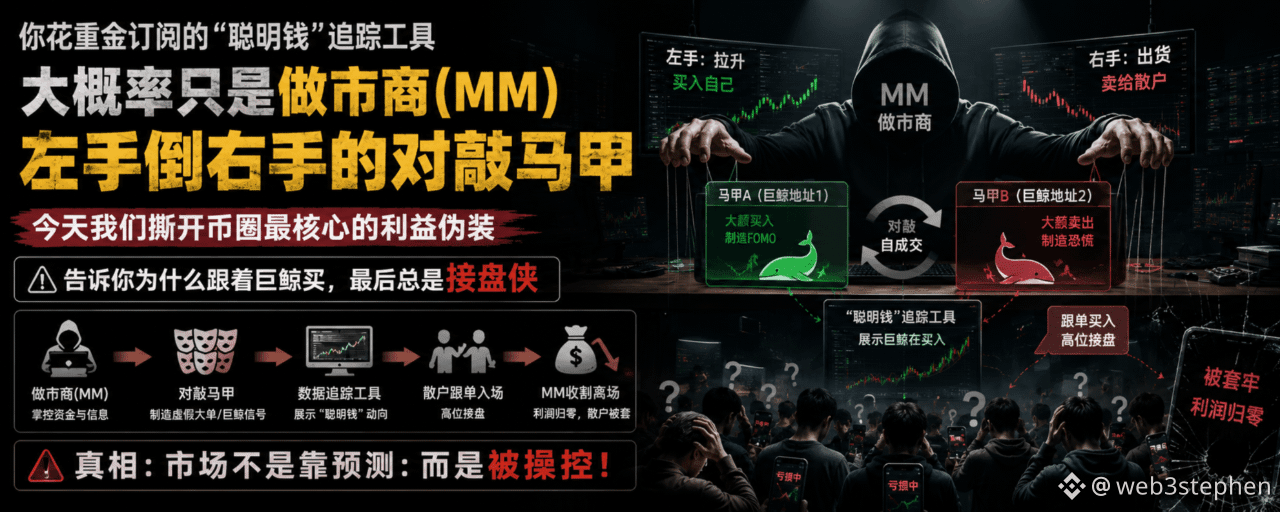
Why do you always buy and watch it dip, sell and see it rise? Uncover the 'wash trading' and liquidity traps behind the high volatility of altcoins, and stop being the exit liquidity for so-called ‘smart money’!
Disclaimer: Includes third-party opinions. No advice. Binance AI may be used without guarantee. See T&Cs.